

A fabricated metal part does not move from drawing to delivery in one step. Even a simple-looking enclosure, bracket, panel, frame, or housing may pass through engineering review, material planning, cutting, forming, machining, welding, finishing, hardware installation, assembly, inspection, packaging, and shipment before it is ready to use. The value of a full-service precision sheet metal fabrication partner is not that all of those capabilities exist on a list — it is that the steps are coordinated in the right order, with fewer handoffs and fewer chances for details to get lost.
That distinction matters for OEMs and industrial buyers because the work rarely ends at “make this part.” A buyer may need the part to fit into a larger assembly, match a previous revision, arrive with the right finish, include installed hardware, meet inspection requirements, and ship in a way that protects cosmetic or functional surfaces. When those requirements are planned together, the production path is smooth; when they are discovered late, small details become rework, delay, or cost. This is what full-service fabrication should actually mean: a controlled path from RFQ to finished part, not a collection of services offered under the same company name.
RFQ and Drawing Review
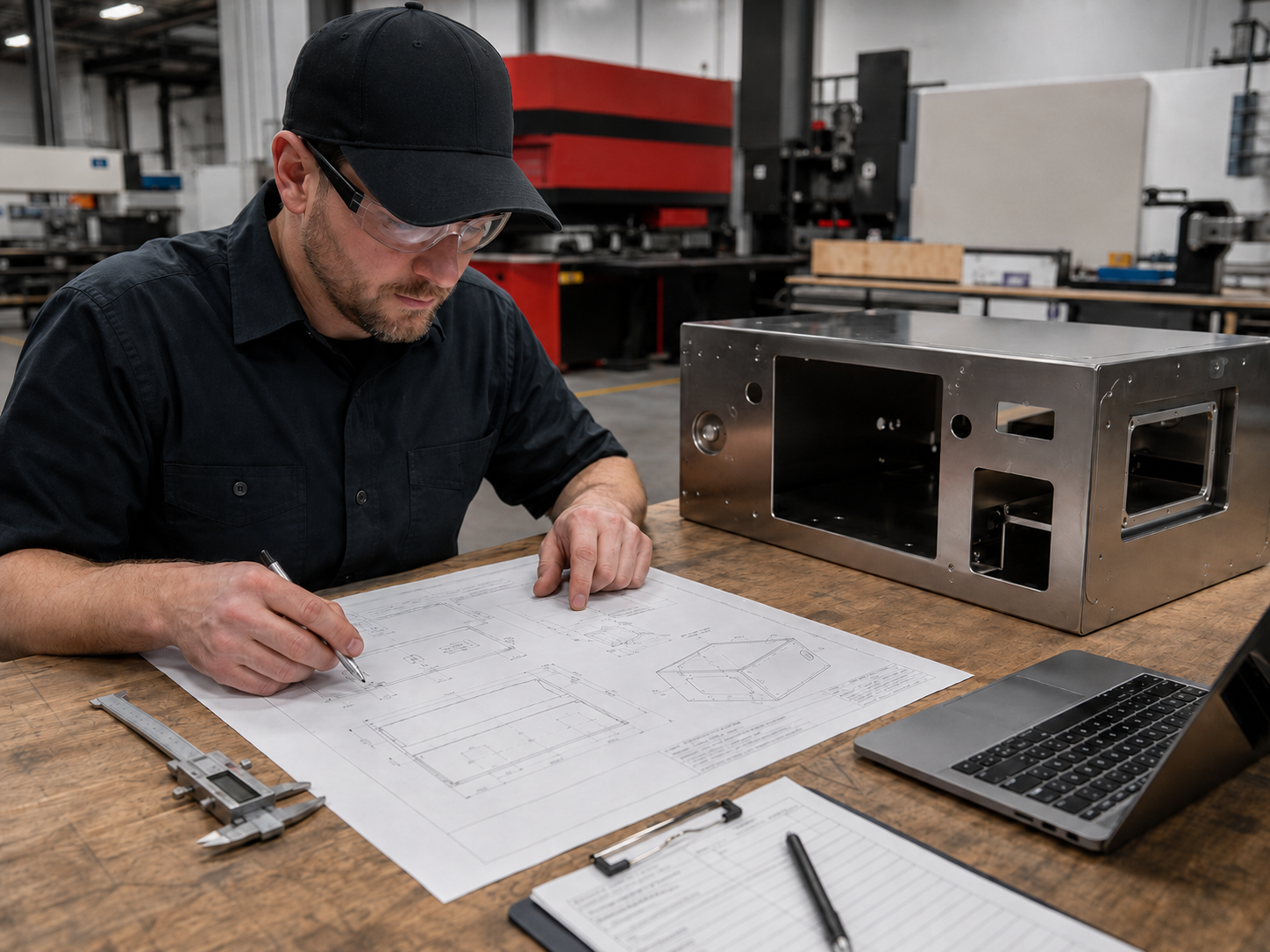 The process starts with the RFQ, but a useful quote depends on more than part dimensions and material thickness. A fabricator needs to understand what the part does, where it fits, how it will be used, and which requirements are critical to performance — which is why drawings, CAD files, bills of material, finish specifications, tolerances, production volumes, inspection requirements, and delivery expectations all shape the quote.
This is also where missing information tends to surface. A drawing may specify material and dimensions but leave finish requirements vague, include tight tolerances without identifying which features are truly critical, or show hardware without making clear whether it installs before or after finishing. A strong fabrication partner uses the RFQ stage to surface those gaps before the job moves into production — not to slow things down with unnecessary questions, but because a question answered at the quoting stage costs nothing, and the same question answered after parts are cut, formed, welded, or coated costs real money.
Engineering and Design-for-Manufacturability Review
Once requirements are clear, engineering review determines whether the design can be manufactured efficiently and consistently: bend radii, hole locations, material behavior, flat patterns, tolerance stackups, hardware placement, weld requirements, finish needs, and assembly fit. A part can be technically manufacturable and still be harder, slower, or more expensive to produce than it needs to be, and a design-for-manufacturability review separates necessary complexity from avoidable complexity — a small drawing revision before production may prevent a forming issue, reduce weld distortion, simplify coating, or make assembly easier.
For repeat production, this step compounds. A prototype can be managed with extra attention, but ongoing production needs a process that repeats without heroic effort, and the earlier fabrication, finishing, assembly, and inspection requirements are aligned, the easier it is to hold quality across future runs.
Material Planning and Production Routing
After engineering review, the project moves into material planning and routing: what material is needed, how parts will be nested, which equipment will be used, and how the job moves through the shop.
Routing matters because sheet metal fabrication is a sequence. Cutting, punching, forming, machining, hardware insertion, welding, finishing, and assembly do not happen interchangeably — the order affects quality, cost, and lead time. Hardware installed too early may interfere with finishing. Coating applied before a required operation may need to be stripped. Welding may move dimensions that matter later in assembly, and a machining step may need to land before or after forming depending on the feature. When routing is planned well, the job moves cleanly from one operation to the next; when it is not, the shop ends up solving preventable problems in real time.
Cutting, Punching, and Forming
For most sheet metal parts, physical production begins with cutting or punching — laser cutting, turret punching, and related processes create the blank geometry, holes, slots, louvers, and knockouts needed before forming. From there, press brakes turn flat blanks into three-dimensional parts, and early design decisions become very real: hole locations near bends, material grain direction, bend radius, flange length, and tolerance requirements all affect how cleanly a component forms. A drawing that looks simple in CAD may need adjustment once the forming sequence is considered.
For parts such as enclosures, panels, brackets, frames, and cabinets, forming accuracy sets the foundation for everything downstream. Doors need to align, tabs need to seat, hardware needs to land where expected, and assemblies need to fit without forcing, grinding, or rework.
Machining, Hardware, and Secondary Operations
 Some parts require machining or secondary operations after cutting and forming — milling, drilling, tapping, countersinking, deburring, or hardware insertion. These operations are often small relative to the whole part and critical to how it functions: a tapped hole, PEM insert, or standoff determines whether the part assembles; a machined surface controls fit. They also interact with everything around them — hardware placement affects coating and masking, machined features may need protection during finishing, tapped holes need to stay clean — which is why the meaningful question is not whether the fabricator has these capabilities, but whether they are sequenced with the rest of the job.
Welding and Fabricated Assemblies
When a part requires welding, the project gains another coordination layer. Welds must meet structural, cosmetic, and dimensional requirements, but welding also introduces heat distortion and surface variation that affect later steps. A welded frame or enclosure may need welds ground smooth before finishing; some welds are cosmetic, others functional but hidden; and if the part will be powder coated, weld quality and surface preparation show through directly in the finished appearance.
Finishing and Powder Coating
Finishing happens near the end of the production path but has to be decided near the beginning, because powder coating, screen printing, and direct-to-substrate printing all interact with fit, masking, grounding, hardware, and packaging decisions made weeks earlier. Color, gloss, texture, film thickness, masking, and cosmetic surfaces need to be defined before anything reaches the coating line — what belongs on the drawing is its own discipline — and a fabricator running in-house powder coating manages those requirements inside the same quality system and schedule as the fabrication itself, with the people coating the part working from the same context as the people who made it.
Assembly and Integration
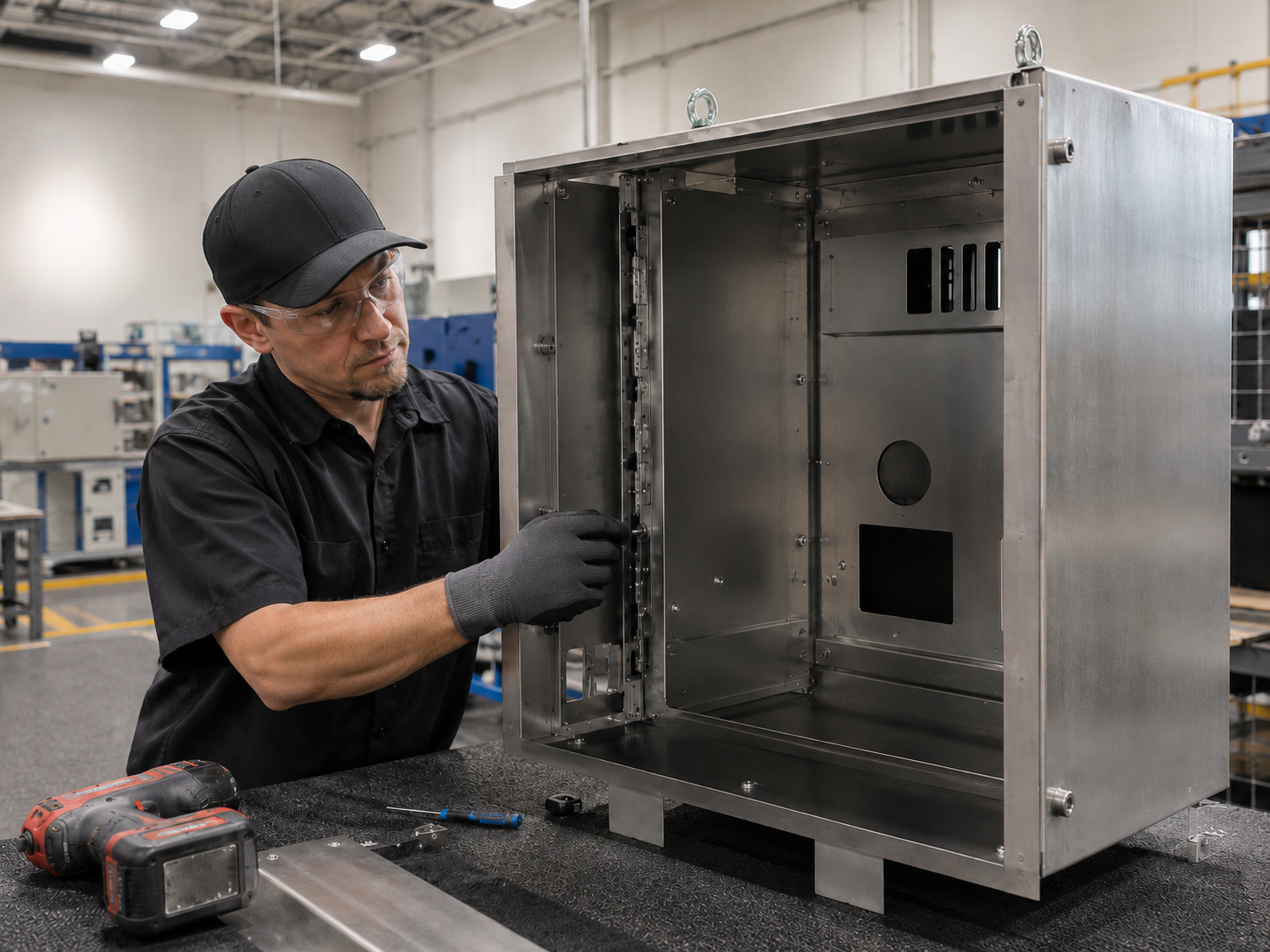 Some projects stop at a finished metal part. Others require assembly and integration: hinges, latches, inserts, handles, labels, wiring, brackets, or full electromechanical builds combining fabricated structures with wiring, controls, power supplies, and sensors. For OEMs this reduces the work that has to happen after the part arrives — but it also means assembly requirements should influence the earlier steps. If a wire path needs clearance, the fabricated part should provide it; if a printed label must align with a cutout, printing and geometry need coordinating; if a bracket installs after coating, that sequence should be settled before production begins, not discovered on the assembly bench.
Inspection, Quality Control, and Documentation
Quality control is not a single final check. It runs through the process: material verification, first-article review, in-process inspection, coating checks, weld review, hardware verification, and final acceptance. For production programs, consistency matters as much as any individual checkpoint — the goal is not one correct part but the same correct part across every future order, which requires clear drawings, revision control, and defined inspection standards.
Documentation carries that consistency outward. Certifications, inspection records, material requirements, and revision histories may all need managing as part of the project, and a full-service process makes those requirements visible from the beginning instead of treating them as paperwork to chase at the end. Done well over time, this is the discipline that earns dock-to-stock vendor status — the point where a customer’s incoming inspection stands down because the supplier’s process has proven it doesn’t need checking.
Packaging, Logistics, and Delivery
Packaging is the last step the production plan should account for and the first thing the customer sees. Finish-sensitive, printed, assembled, and cosmetic components need packaging matched to their geometry and surfaces — separators, protective wrapping, orientation controls, nesting restrictions — and some programs need staged shipments, labeling, kitting, or coordination with the customer’s production schedule. For OEMs, components that arrive ready for installation or inventory, without extra handling work, are part of what the full-service model is supposed to deliver.
When Full-Service Fabrication Matters Most
A simple flat bracket doesn’t need much process coordination. A finished enclosure, kiosk, control panel, welded frame, or assembled component does — and the more steps a part requires, the more each handoff between disconnected operations adds opportunity for delay, damage, or unclear accountability. The strategic case for consolidating that work with one supplier is covered elsewhere; the operational case is this article: a coordinated production path simply has fewer places for the details to fall through.
Full-Service Sheet Metal Fabrication at EVS Metal
EVS Metal supports precision sheet metal fabrication projects from early engineering review through production, finishing, assembly, inspection, and delivery, with facilities in New Jersey, Texas, Pennsylvania, and New Hampshire. Capabilities include precision sheet metal fabrication, CNC machining, welding, in-house powder coating, screen printing, direct-to-substrate printing, assembly and integration, quality control, and logistics support — coordinated within one structured production process, so customers move from RFQ to finished part with fewer handoffs and fewer avoidable surprises.
To discuss an upcoming fabrication project, request a quote or contact the EVS facility best suited to support your program.
Frequently Asked Questions
What does full-service sheet metal fabrication mean? Full-service sheet metal fabrication means a fabricator can support more of the production path beyond cutting and forming. That may include engineering review, material planning, CNC machining, welding, finishing, hardware installation, assembly, inspection, packaging, and delivery.
Why does the RFQ stage matter in fabrication? The RFQ stage is where the fabricator identifies requirements that affect cost, lead time, and manufacturability. Drawings, CAD files, materials, tolerances, finish requirements, production volumes, and inspection needs all influence how the work should be quoted and produced.
How does design-for-manufacturability review help fabrication projects? Design-for-manufacturability review helps identify issues before production begins, including tight tolerances, difficult bends, hardware conflicts, finishing risks, assembly concerns, or unclear specifications. Early changes are usually less expensive than rework after production has started.
What steps are involved in a sheet metal fabrication project? A typical project may include RFQ review, engineering review, material planning, cutting, punching, forming, machining, welding, hardware insertion, finishing, assembly, inspection, packaging, and delivery. The exact steps depend on the part and customer requirements.
When is full-service fabrication most useful? Full-service fabrication is most useful for projects with multiple connected requirements, such as finished enclosures, cabinets, panels, equipment housings, welded frames, assembled components, cosmetic finishes, printed graphics, documentation, or repeat production.
Does EVS Metal offer full-service fabrication? Yes. EVS Metal provides precision sheet metal fabrication, CNC machining, welding, in-house powder coating, screen printing, direct-to-substrate printing, assembly, quality control, and logistics support across facilities in New Jersey, Texas, Pennsylvania, and New Hampshire.