

Powder coating is often treated like a simple finishing line item, but the way that work is handled can change the entire production path. If the coating is outsourced, fabricated parts leave the shop, enter another vendor’s queue, and come back before assembly, inspection, or shipment can continue. If it is handled in-house, finishing stays connected to the same team, schedule, and quality system that produced the part.
That difference matters most when cost, lead time, finish quality, and accountability are all part of the decision. In-house powder coating is not the right answer for every project or every type of finish, but for many fabricated metal parts and assemblies, it removes avoidable handoffs at one of the most failure-prone points in production. The question is not simply whether a fabricator can deliver a powder-coated part; it is how much control they have over the process that gets it there.
What “In-House” Actually Means (and Why You Should Verify It)
 In-house powder coating means the fabricator operates its own coating line — surface preparation, application, and cure ovens — inside the same operation that cuts, forms, and welds your parts. The same production system that fabricated the part finishes it, under one quality system and one schedule.
The reason this needs verifying is that the alternative looks identical on a quote. A fabricator who subcontracts coating still delivers a coated part; what you can’t see is that your components left the building, rode a truck to a coating house, sat in that shop’s queue behind every other customer’s work, got coated by people who have never seen your drawing, and rode a truck back. Every one of those steps is invisible on the quote and very visible in the lead time, and none of it is under the control of the vendor you actually hired — so ask plainly: do you coat in-house, at which locations, and is my work coated there? It’s a fair question, and how directly a fabricator answers it tells you something too.
The Handoff Tax: What Outsourced Coating Actually Costs
The price markup on subcontracted coating is real, but it’s the smallest part of the problem. The larger costs are structural — they live in freight lanes, in other companies’ schedules, and in what happens when something goes wrong — and they show up in places the quote never itemizes.
Transit, twice, on freshly fabricated parts. Every outsourced coating cycle means packaging parts well enough to survive a truck, twice — once raw, once finished. Finished parts are the worse half of that trip, because a powder-coated surface that gets scuffed in transit isn’t touched up; it’s stripped and recoated, or scrapped. The packaging good enough to prevent that costs money and time on every single order, forever.
Someone else’s queue. When coating is subcontracted, your job’s schedule has a dependency on a shop you have no relationship with. Your fabricator can’t see that queue, can’t expedite within it without paying for the privilege, and can’t resequence around it. When a coating house gets busy — and they all get busy at the same times, because their customers share the same seasonal demand — your lead time stretches and nobody calls to tell you until the date is already missed.
The rework loop from hell. Here’s the failure mode that does the real damage: a defect gets discovered after coating. Maybe a formed feature was out of tolerance, maybe a weld needed dressing, maybe the coater missed a masking callout that was communicated by email three weeks earlier. In an integrated operation, that part walks back to the appropriate department the same day. In a subcontracted model, it’s a truck ride, a conversation about whose fault it is, a requeue at the coating house, and another truck ride — a loop measured in weeks, triggered by a problem that took minutes to find.
Quality Control: The Inspection That Happens Before Coating
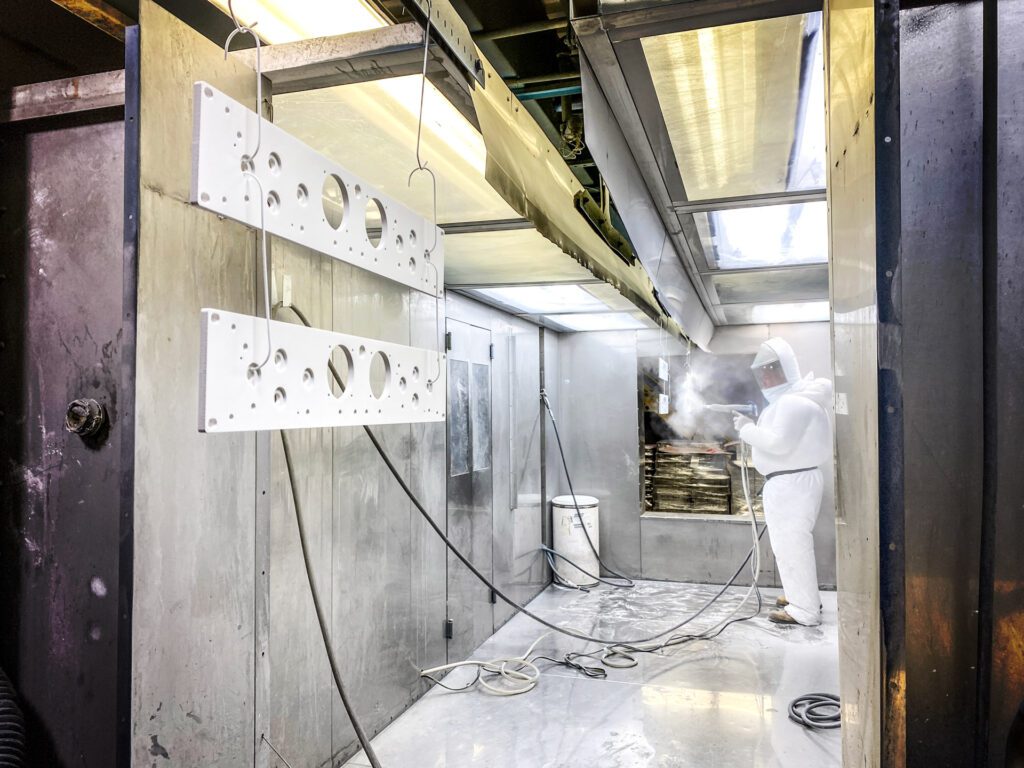 The most underrated quality advantage of in-house coating has nothing to do with the coating itself — it’s what happens immediately before it. Powder coating is unforgiving of surface defects, because a scratch, a handling mark, or a weld imperfection that’s barely visible on raw metal becomes prominent under a gloss finish. In an integrated shop, the people loading the coating line know the part, know which surfaces are cosmetic, and work alongside the quality team that inspected it after forming and welding, which means a defect caught at that moment costs almost nothing to fix — the departments that can fix it are under the same roof.
A third-party coater, by contrast, coats what arrives. They don’t know your part, don’t know which face shows in the final assembly, and aren’t paid to inspect your fabricator’s work — so surface problems get faithfully sealed under the finish and discovered at incoming inspection or, worse, at assembly. At that point you’re not debugging a part; you’re debugging a relationship between two vendors, each of whom can plausibly point at the other.
That accountability question is worth sitting with. When fabrication and finishing live with one supplier, every defect has one owner. There is no conversation about whether the prep was inadequate or the handling was rough or the masking instructions got lost, because the same company did all of it. For programs with cosmetic requirements or recurring production, that single-owner structure prevents more problems than any inspection regime layered on top of a split supply chain.
Color and finish consistency across orders follows the same logic. Repeat production means the enclosure coated in March needs to match the one coated in September. In-house lines make it easier to manage powder specifications, cure profiles, application methods, and inspection standards from run to run. Across two companies and a freight lane, that consistency is a hope rather than a process.
Lead Time: One Schedule Instead of Two
Integrated coating removes an entire external dependency from the production path. Parts move from welding to finishing to assembly as steps on one schedule rather than handoffs between companies — no transit days, no queue uncertainty, no waiting on another shop’s capacity. In EVS Metal’s experience, integrating finishing with fabrication and assembly operations can often shorten lead times compared to outsourced coating models, and just as importantly, it makes the dates reliable, because every step is visible to one production planning system.
That visibility matters most when something changes. A pulled-in delivery date, a revision mid-run, a partial shipment request — an integrated shop can resequence its own operations in a planning meeting. A fabricator dependent on an outside coater can only ask nicely.
Cost: Quote the Markup, Pay the Total
 On paper, outsourced coating costs more because the fabricator passes through the coater’s price plus margin. In practice the markup is the visible tip of it. The full total includes freight in both directions, transit-grade packaging on every order, the carrying cost of longer lead times, the occasional stripped-and-recoated part, and the rework loops described above — none of which appear as line items, all of which you pay for.
In-house coating lets a fabricator quote the operation they actually control, down to the dollar, with no embedded third-party margin and no buffer padding for someone else’s schedule risk. This is the same total-cost logic that applies to supplier consolidation generally: the lowest piece price is frequently not the lowest total manufacturing cost, and the cheapest-looking arrangement on a per-line-item basis is often the most expensive one to actually live with.
Where Outsourced Finishing Still Makes Sense
Honesty requires saying this part too: not every finish belongs in-house, and a fabricator who claims to do everything internally should get the same skepticism as one who subcontracts everything. Specialty processes — plating, anodizing, e-coating, ceramic and other exotic coatings — involve dedicated chemistry, environmental controls, and volumes that don’t make sense inside most fabrication operations, and the right answer for those is a qualified outside specialist managed well.
The distinction that matters is whether the standard, high-volume finishing path — which for fabricated metal parts overwhelmingly means powder coating — runs in-house. That’s the process touching most of your parts on most of your orders, and that’s where integration pays every single time.
Questions Worth Asking a Fabricator
If you’re evaluating suppliers for work that includes finishing, a few direct questions separate integrated operations from pass-through arrangements: Do you operate your own powder coating lines, and at which facilities? Will my parts be coated where they’re fabricated? How are masking requirements documented and communicated to the coating line? How do you maintain color and finish consistency across repeat orders? And when a finish defect is found at assembly, who owns it?
None of those questions are hostile. A fabricator with real in-house capability will answer them in a sentence each — and the answers connect directly to the cost, lead time, and quality outcomes that powder coating decisions drive in the first place.
Kiosk enclosure programs lean on this heavily — brand-matched colors and UV-stable outdoor chemistry, applied in the same facility that formed the metal.
In-House Powder Coating at EVS Metal
 EVS Metal operates in-house powder coating at all four of its facilities — New Jersey, Texas, Pennsylvania, and New Hampshire — integrated with its precision sheet metal fabrication, welding, and assembly operations. Parts move from fabrication to surface preparation to coating to assembly under one quality system and one production schedule — with pre-coat inspection by teams who know the part, masking handled by the same organization that received the drawing, and finish consistency maintained across repeat orders. For programs like custom electrical panels and enclosures, where coating thickness, masking, and cosmetic surfaces all interact with fit and function, that integration removes an entire category of cross-vendor failure. The Whitestone onshoring case study shows what that looks like in practice — fabrication, in-house powder coating, and finishing consolidated into one production path.
To discuss a project that includes powder coat finishing, request a quote or contact the EVS facility best suited to support your program.
Frequently Asked Questions
What does in-house powder coating mean? In-house powder coating means the metal fabricator operates its own coating line — surface preparation, electrostatic application, and cure ovens — within the same operation that fabricates the parts, rather than subcontracting finishing to a third-party coating house. Many fabricators offer powder coating but outsource it; the difference affects lead time, quality control, and accountability.
Why do many fabricators outsource powder coating? Coating lines require significant capital investment, floor space, and process expertise, so many fabricators subcontract finishing rather than operating it internally. The arrangement is common and can produce acceptable parts, but it adds transit, queue time at the coating house, and a second company to the quality and accountability chain.
How much lead time does in-house powder coating save? Integrating coating with fabrication and assembly can shorten lead times by days or even weeks compared to outsourced models, by eliminating two freight legs and the queue time at an outside coating house. It also makes delivery dates more reliable, since every production step runs on one schedule.
Is in-house powder coating less expensive? Usually, when measured as total cost. In-house coating removes the third-party markup, two-way freight, transit-grade packaging, and the rework loops created when defects are discovered after parts return from an outside coater. The per-part price difference is often modest; the difference in avoided costs and schedule risk is typically larger.
Does in-house capability cover every type of finish? No. Specialty processes such as plating, anodizing, and e-coating are typically handled by dedicated outside specialists even by fabricators with strong in-house finishing. The meaningful question is whether the standard high-volume finishing path — powder coating, for most fabricated metal parts — runs in-house.
How can I verify that a fabricator actually coats in-house? Ask directly: do you operate your own powder coating lines, at which facilities, and will my parts be coated where they’re fabricated? Fabricators with real in-house capability answer specifically. Vague answers about “finishing partners” or “our coating network” usually indicate subcontracted finishing.