

When fabricated metal parts need logos, labels, instructions, control markings, or other graphics, the finish is only part of the decision. A powder-coated surface may provide the base color and protective layer, but the graphics added on top still need to be readable, durable, repeatable, and appropriate for the way the part will be used. For OEMs and product teams, the most common question is not whether metal can be printed — it is which marking method makes the most sense for the part, the design, the production volume, and the finish underneath it. Screen printing and direct-to-substrate printing both work well on fabricated metal components, including powder-coated parts, and the right choice depends on what the graphic needs to do.
Why Graphics on Metal Require Their Own Decision
Printed graphics on fabricated metal parts are often functional, not just decorative. A control panel may need clear button labels, directional markings, warnings, serial information, or operating instructions. A kiosk, enclosure, cabinet, or equipment housing may need branding, product identification, or customer-facing graphics. In these cases, the printed information becomes part of how the finished product is used — which means the graphic has to adhere to the surface, align with fabricated features, withstand expected handling, and remain legible over time. A design that works on flat sheet metal may need adjustment if it crosses a bend, sits near a hardware location, or lands on a surface that will see frequent touch or abrasion.
Powder coating often provides the base finish for these parts, but powder coating is not a substitute for printing. It creates the durable coated surface the graphic is applied to; the print method determines how logos, labels, symbols, or artwork are added after that base finish is in place.
What Is Screen Printing on Metal?
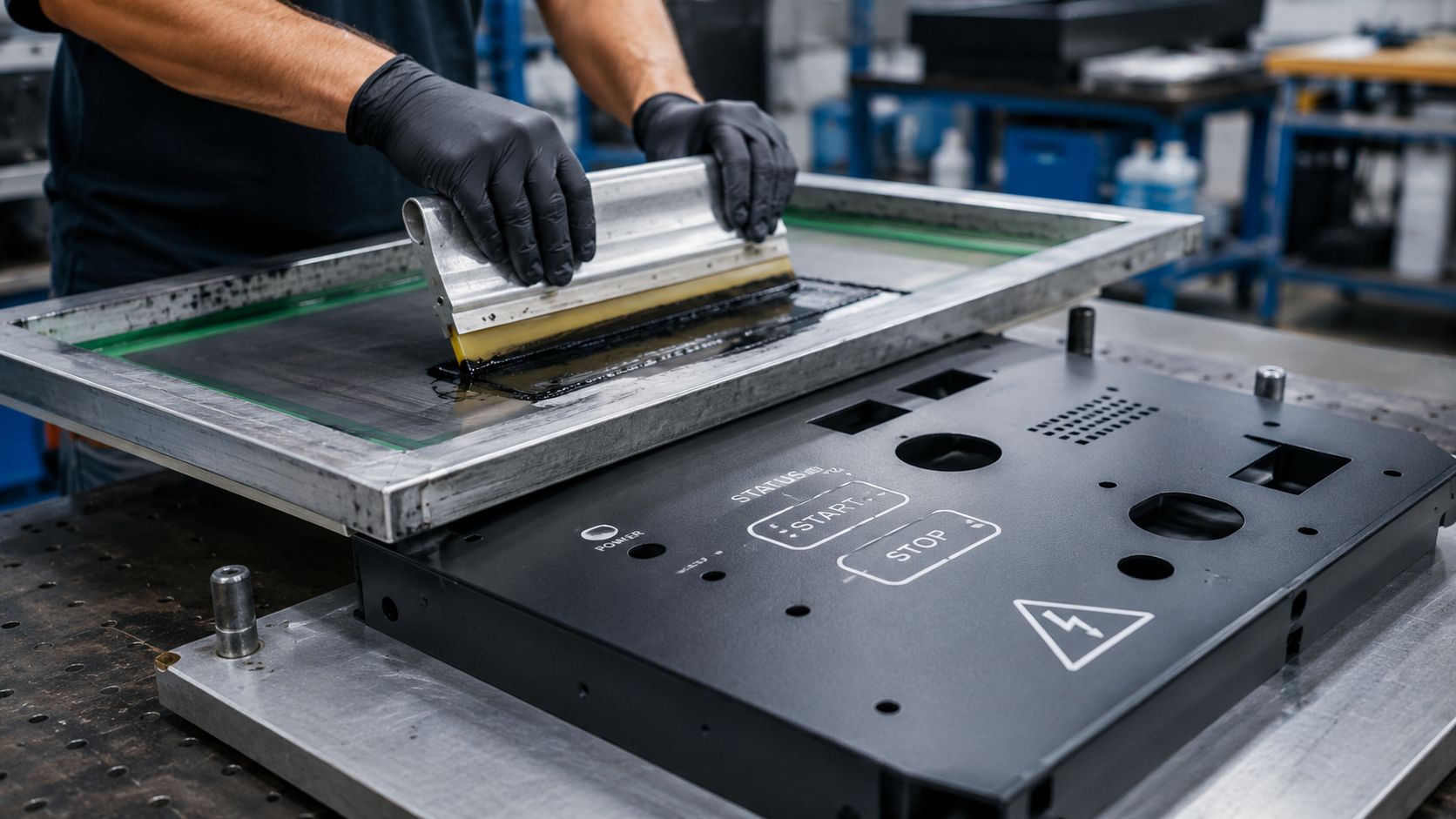 Screen printing, also known as silkscreening or serigraphy, uses a mesh screen, stencil, and squeegee to transfer ink onto a substrate — in metal fabrication, usually a powder-coated surface. It is a proven method for adding sharp, durable graphics to fabricated parts: text, logos, icons, safety markings, operator instructions, and other fixed graphics that need to repeat consistently across a production run.
Its defining advantage is color control. When a project requires exact PMS or spot-color matching, screen printing is usually the better choice, because custom inks can be formulated to meet a specific brand or design standard rather than approximated. Once the screen is created, the same design applies consistently across a run of parts, and for many industrial and OEM applications, that combination of exact color and long-run repeatability is exactly what is needed.
The tradeoff is setup. Screen printing requires a screen or stencil for each design, and in some cases for each color, which makes it less efficient for short runs, frequent revisions, highly detailed full-color graphics, or jobs with multiple variations. It also becomes more challenging on dimensional or irregular surfaces unless special fixturing is built for the job.
What Is Direct-to-Substrate Printing?
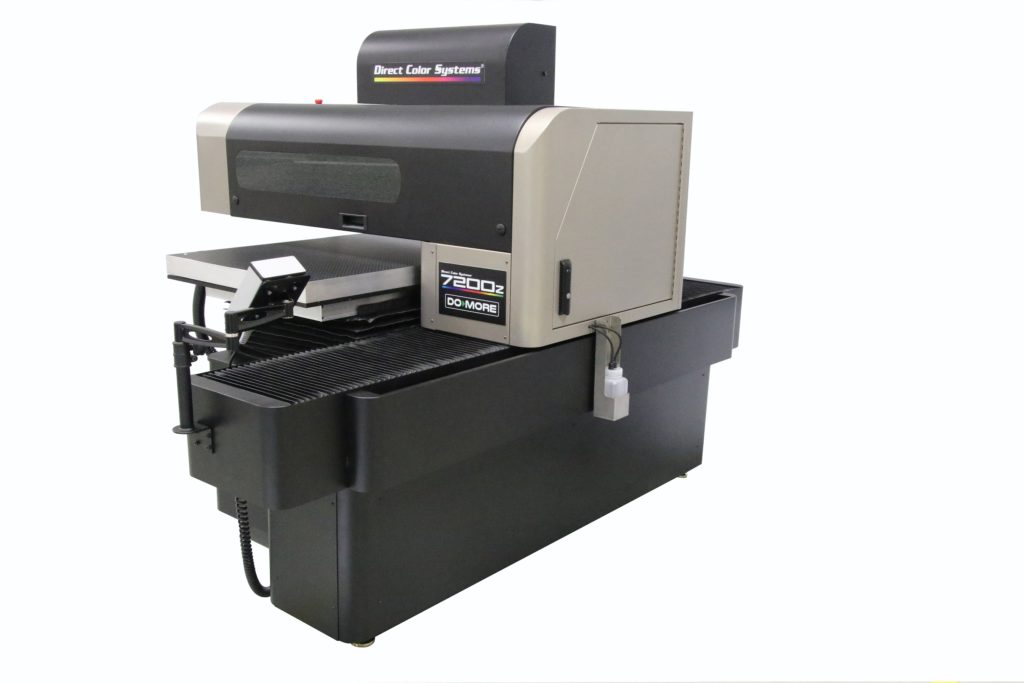 Direct-to-substrate printing is a digital process that applies graphics directly to a surface without a traditional screen, plate, or print master. It works much like a specialized large-format inkjet printer designed for rigid substrates such as metal, plastic, and glass.
Because the process is digitally controlled, DSP cuts setup time dramatically compared to screen printing and makes revisions almost free: change the file, print the next part. That supports complex artwork, gradients, full CMYK color, shorter runs, customer-specific variations, and graphics that change between orders — the categories where screen printing’s per-design setup cost is hardest to justify. DSP produces close color matching through CMYK rather than the exact custom-ink matching of screen printing, which is sufficient for most applications and not sufficient for strict brand-color programs; that single distinction settles many projects on its own.
DSP also handles surfaces that are not perfectly flat, depending on the equipment and part geometry, which makes it practical for certain formed or dimensional components where screen printing would need specialized fixturing. And because most DSP systems use UV curing, printed graphics cure quickly and hold up well, especially when the finished part receives appropriate post-printing protection.
How Powder Coating Fits Into the Process
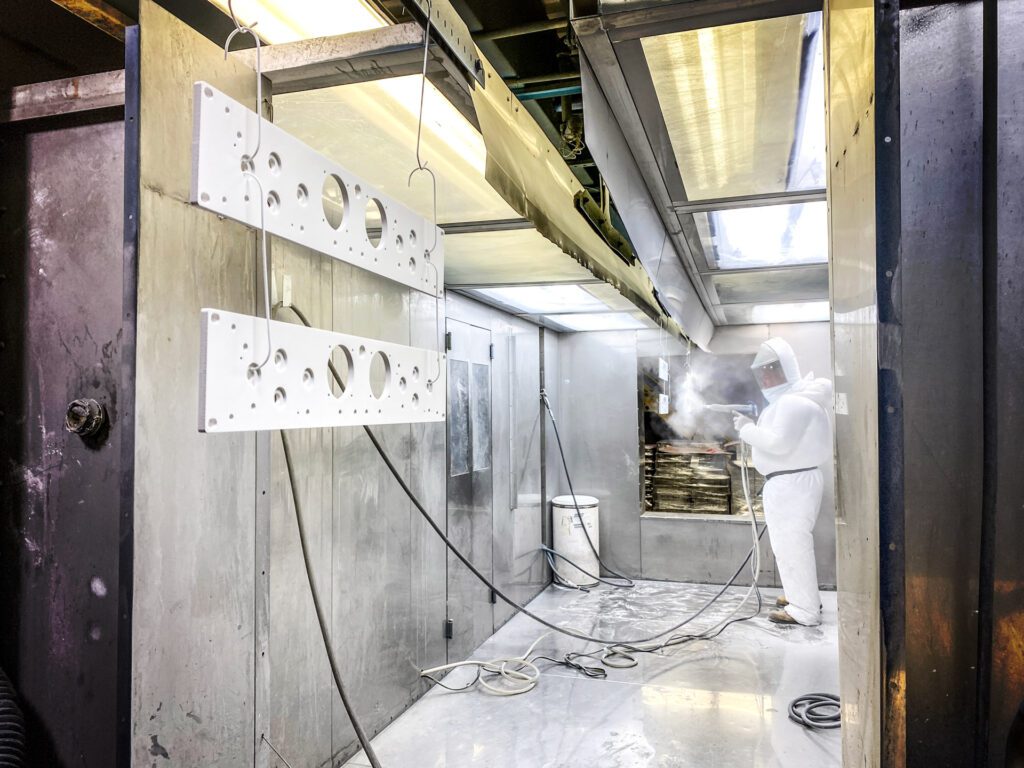 Powder coating is usually the base layer that screen printing or DSP is applied to: it provides the color, appearance, and protection, while the print method adds the graphic content on top. That sequencing sounds obvious, but it is where projects actually go wrong, because the coating and the printing interact in ways that only show up if nobody planned them together.
Surface texture is the classic example. A logo specified against a smooth sample develops soft, fuzzy edges when the final finish turns out to be a textured powder coat, because the ink sits on the peaks of the texture instead of flowing into a flat surface. Gloss level matters in both directions: it affects how well ink adheres and how the printed graphic reads visually, since the same black text presents differently against a high-gloss surface than a matte one. Timing matters too — printing happens on a fully cured coating, never between coating steps, because an under-cured surface compromises adhesion in ways that may not show up until the part is in service. And any finish outside the ordinary — heavy texture, metallic, high gloss — should get a print test before production quantities, because the cost of one test part is nothing against the cost of re-coating and re-printing a run. Alignment is the other recurring failure: a powder-coated enclosure, kiosk, or control panel often needs graphics that register precisely with doors, hinges, switches, cutouts, or formed features — and artwork laid out against the flat blank can land in the wrong place on the finished, formed part.
This is why coating and printing should be planned as one decision, not two. If a graphic must align with a cutout, control, or mating part, the fabrication, coating, and printing teams need to understand that before production begins — and it is one reason integrated fabrication and finishing support reduces problems that otherwise surface at final assembly, when they are most expensive to fix.
Additional Printing Options for Metal
Other printing methods exist for metal, including gravure and flexographic printing. Both are conventional processes that require a print master or print form. Gravure produces extremely sharp resolution at high speeds but is typically too costly for fabricated metal applications, and flexographic printing, while capable of strong print quality, is rarely practical for the parts, enclosures, panels, and assemblies most contract fabricators produce. For most OEM and industrial fabrication projects, screen printing and direct-to-substrate printing cover the realistic range of graphics, volumes, and part geometries without the cost or setup burden of less common methods.
Choosing the Right Marking Method for Fabricated Metal Parts
Before choosing between screen printing and direct-to-substrate printing, define what the graphic needs to accomplish. Does the part require exact PMS color matching, or is close CMYK matching acceptable? Is the design fixed, or likely to change? Will the same artwork repeat across a long run, or will there be multiple versions? Is the surface flat, formed, textured, or dimensional? Will the part be handled frequently, installed outdoors, cleaned often, or exposed to abrasion?
The answers usually point toward the process. Exact brand colors on a fixed, repeating design favor screen printing. Detailed or variable artwork on shorter runs favors DSP. And a customer-facing kiosk or enclosure frequently needs both decisions made together — powder coating for the base finish, printing for the visible graphics — with placement, surface preparation, hardware, bends, and assembly sequence all settled before the part reaches finishing, because that is the last point at which changing the plan is cheap.
When requesting quotes for printed parts, a complete package makes both the pricing and the result more accurate: vector artwork files for the graphics, PMS numbers if exact color matching is required, a placement drawing showing where graphics land relative to part features, the finish specification for the surface being printed, expected quantities, and the number of design versions in the run. A fabricator can quote from less, but every one of those details left unstated becomes an assumption — and assumptions about graphics tend to get discovered on finished parts.
EVS Metal Printing and Finishing Capabilities
EVS Metal provides precision sheet metal fabrication, powder coating, screen printing, direct-to-substrate printing, and related finishing support for fabricated metal parts and assemblies. EVS operates in-house powder coating at its facilities in New Jersey, Texas, Pennsylvania, and New Hampshire, supporting projects that require durable, repeatable finishes as part of the broader fabrication process. For printed graphics and marking requirements, EVS Metal’s New Jersey facility offers direct-to-substrate printing and screen printing for fabricated parts such as panels, enclosures, kiosks, cabinets, housings, and other components that require branding, labels, instructions, or finished visual elements.
Because printing and finishing are connected to EVS Metal’s fabrication, engineering, welding, assembly, and quality operations, customers can plan surface finish, graphics, masking, print placement, and final assembly requirements earlier in the production process. That coordination reduces late-stage surprises and supports a cleaner path from fabricated part to finished product.
To discuss a project that requires powder coating, screen printing, direct-to-substrate printing, or other finishing support, request a quote or contact the EVS facility best suited to support your program.
Frequently Asked Questions
Can you screen print on powder-coated metal? Yes. Screen printing can be applied to powder-coated metal when the surface is properly prepared and the ink is compatible with the finish. It is often used for logos, labels, control markings, icons, and other graphics on powder-coated panels, enclosures, kiosks, and fabricated parts.
What is the difference between screen printing and direct-to-substrate printing on metal? Screen printing uses a mesh screen and stencil to apply ink to the surface, while direct-to-substrate printing digitally prints graphics directly onto the part. Screen printing is generally better for exact spot-color matching and fixed, repeated designs. Direct-to-substrate printing is generally better for faster setup, detailed graphics, shorter runs, design variation, and dimensional surfaces.
Is screen printing or direct-to-substrate printing better for powder-coated parts? Screen printing is usually preferred when exact PMS color matching or a fixed repeat design is required, while direct-to-substrate printing is usually better when the design is complex, changes between runs, or benefits from faster digital production. Both work on powder-coated parts when the coating and print requirements are planned together.
Does powder coating replace screen printing? No. Powder coating and screen printing serve different purposes. Powder coating provides the base color and protective finish for a fabricated metal part. Screen printing adds graphics, labels, logos, icons, or instructions on top of that finished surface.
What types of metal parts can be printed? Printed graphics can be added to many fabricated metal parts, including panels, enclosures, kiosks, cabinets, housings, equipment faces, control panels, and other components that require branding, labeling, instructions, or visual identification.
Does EVS Metal offer direct-to-substrate printing? Yes. EVS Metal offers direct-to-substrate printing through its New Jersey metal fabrication facility, along with screen printing and powder coating capabilities for fabricated metal parts and assemblies.