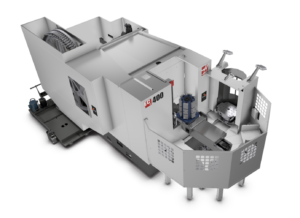
When EVS Metal installed the Haas EC-400 at its Texas facility, the most obvious change was visual: machining that had traditionally happened from above was now happening from the side. But once production began, it became clear that the larger difference had less to do with machine orientation alone and more to do with how that orientation changed the machining process itself. Horizontal machining affects chip control, setup efficiency, spindle utilization, and the way multiple operations can be sequenced across repeat production runs.
In practical terms, it changes how parts move through production once machining becomes more than a simple secondary operation. That matters because many fabricated components do not arrive at machining as clean, isolated blocks of material. They often arrive already cut, formed, or welded, carrying dimensional relationships that have to remain intact while additional features are added. A machine that reduces repositioning and keeps cutting conditions stable can make a meaningful difference in whether those later operations stay predictable, especially when production moves beyond prototypes into repeat orders. That is one reason broader
precision CNC machining capabilities often become more important as assemblies grow more complex.
Why Horizontal Machining Feels Different in Production
Vertical machining centers remain the standard choice for a large percentage of CNC work because top-down access is straightforward and highly flexible. Horizontal machining does not replace that. What it changes is the way the machine behaves once parts require machining across several faces or longer unattended cycles begin affecting overall efficiency.
Because the spindle approaches the workpiece horizontally, chips fall away naturally instead of collecting near the cutting area. That improves coolant access, reduces heat buildup around the tool, and helps maintain more stable cutting conditions over longer cycles. Those benefits sound small until production volume increases or cycle times lengthen. At that point, chip accumulation, repeated stoppages, and unnecessary cleaning interruptions become part of the real cost of machining. Horizontal systems reduce much of that friction simply through machine geometry, which is one reason integrated
machine shop capability inside fabrication can change production outcomes more than buyers initially expect.
What the Haas EC-400 Added at EVS Texas
The Haas EC-400 installed at EVS Metal’s
Pflugerville (Austin), Texas facility introduced a different level of machining flexibility because it was configured specifically for unattended and repeat production. The machine includes a 15,000 RPM spindle, high-pressure through-spindle coolant, a 100+1 side-mount tool changer, and a six-station pallet pool that allows multiple parts to be queued while machining continues without interruption.
That pallet system is one of the features that changes production most noticeably. While one part remains in cycle, another can be loaded and prepared outside the cutting zone, which means spindle time stays productive instead of waiting through repeated setup delays. On higher-mix production work, that efficiency becomes increasingly valuable because setup time can begin competing with machining time itself.
Why Pallet Systems Matter More Than the Spec Sheet Suggests
Pallet systems are often described as a throughput feature, but in practice they also improve consistency. Once fixtures are established, repeated loading happens under much tighter control, which helps preserve dimensional relationships between cycles. For fabricated parts that already depend on earlier bending, welding, or secondary operations, that consistency matters just as much as raw speed.
This is often where buyers begin recognizing the difference between equipment ownership and production capability. A machine can be impressive on paper, but the larger question is how well it fits within the broader manufacturing workflow and whether it improves reliability once projects move into production. That same distinction often shapes what manufacturers look for in
a quality machine shop beyond the machine specifications alone.
What the Performance Numbers Actually Mean
Machine specifications become useful only when they affect real production decisions. The EC-400 delivers rapid traverse rates up to 1400 inches per minute, feed rates up to 833 inches per minute, and tool changes measured in just a few seconds. Those numbers matter less as isolated data points than for what they reduce: idle machine time between cuts, tool changes, and repositioning during longer cycles.
Axis travel of 22 inches on X, 25 inches on Y, and 22 inches on Z gives the machine flexibility across a wide range of machined components, from fabricated brackets and housings to multi-face parts that require several operations without repeated handling.
Where Horizontal Machining Fits Within EVS Metal’s Broader Capabilities
Horizontal machining becomes most valuable when production involves repeatable multi-face work, medium- to high-volume batches, or parts where setup reduction directly improves delivery reliability. It does not replace vertical machining, but it adds a different type of efficiency once parts become more complex and machining starts influencing throughput as much as tolerance.
At EVS Metal, horizontal machining in Texas complements broader machining resources that also support production at the company’s
Pennsylvania fabrication and machining facility. Together, those operations allow machined parts and fabricated assemblies to stay within one controlled production environment alongside laser cutting, forming, welding, finishing, and assembly. That becomes even more valuable when machining is treated as part of a broader
fabrication workflow rather than as a separate outsourced step.
As machining programs become more complex, the value of horizontal systems often appears less in the machine itself and more in how smoothly production continues around it. What begins as a machine investment usually becomes most meaningful later, when production schedules tighten and keeping machining aligned with fabrication prevents delays that separate suppliers often introduce.

