

A self-service kiosk is a computer that lives in public. That single fact drives nearly every fabrication decision behind it.
The touchscreen, the payment hardware, the software — those get the attention. But the component that determines whether a kiosk survives five years in a mall entrance, a hospital lobby, or a ferry terminal is the one nobody photographs: the enclosure. It’s the part that gets leaned on, kicked, rained on, power-washed, and pried at. It manages the heat the electronics generate, keeps water and dust out of components that fail when wet, and does all of it while looking like a finished consumer product rather than an electrical cabinet.
EVS Metal has fabricated kiosk enclosures for more than three decades — for wayfinding directories, self-service ordering systems, check-in stations, and interactive displays deployed across retail, healthcare, hospitality, and transportation environments. This article covers what actually goes into designing and building an enclosure that holds up: the requirements that drive the design, the materials and processes involved, and the manufacturing decisions that separate a kiosk that ships on time and lasts from one that becomes a maintenance liability.
Why Kiosk Enclosures Are a Distinct Fabrication Problem
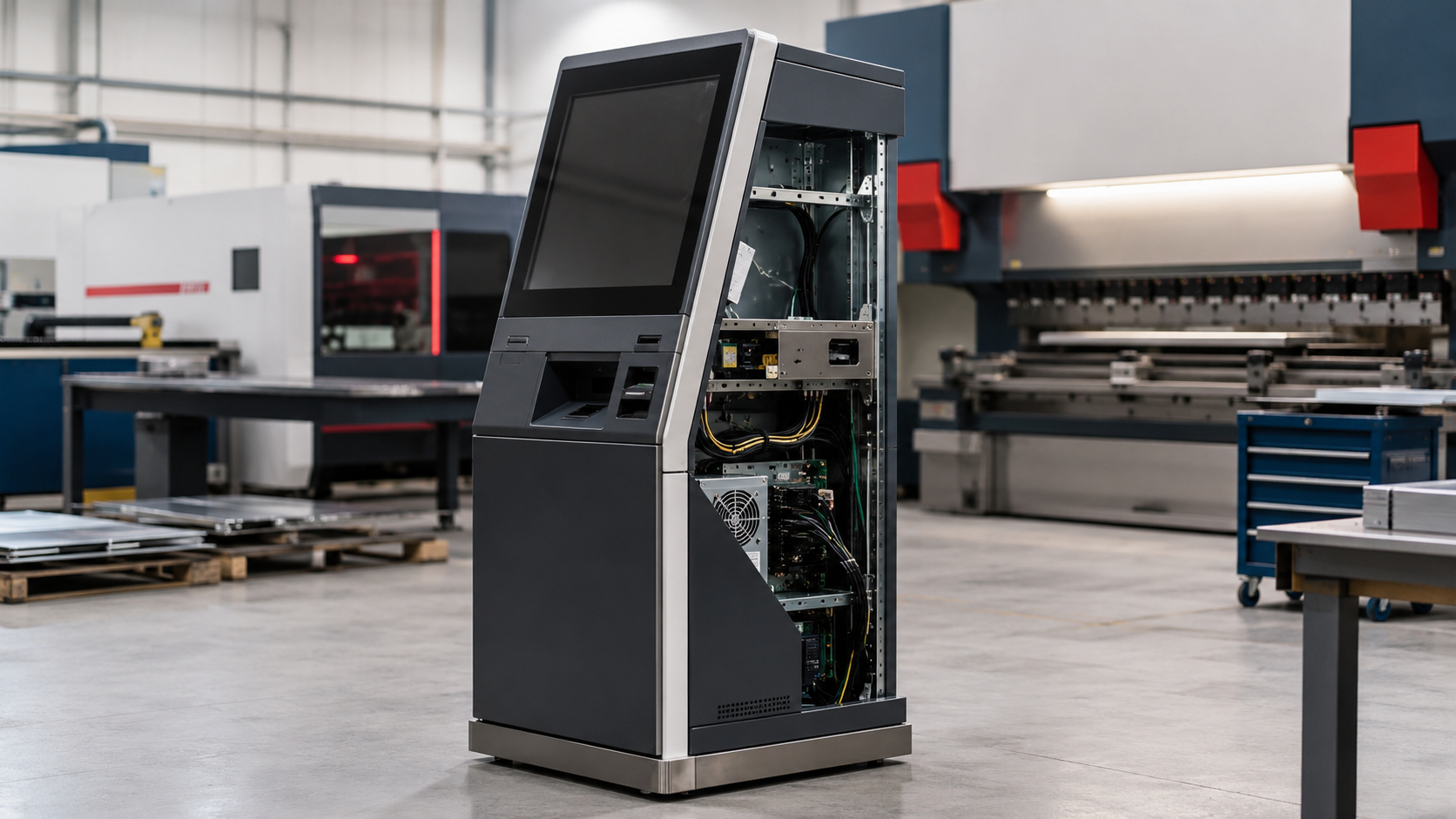 It’s tempting to think of a kiosk enclosure as a fancy electrical cabinet. It isn’t, and the differences are exactly where inexperienced fabricators get into trouble.
The public touches it. An industrial enclosure lives behind a locked door and gets handled by trained technicians. A kiosk gets handled by everyone — including people who are frustrated, careless, or actively trying to break it. Edges must be finished so they can’t cut a hand. Seams must resist prying. Fasteners must be tamper-resistant. Access panels have to open easily for an authorized technician and not at all for anyone else.
It’s a consumer-facing product. Weld seams that would be perfectly acceptable on a factory-floor cabinet are visible defects on a kiosk in a hotel lobby. Cosmetic surfaces need consistent grain, clean welds (often ground and finished to be invisible), and powder coat coverage without runs, thin spots, or orange peel. The enclosure is the brand experience before the screen ever turns on.
Electronics live inside it. Displays, computers, printers, and payment hardware generate heat and hate moisture. The enclosure has to move air (or manage heat passively) without creating a path for rain, cleaning spray, or dust — a genuine design tension, since every vent is a potential leak. Component layout, cable routing, and service access all have to be engineered before the first sheet is cut.
Many of them live outdoors. Outdoor deployments add UV exposure, temperature swings, wind loading on freestanding units, and direct weather. That pushes the design toward gasketed sealing, drainage paths, corrosion-resistant materials and finishes, and thermal management that works in both August sun and January cold. The same engineering discipline behind NEMA-rated metal enclosures applies directly here — outdoor kiosks are, functionally, NEMA problems wearing consumer clothing.
Get any of these wrong and the failure shows up after deployment — the most expensive possible place to discover a design problem.
Design and Engineering: Where Kiosk Projects Succeed or Fail
The majority of kiosk enclosure cost and reliability is locked in before fabrication begins. This is where working with a fabricator that has in-house engineering pays off, because the enclosure design has to reconcile competing requirements:
Component integration. The enclosure is designed around the hardware, not the other way around. Display dimensions and mounting patterns, computer placement and airflow needs, printer paper-path and service access, card reader and payment device positioning at accessible heights — all of it gets modeled before cutting begins. A good fabrication partner works from your component specifications and flags integration conflicts at the CAD stage, not on the assembly floor.
Serviceability. A kiosk that requires two technicians and an hour of disassembly to replace a receipt printer roll is a design failure regardless of how good it looks. Access panels, component trays, and cable management should be designed around the maintenance the unit will actually need over its life.
Accessibility. Kiosks deployed in public accommodations in the U.S. generally need to account for ADA requirements — reach ranges, operable-part heights, and clear floor space all influence enclosure geometry. This is far cheaper to design in than to retrofit.
Design for manufacturability. The same DFM principles that govern any precision sheet metal project apply here, with interest: bend radii consistent with material and tooling, part geometry that supports efficient forming and welding, and — critically — tolerances specified where they matter and relaxed where they don’t. Over-specifying tolerances on non-critical features inflates cost on every unit of the production run.
Prototype before production. Kiosk programs almost always involve a prototype phase: a first article that validates component fit, thermal behavior, serviceability, and appearance before committing to a run. Fabricators with rapid prototyping capability compress this loop — revisions happen in days, not shipping containers.
Materials: What Kiosk Enclosures Are Made From
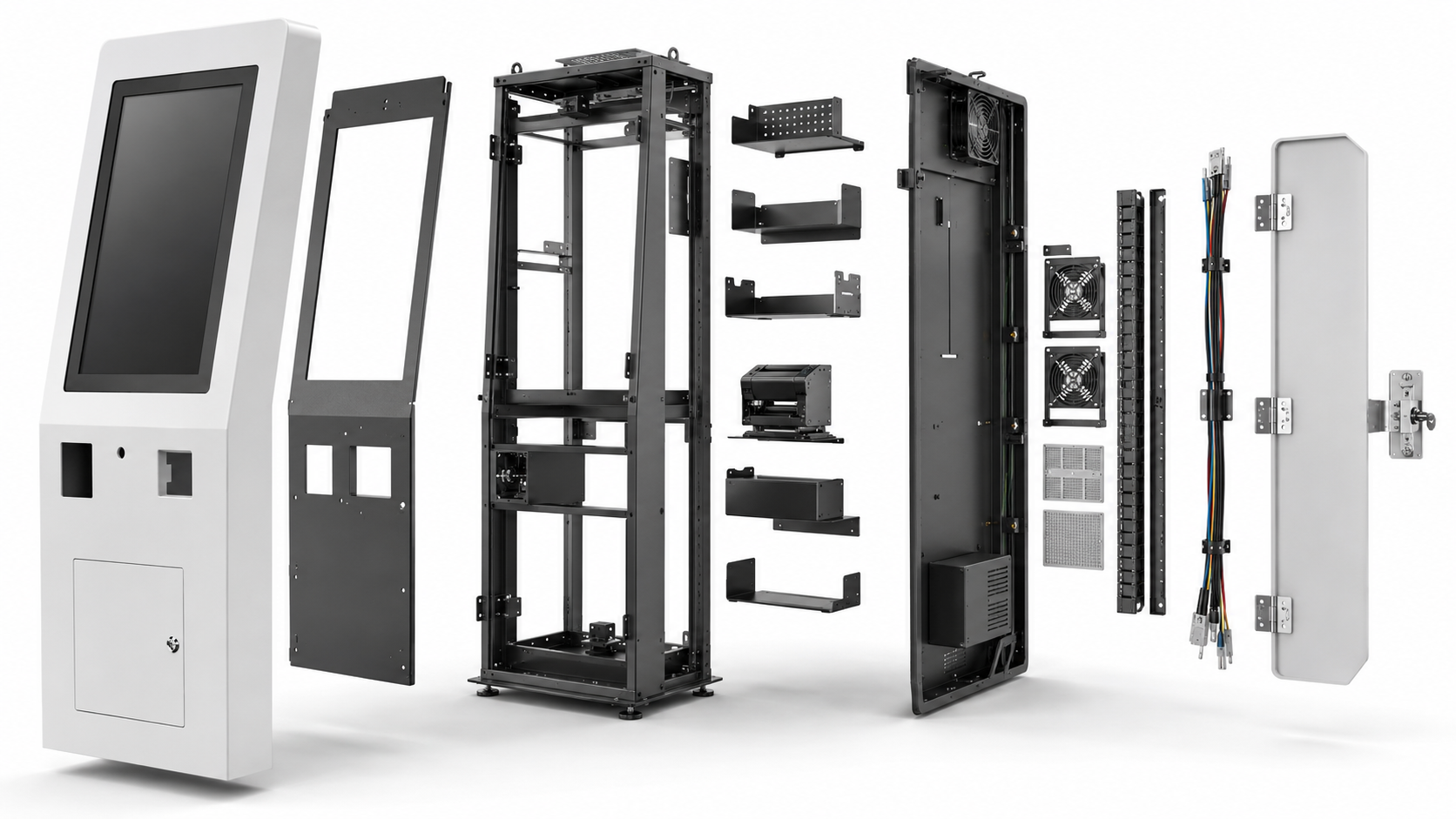 Material selection follows the deployment environment:
Cold rolled steel is the workhorse for indoor kiosks — economical, strong, forms and welds predictably, and takes powder coat beautifully. The overwhelming majority of indoor wayfinding directories and self-service kiosks are cold rolled steel under a powder coat finish.
Galvanneal and galvanized steel add zinc-based corrosion protection for units that may see humidity or occasional moisture — entryway placements, semi-sheltered outdoor use — while remaining paintable and economical.
Stainless steel is the choice where corrosion resistance, hygiene, or abuse resistance dominate: outdoor units, healthcare environments, food service settings subject to washdown, and high-vandalism locations. It costs more in both material and fabrication time (stainless work-hardens and demands more careful welding and finishing) but removes whole categories of field failure.
Aluminum trades some strength for significant weight savings and natural corrosion resistance — attractive for wall-mounted units, ceiling-hung directories, and designs where installation weight matters. It also machines and extrudes well for trim and structural framing elements.
Most real kiosks are hybrids: a cold rolled or galvanneal body, stainless in the high-touch or high-abuse zones, aluminum trim or internal component trays. A vertically integrated fabricator can work across all of these in one build.
Fabrication: From Flat Sheet to Finished Enclosure
A kiosk enclosure moves through the full precision sheet metal process chain:
Cutting. Laser cutting handles the enclosure’s blanks, ventilation patterns, display cutouts, and speaker perforations with clean edges and tight nesting for material efficiency. Complex perforation patterns — common on kiosk vents and speaker grilles — are exactly where fiber laser speed pays off. Punching remains efficient for high-volume repeated features.
Forming. CNC press brakes form the bends that give the enclosure its structure. Kiosk designs tend to be bend-intensive — wrapped corners, return flanges, integrated stiffeners — because well-designed bends replace welds, and every weld eliminated is finishing labor saved and a cosmetic risk removed.
Welding. Where welds are necessary, kiosk work demands cosmetic-grade results: TIG welding on visible seams, ground and blended so the finished surface shows no evidence of the joint. Frames and internal structures can use faster processes — including robotic welding on production runs — where appearance doesn’t matter.
Hardware insertion. Self-clinching studs, nuts, and standoffs go in before finishing — providing the mounting points for components, hinges, locks, and panels without visible fasteners on cosmetic surfaces.
Finishing. In-house powder coating is the standard kiosk finish: durable, uniform, available in effectively any color for brand matching, and — with the right chemistry — UV-stable for outdoor deployment. Surface prep matters as much as the coating itself; a powder coat is only as good as the cleaning and pretreatment under it. Stainless components may instead be grained, brushed, or passivated.
Assembly and integration. This is where vertical integration shows its value. A fabricator that stops at bare metal hands you a logistics problem: the enclosure ships somewhere else for electronics integration, adding freight, lead time, and a second quality-control seam. EVS performs full integration in-house — mechanical assembly, electronic component installation, wiring, testing, and packaging — so what ships is a working kiosk, not a kit. Integration isn’t an add-on service; it’s a core part of the end-to-end manufacturing EVS provides.
Wayfinding Directories and Self-Service Kiosks: Two Applications, One Fabrication Discipline
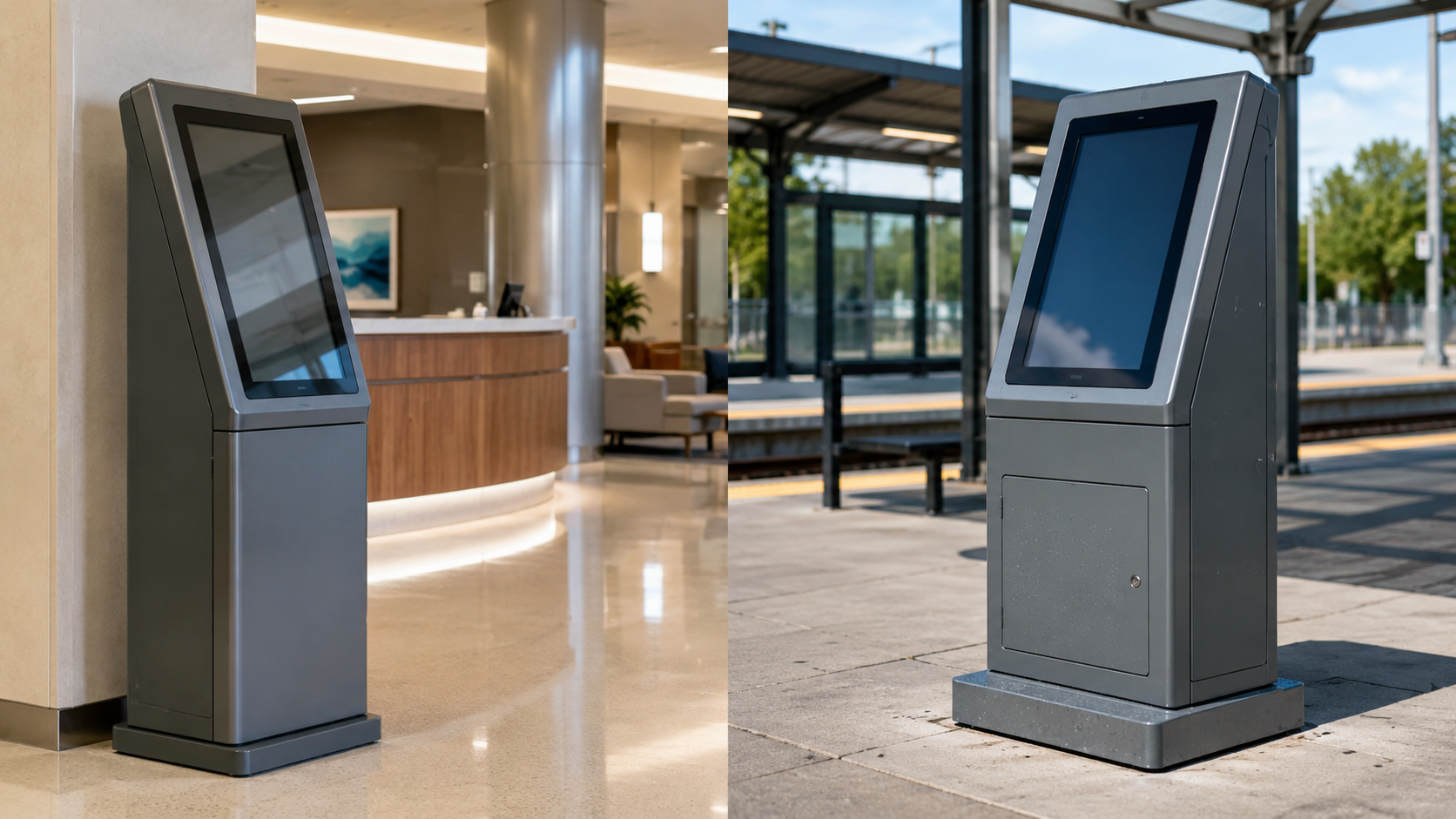 The two most common kiosk categories we fabricate illustrate how application drives enclosure design.
Digital wayfinding directories — the interactive building directories in office lobbies, hospital campuses, universities, and shopping centers — are typically indoor, large-format-display units where cosmetics dominate. The enclosure is effectively architectural furniture: it has to complement the lobby it lives in, present a large touchscreen at accessible height, and hide its ventilation. Freestanding models need engineered bases for tip stability; wall-mounted models need mounting structures matched to the display weight.
Self-service transaction kiosks — ordering, check-in, payment, and ticketing units in retail, restaurants, healthcare, and transportation — carry more hardware (payment devices, printers, scanners) and take more abuse. Their enclosures prioritize component density, service access, and durability, and increasingly need to perform outdoors: drive-throughs, transit platforms, parking facilities. Demand for these units has grown steadily as labor costs rise and consumers grow comfortable with — and often prefer — self-service transactions, a shift that accelerated during the pandemic and never reversed.
Different priorities, same underlying discipline: precision forming, cosmetic finishing, thermal design, and integration engineering. It’s also worth noting that enclosures for UL-certified electrical equipment share much of this DNA — kiosks housing payment and power systems often carry certification requirements of their own. And for organizations looking for complete, deployed kiosk solutions — hardware, software, and networks together — this fabrication foundation is exactly what the finished product stands on.
What to Look For in a Kiosk Enclosure Fabrication Partner
In-house engineering. Kiosk enclosures fail at the interfaces — thermal, structural, service access. A fabricator who can review and refine your design before cutting metal prevents field failures.
Vertical integration. Every process handed to a subcontractor — powder coating, hardware, assembly — adds lead time, freight, and a quality seam. Under-one-roof fabrication compresses schedules and keeps accountability in one place.
Prototype-to-production capability. Kiosk programs start with one unit and scale to hundreds. Your fabricator should handle both without a handoff: the shop that builds the prototype should be the shop that builds the run, so lessons learned transfer automatically.
Domestic manufacturing and proximity. Kiosk programs iterate — component revisions, display model changes, mid-run engineering changes. A U.S.-based fabricator turns revisions around in days and eliminates ocean freight from the critical path, which matters enormously in competitive deployments where installed units are generating revenue.
Quality systems. Look for ISO 9001 certification and real inspection capability. On a 200-unit run, dimensional consistency is what makes unit 200 assemble exactly like unit 1.
Fabricating Next-Generation Kiosks at EVS Metal
EVS Metal builds kiosk enclosures from prototype through production at our four U.S. manufacturing facilities, with design and engineering support, precision sheet metal fabrication, powder coating, and full assembly and integration under one roof. Whether the project is a run of wayfinding directories for a hospital campus or an outdoor-rated self-service kiosk fleet, our engineers, fabricators, and logistics specialists deliver complete, deployment-ready units on schedule.
Find out how we can help with your kiosk enclosure project by requesting a quote online or calling us at (973) 839-4432 today.
FAQ
What materials are kiosk enclosures made from? Most kiosk enclosures are precision-fabricated sheet metal: cold rolled steel with a powder coat finish for indoor units, galvanneal or stainless steel where moisture or heavy use is expected, and aluminum where weight matters. Many designs combine materials — a steel body with stainless high-touch panels and aluminum internal trays.
What’s the difference between a kiosk enclosure and an electrical enclosure? A kiosk enclosure is a public-facing consumer product as well as a protective housing. Beyond keeping electronics safe from heat, moisture, and dust, it must present cosmetic-grade finishes, resist tampering and vandalism, meet accessibility requirements, and allow fast field service — demands a back-of-house electrical cabinet never faces.
Can kiosk enclosures be used outdoors? Yes, with the right design: corrosion-resistant materials or coatings, gasketed sealing and drainage to manage weather, UV-stable finishes, and thermal management engineered for temperature extremes. Outdoor requirements should be established at the start of design — they affect nearly every fabrication decision.
Why does vertical integration matter for kiosk fabrication? Kiosk builds involve many processes — cutting, forming, welding, hardware, powder coating, assembly, and integration. When one fabricator performs all of them in-house, lead times compress, freight and handoff risks disappear, and a single team is accountable for the finished unit’s quality.
How does the kiosk prototyping process work? A first article is fabricated to validate component fit, thermal behavior, serviceability, and appearance before production begins. Domestic fabricators with in-house engineering can turn prototype revisions around in days, so design issues are resolved before they’re multiplied across a production run.
Does EVS Metal build complete kiosks? Yes — integration is a core part of EVS’s end-to-end manufacturing. EVS fabricates the enclosure and performs full assembly and integration in-house, including electronic component installation, wiring, and testing to customer specification, delivering complete, deployment-ready kiosks.