

NEMA-rated fabricated metal enclosures protect electrical and electronic equipment from environmental conditions, physical damage, and personnel contact hazards. The National Electrical Manufacturers Association (NEMA) establishes standardized ratings that define the level of protection an enclosure provides against specific environmental factors—dust, water, corrosion, ice formation, and physical impact.
Understanding NEMA ratings enables engineers and procurement professionals to specify appropriate enclosure protection for their application requirements, ensuring equipment reliability while avoiding over-specification that increases costs unnecessarily.
NEMA Rating System Overview
The NEMA rating system uses numerical designations (NEMA 1, NEMA 4, NEMA 12, etc.) to indicate protection levels. Each rating defines specific test requirements the enclosure must pass to receive that designation. Unlike IP (Ingress Protection) ratings which focus primarily on dust and water intrusion, NEMA ratings address broader environmental protection requirements relevant to North American industrial applications.
Critical distinction: NEMA ratings are not directly equivalent to IP ratings, though rough correlations exist. NEMA standards include additional requirements beyond ingress protection—corrosion resistance, construction materials, gasket performance, and operational considerations that IP ratings don’t address. Specifications should reference the appropriate standard for the intended market and application.
Common NEMA Ratings for Industrial Applications
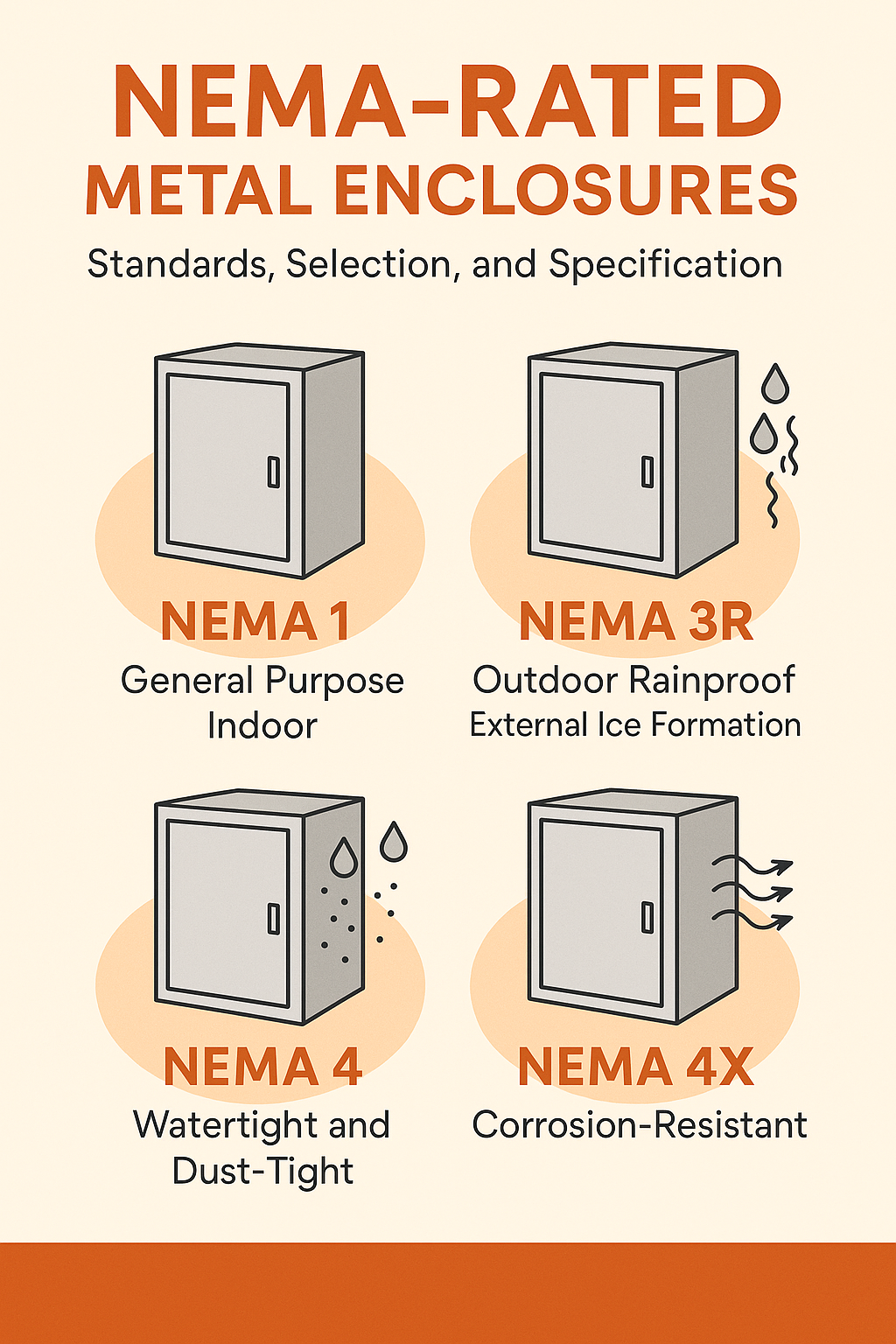 NEMA 1 – General Purpose Indoor
Provides basic protection against dust, light, and incidental contact with enclosed equipment. Suitable for indoor environments with controlled temperature and humidity where the enclosure won’t encounter water, corrosive materials, or harsh conditions.
Typical applications: Control panels in office or commercial buildings, indoor electrical distribution equipment, instrumentation in climate-controlled facilities.
Limitations: No water resistance, minimal dust protection, no corrosion resistance. Not suitable for manufacturing environments with airborne contaminants or any outdoor use.
NEMA 3R – Outdoor Rainproof
Protects against rain, sleet, and external ice formation. Provides protection from windblown dust but does not seal completely against fine dust intrusion. Most cost-effective outdoor rating for applications not requiring complete weatherproofing.
Typical applications: Outdoor electrical service equipment, building-mounted controls, telecommunications enclosures in protected locations.
Limitations: Not dust-tight, provides limited protection against blowing debris. Not suitable for environments requiring washdown capability or complete dust exclusion.
NEMA 4 – Watertight and Dust-Tight Indoor/Outdoor
Provides protection against windblown dust, rain, splashing water, and hose-directed water. Fully gasketed construction prevents water and dust intrusion. Suitable for most outdoor industrial applications and indoor environments requiring washdown capability.
Typical applications: Food processing equipment, outdoor industrial controls, manufacturing environments with washdown requirements, marine applications.
Limitations: Does not protect against prolonged submersion or high-pressure/high-temperature washdown. Not inherently corrosion-resistant without appropriate materials and finishes.
NEMA 4X – Corrosion-Resistant Watertight
Provides all NEMA 4 protection plus resistance to corrosion from salt spray, chemicals, and harsh environments. Typically constructed from stainless steel, fiberglass, or specially coated materials that resist deterioration.
Typical applications: Chemical processing facilities, coastal/marine installations, food and pharmaceutical manufacturing, wastewater treatment plants, any corrosive environment.
Material considerations: 304 stainless steel suits most applications; 316 stainless steel provides superior corrosion resistance for highly aggressive environments. Powder-coated steel or aluminum can meet NEMA 4X requirements for moderate corrosion resistance at lower cost than stainless steel.
NEMA 12 – Industrial Dust-Tight Indoor
Designed specifically for industrial manufacturing environments. Protects against circulating dust, lint, fibers, and dripping non-corrosive liquids. Gasketed construction prevents fine dust intrusion that could interfere with electrical components.
Typical applications: Manufacturing floor control panels, CNC machine controls, industrial automation equipment, warehouse electrical systems.
Advantages: More economical than NEMA 4 while providing superior dust protection compared to NEMA 1. Ideal for clean manufacturing environments without water exposure.
Limitations: Not rated for outdoor use or water resistance beyond dripping liquids. Does not provide corrosion protection.
NEMA 13 – Oil and Coolant Resistant Indoor
Similar to NEMA 12 but includes protection against oil and non-corrosive coolants. Specialized gasket materials and sealed construction prevent liquid ingress common in metalworking environments.
Typical applications: CNC machining centers, metalworking equipment controls, precision manufacturing systems where cutting fluids are present.
Key Specification Factors Beyond NEMA Rating
 NEMA ratings address environmental protection but don’t specify all enclosure requirements. Complete specifications should consider:
Thermal Management Requirements
Electrical equipment generates heat that must dissipate to maintain reliable operation. Sealed NEMA 4 and 4X enclosures trap heat inside. Specifications should address:
- Heat load calculations for enclosed components
- Ventilation requirements (which may compromise NEMA rating)
- Heat exchanger or air conditioning requirements for high-heat applications
- Component temperature limits and derating factors
Design consideration: Ventilation and NEMA ratings present competing requirements. Filtered fan systems can maintain NEMA 12 protection while enabling air exchange. NEMA 4/4X applications requiring ventilation typically need air conditioning or heat exchangers that don’t compromise sealing.
Access and Mounting Hardware
- Door quantity, size, and hinging direction for maintenance access
- Latch and lock types for security and safety requirements
- Mounting provisions (floor stand, wall mount, pole mount)
- Cable entry methods and conduit fitting provisions
- Internal mounting rails and panels for component installation
Material Selection and Finish
While NEMA 4X requires corrosion resistance, other ratings allow material choices:
- Carbon steel with powder coating (most economical, suitable for NEMA 1/12)
- Stainless steel 304 (moderate corrosion resistance, NEMA 4X)
- Stainless steel 316 (superior corrosion resistance, aggressive environments)
- Aluminum (lightweight, moderate corrosion resistance with appropriate finish)
Size and Weight Constraints
Enclosure dimensions affect cost, shipping, and installation complexity:
- Manufacturing economically up to approximately 72″ x 60″ x 24″ as single units
- Larger enclosures require multi-section construction with field assembly
- Weight considerations for mounting location structural capacity
- Transport and handling requirements for installation access
Design for Manufacturability Considerations
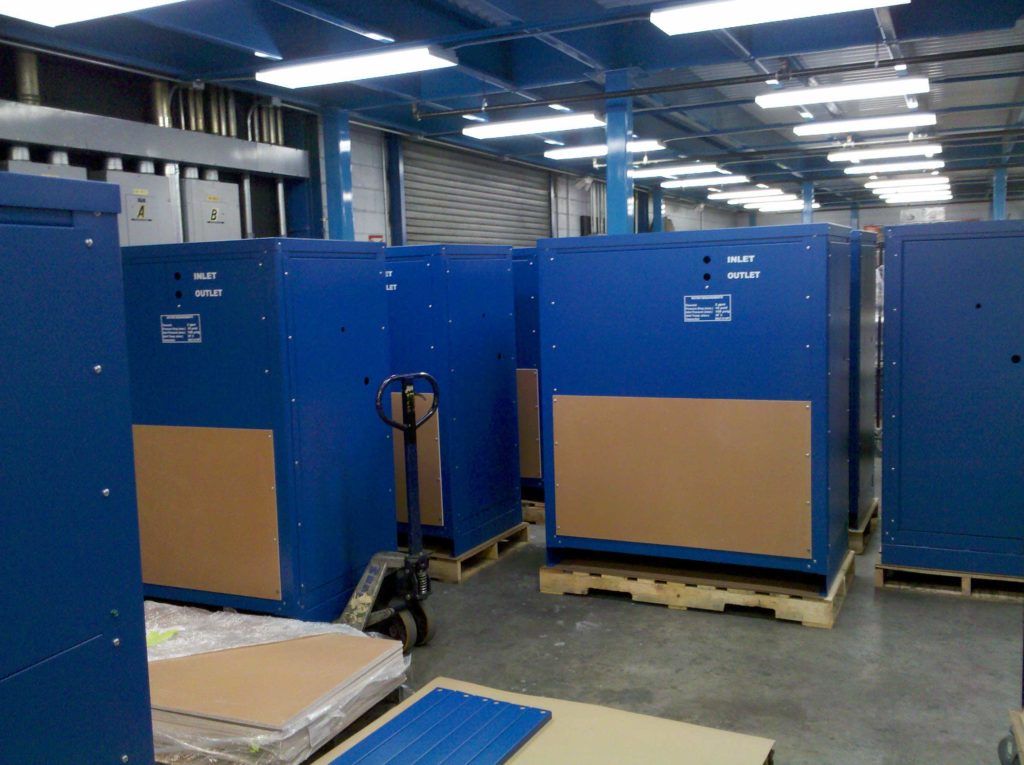 Engineers specifying custom enclosures should consider fabrication factors affecting cost, lead time, and quality:
Standard vs. Custom Sizing
Standard enclosure dimensions use common material sizes efficiently. Custom sizes requiring special material orders or excessive scrap increase costs and lead times. Fabricators can guide sizing decisions that optimize manufacturing efficiency without compromising functionality.
Gasket and Sealing Design
NEMA 4/4X ratings require continuous gasket sealing. Design considerations include:
- Gasket material selection for application environment and temperature
- Compression requirements and door/panel flatness tolerances
- Corner sealing methods for rectangular enclosures
- Long-term gasket compression set and replacement accessibility
Modification and Cutout Coordination
Enclosures typically require modifications for components, cable entries, and mounting hardware:
- Coordinate all cutouts, holes, and modifications before fabrication
- Specify precise locations, dimensions, and tolerances for critical features
- Consider component accessibility for installation and maintenance
- Specify conduit entry locations and fitting types
Finish and Coating Requirements
Powder coating provides durable, attractive finishes for metal enclosures:
- Specify color, texture, and gloss level requirements
- Consider exterior vs. interior finish requirements
- Chemical resistance requirements for harsh environments
- Electrical grounding implications of powder coating thickness
Testing and Certification Considerations
NEMA Rating Verification
NEMA ratings rely on manufacturer attestation rather than third-party certification. Reputable fabricators test enclosures to verify NEMA rating compliance, but formal certification isn’t required. Specifications can require test reports documenting compliance.
UL Listing Requirements
Unlike NEMA ratings, UL (Underwriters Laboratories) listing requires third-party testing and certification. Many enclosures require both NEMA rating and UL listing:
- NEMA rating addresses environmental protection
- UL listing addresses electrical safety, construction methods, and materials
- UL 508A covers industrial control panels
- UL 50/50E covers enclosures for electrical equipment
Important distinction: NEMA rating and UL listing address different requirements. Both may be necessary depending on application, electrical code requirements, and customer specifications.
Special Testing and Certification
Certain applications require additional certification:
- CSA (Canadian Standards Association) for Canadian installations
- CE marking for European applications
- ATEX certification for explosive atmospheres
- IECEx for international hazardous location applications
- Seismic certification for earthquake-prone regions
Practical Selection Guidance
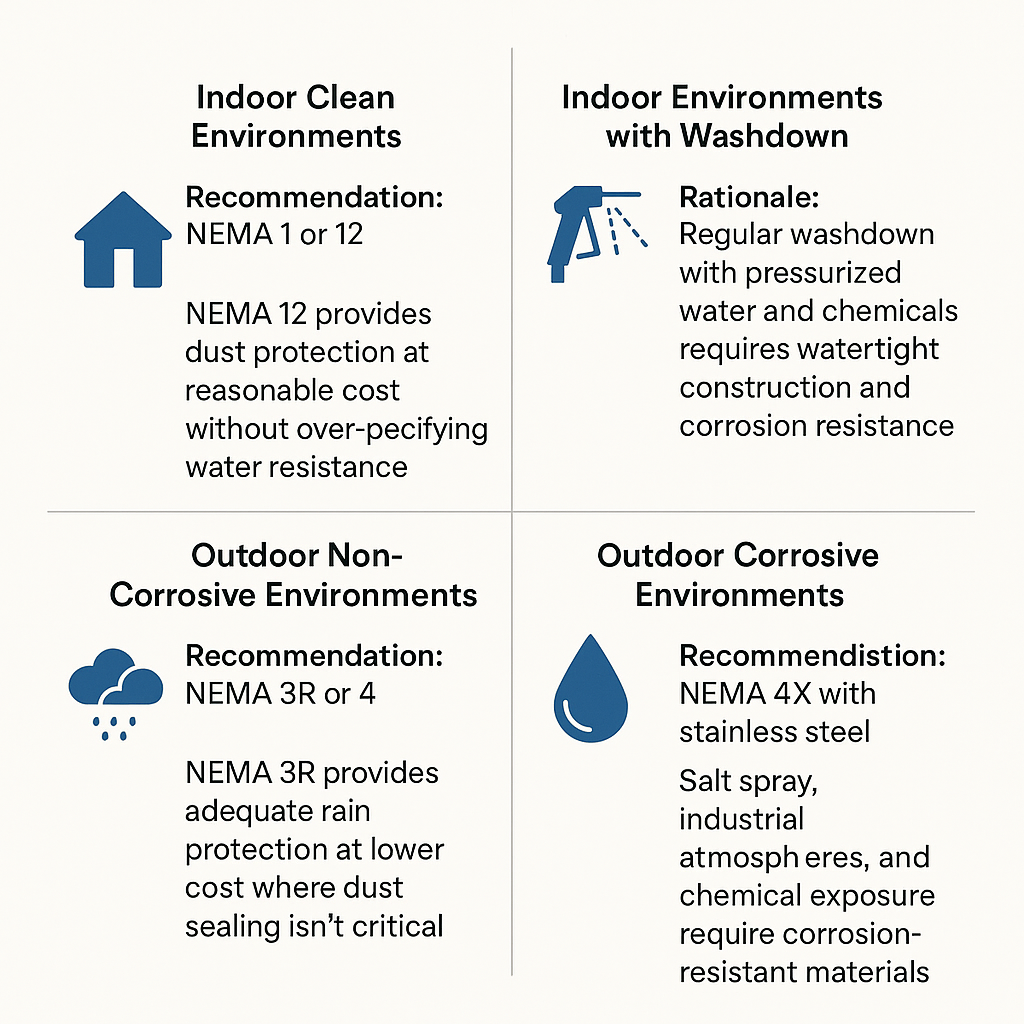 Indoor Clean Environments
Recommendation: NEMA 1 for climate-controlled commercial/office spaces; NEMA 12 for manufacturing environments with airborne dust and particulates.
Rationale: NEMA 12 provides dust protection at reasonable cost without over-specifying water resistance. Carbon steel with powder coating offers adequate durability for indoor service.
Indoor Environments with Washdown
Recommendation: NEMA 4X with stainless steel construction and specialized gasket materials resistant to cleaning chemicals.
Rationale: Regular washdown with pressurized water and chemicals requires watertight construction and corrosion resistance. Consider higher gasket compression and stainless steel hinges/latches for longevity.
Outdoor Non-Corrosive Environments
Recommendation: NEMA 3R for cost-sensitive applications; NEMA 4 for complete weather protection.
Rationale: NEMA 3R provides adequate rain protection at lower cost where dust sealing isn’t critical. NEMA 4 suits applications requiring dust exclusion or exposure to driving rain.
Outdoor Corrosive Environments
Recommendation: NEMA 4X with stainless steel construction. Consider 316 stainless steel for coastal/marine applications or chemical exposure.
Rationale: Salt spray, industrial atmospheres, and chemical exposure require corrosion-resistant materials. Initial investment in stainless steel prevents premature failure and replacement costs.
These same environmental design principles govern public-facing equipment too — kiosk enclosures are essentially NEMA engineering problems with a consumer product wrapped around them.
Hazardous Locations
Recommendation: Consult enclosure specialists familiar with Class/Division or Zone classifications. Purged enclosures or explosion-proof construction may be required depending on specific hazard classification.
Rationale: Hazardous location requirements extend beyond NEMA ratings. Specialized engineering ensures compliance with NEC Article 500 requirements.
The EVS Metal Difference
EVS Metal fabricates NEMA-rated enclosures from design consultation through production, including engineering support for rating selection, thermal management analysis, UL 508A listing, and custom modifications. Our experience across industrial automation, process control, and outdoor equipment applications informs practical specification guidance aligned with application requirements and budget constraints.
Ready to discuss your enclosure requirements? Request a quote online or call (973) 839-4432.
Frequently Asked Questions
Can a NEMA 4 enclosure be upgraded to NEMA 4X?
No. A NEMA 4 enclosure cannot be upgraded to NEMA 4X because the 4X rating requires corrosion-resistant materials and hardware throughout the entire enclosure. Powder coating a NEMA 4 carbon steel enclosure does not meet NEMA 4X requirements, as internal surfaces, welds, and hardware remain susceptible to corrosion.
What is the cost difference between common NEMA enclosure ratings?
Costs increase with required environmental protection. NEMA 1 to NEMA 12 typically increases by 15–25%. NEMA 12 to NEMA 4 adds 20–30% for watertight construction. NEMA 4 to NEMA 4X can add 50–100% due to stainless steel or corrosion-resistant materials. Actual costs vary by size, material, and customization.
How do NEMA and IP ratings compare?
NEMA and IP ratings are not equivalent, but rough correlations exist: NEMA 1 ≈ IP10, NEMA 12 ≈ IP52, NEMA 4/4X ≈ IP65. NEMA ratings cover additional factors such as corrosion resistance, gasket performance, and construction durability, while IP ratings only evaluate dust and water ingress.
Do NEMA enclosure gaskets require replacement over time?
Yes. Gaskets compress and degrade with age, temperature cycling, UV exposure, and chemical contact. Service life typically ranges from 3–7 years depending on operating conditions. Regular inspection and accessible replacement design help maintain the enclosure’s NEMA rating.
Can NEMA-rated enclosures be field-modified without losing their rating?
Field modifications can compromise the NEMA rating unless performed with proper sealing methods and components. Holes, cutouts, and cable entries must be resealed to the original standard using approved glands, gaskets, and hardware. Factory modifications are recommended to ensure compliance.
What causes most NEMA enclosure failures?
Common failure modes include gasket deterioration, corrosion at unsealed areas, inadequate cable entry sealing, heat buildup from poor thermal management, and physical damage. Proper rating selection, quality materials, sealing, and preventive maintenance reduce failure risk.