

In industrial environments where electrical safety is paramount, UL-certified enclosures provide the foundation for protecting both equipment and personnel. For applications ranging from manufacturing automation to HVAC systems, understanding the difference between NEMA ratings, UL Type ratings, and UL 508A certification requirements ensures your control systems meet recognized safety standards while complying with National Electrical Code (NEC) requirements.
At EVS Metal, our New Jersey precision sheet metal fabrication facility maintains UL authorization specifically for fabricating UL 508A industrial control panel enclosures that meet UL Type 1 rating standards. This specialized authorization represents rigorous facility audits, qualified technical staff, and systematic manufacturing processes that ensure every industrial control panel enclosure meets UL 508A safety requirements from design through delivery.
Understanding UL Certification: Third-Party Verification vs. Self-Certification
UL (Underwriters Laboratories) serves as a globally recognized independent safety science organization that tests and certifies products for compliance with established safety standards. Founded in 1894, UL has become synonymous with product safety certification, providing assurance that electrical equipment has undergone rigorous evaluation and meets strict performance criteria.
The critical distinction between UL certification and other enclosure ratings lies in verification methodology. UL ratings require manufacturers to send samples to third-party qualified evaluators for compliance determination, followed by periodic audits of manufacturing specifications and materials. In contrast, NEMA (National Electrical Manufacturers Association) ratings don’t require third-party testing – manufacturers alone determine compliance.
This independent verification provides several advantages for equipment purchasers and facility managers:
Objective Safety Assurance
Third-party testing eliminates potential conflicts of interest in safety determination. UL inspectors often visit facilities for every production run of UL certified enclosures to verify they follow documented processes and meet certifications, ensuring ongoing compliance rather than one-time evaluation.
Regulatory Acceptance
Authorities Having Jurisdiction (AHJs) – typically local electrical inspectors – consistently accept UL certification as meeting NEC requirements. While law doesn’t require UL Listing for industrial control panels in most jurisdictions, prospective customers, inspectors, and insurance companies often require UL 508A compliance.
Insurance and Liability Protection
Insurance carriers frequently specify UL-certified equipment for coverage, recognizing that independent verification reduces risk exposure. In liability situations, UL certification demonstrates adherence to recognized safety standards.
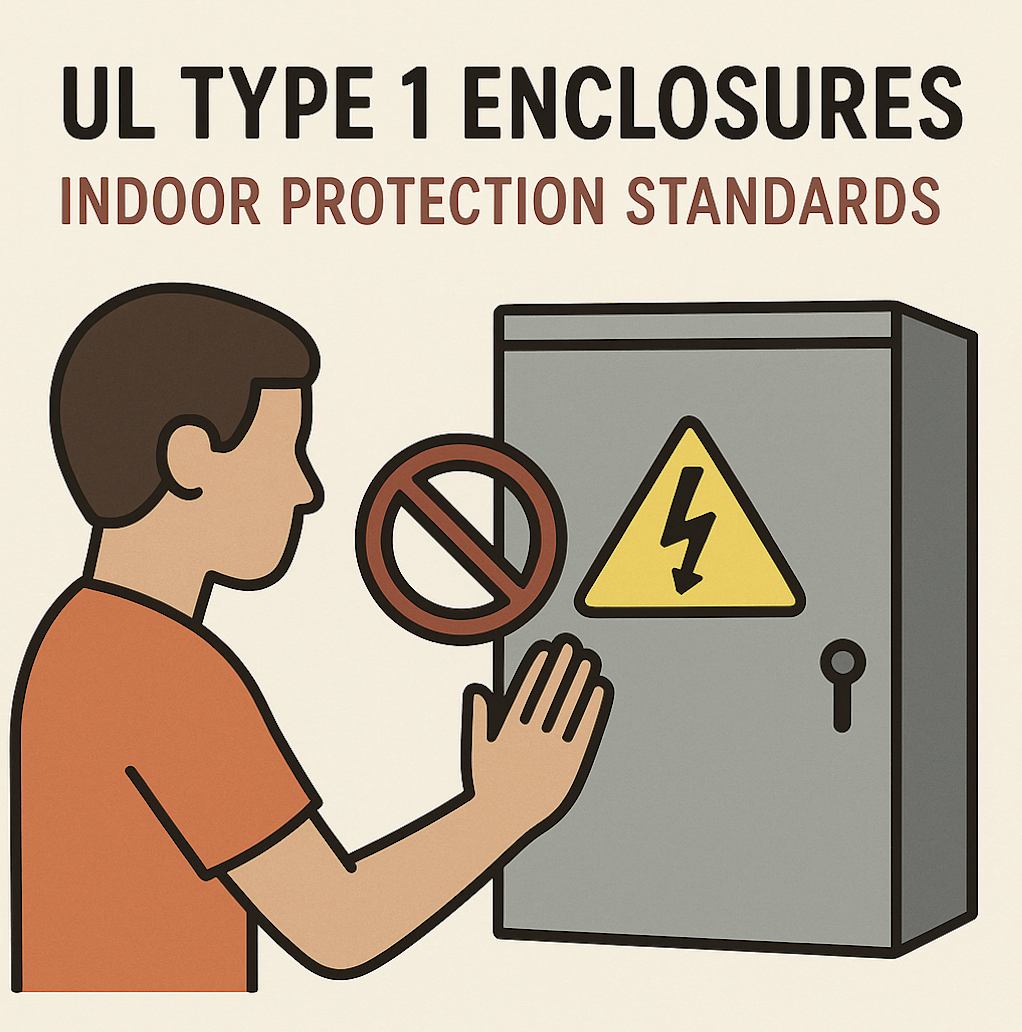
UL Type 1 Enclosures: Indoor Protection Standards
UL Type 1 represents the baseline enclosure rating for indoor electrical equipment, designed primarily to protect personnel from accidental contact with hazardous electrical components while providing basic environmental protection.
Protection Capabilities
Type 1 enclosures are designed to keep people away from parts that could be hazardous, specifically protecting against incidental contact to stop people touching live electrical parts accidentally, while providing environmental protection against falling dust.
These enclosures serve applications where:
- Indoor installation eliminates exposure to weather, moisture, or corrosive conditions
- Dust is the primary environmental concern rather than liquid ingress
- Personnel protection requires basic barriers preventing unintentional contact with energized components
- Ambient temperature remains within normal indoor ranges (41-104°F)
Typical Applications
Type 1 electrical enclosures often house motor start and stop stations, typically featuring latching doors but not requiring sealing surfaces, making them unsuitable for applications requiring protection against dust, oil, and water.
Common installations include:
- Office and commercial building electrical systems: Breaker panels, junction boxes, and distribution equipment in controlled indoor environments
- Clean manufacturing environments: Control stations for equipment in climate-controlled production facilities
- Electrical closets and utility rooms: Main distribution panels and subpanels in protected indoor spaces
- Light industrial applications: Basic motor controls and switch gear in indoor manufacturing areas
Design and Construction Requirements
While UL Type 1 requirements focus on personnel safety rather than stringent environmental sealing, proper construction ensures compliance:
Structural Integrity
Enclosures must maintain rigidity under normal handling and installation conditions. Precision sheet metal fabrication techniques ensure consistent gauge thickness, proper bend radii, and structural reinforcement at stress points.
Access Control
Doors and covers must prevent casual access to live parts while allowing authorized personnel entry for maintenance. Latching mechanisms should operate reliably throughout the enclosure’s service life.
Material Selection
Steel, stainless steel, and aluminum all meet Type 1 requirements when properly fabricated. Material choice typically depends on mounting environment, aesthetic requirements, and budget considerations rather than environmental protection needs.
UL 508A Certification: Industrial Control Panel Standards
UL 508A represents a more comprehensive safety standard specifically addressing industrial control panels (ICPs) – assemblies incorporating two or more industrial control equipment pieces with interconnecting wiring and field connection terminals.
The 2025 Standard Evolution
As of June 26, 2025, UL 508A underwent significant revision to align with NFPA 79, the NEC, and evolving technologies in automation and safety. These updates reflect the consensus-based standards development process involving industry representatives, regulatory bodies, and testing laboratories.
Major 2025 Revisions Include:
Updated Voltage Limits
New voltage limits for control circuits are now defined at 120 Vac or 250 Vdc maximum, with flexibility for electronic devices, aligning UL 508A requirements with NFPA 79 standards.
Emergency Stop Requirements Modified
The emergency stop (E-Stop) requirement has been relaxed and is now optional depending on the control scheme, whereas past standards required an emergency stop button on each industrial control panel for machinery with operator controls.
HVAC Equipment Standards Update
UL 1995 is being phased out in 2025, with UL 60335-2-40 now accepted for HVAC (Heating, Ventilation, and Air-Conditioning) equipment. This affects control panel manufacturers serving the HVAC industry, requiring updated component selection and certification approaches.
Enhanced Motor Controller Standards
UL 60947-4-1 joins UL 508 as an acceptable standard for motor controllers, providing manufacturers additional flexibility in component selection while maintaining safety equivalence.
Voltage Detection and Test Point Requirements
Voltage detection devices now have clear requirements under Clause 36, and test points may now be connected on the supply side of the disconnect, with specific compliance requirements for absence of voltage testers (AVTs), presence indicators, or test point devices.
Fiber Optic Cable Specifications
Fiber optic cables must now be certified to UL 1277 or UL 1651, with separation required for UL 1651 types, reflecting the increasing integration of fiber optic communication in modern control systems.
What UL 508A Covers
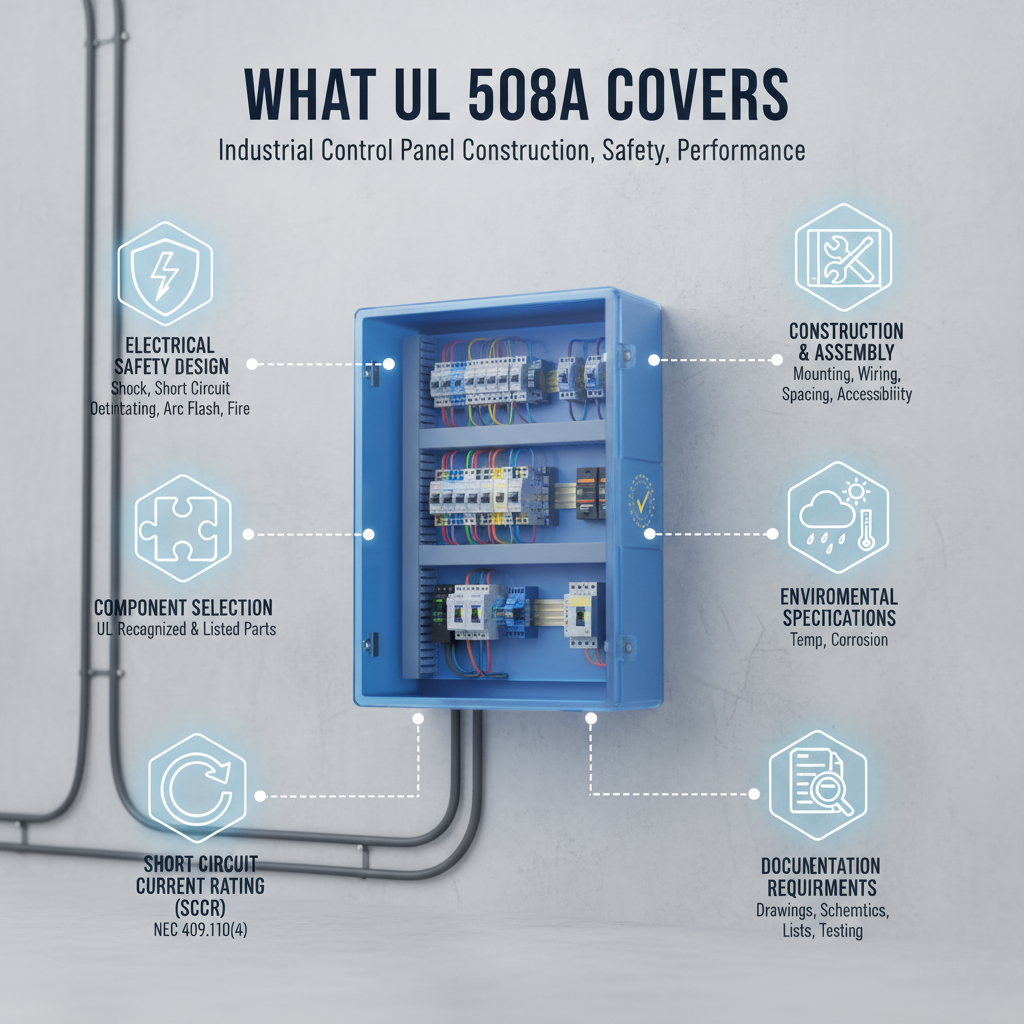
The standard addresses multiple aspects of industrial control panel construction, safety, and performance:
Electrical Safety Design
Safety guidelines prevent various hazards such as electrical shock, short circuits, overheating, arc flash, and fire hazards, based on safety rules recommended by the NEC.
Component Selection Requirements
For a control panel to carry the UL 508A Listing Mark, the panel must contain only UL recognized and listed components. This requirement extends beyond major components to include wire, terminal blocks, fuses, circuit breakers, and fastening hardware.
Short Circuit Current Rating (SCCR)
National Electrical Code Subsection 409.110(4) requires that an ICP be marked with a short-circuit current rating to ensure the ICP’s rating meets or exceeds the available fault current at the point of installation. UL 508A provides recognized calculation methods for determining SCCR.
Construction and Assembly Standards
Specifications cover control panel construction and assembly, including mounting of components, enclosure design, accessibility, and serviceability. Proper wire routing, adequate spacing between components, and accessible maintenance points all factor into compliant construction.
Environmental Specifications
The standard includes specifications to ensure that industrial control panels can endure environmental factors such as dust, moisture, temperature fluctuations, and corrosion.
Documentation Requirements
Criteria address required documentation related to design, construction, and installation of industrial control panels, including drawings, schematics, component lists, and testing records.
The UL 508A Panel Shop Program: Authorization Requirements
Obtaining UL 508A authorization involves more than simply using certified components. UL’s Industrial Control Panel Shop Program requires control panel manufacturers to complete mandatory training on the UL 508A standard when entering the program and maintain qualified staff knowledgeable of requirements.
Manufacturer Technical Representative (MTR) Requirements
Each manufacturing location must maintain at least one UL 508A qualified manufacturer technical representative (MTR) on staff who can effectively interpret and accurately apply requirements of the UL 508A industrial control panels Standard.
MTR qualification involves:
- Completion of comprehensive UL 508A certification course
- Passing rigorous certification examination
- Recertification every three years to ensure current knowledge
- Ongoing responsibility for interpreting standards application at the facility
This requirement ensures manufacturing facilities maintain in-house expertise for proper standard application rather than relying solely on external consultants or periodic audits.
Ongoing Compliance and Audits
Manufacturers carrying UL 508A certification are subject to periodic unannounced inspections of their facilities by UL personnel, allowing UL to ensure the manufacturer continues meeting UL requirements for 508A certification.
These audits verify:
- Continued use of UL recognized and listed components
- Adherence to documented manufacturing processes
- Proper application of UL Listing Marks
- Maintenance of required documentation
- MTR certification currency
- Training record completeness
Applications for UL 508A Industrial Control Panel Enclosures
UL 508A certified industrial control panel enclosures serve diverse applications where electrical safety and regulatory compliance are essential:

Industrial Machinery Control Panels
Manufacturing automation systems require sophisticated control panels managing multiple motors, drives, PLCs, and safety circuits. Industries with manufacturing operations, food processing, chemical handling, water treatment, data centers, or automated material handling typically need UL 508A compliance.
These applications benefit from UL 508A certification through:
- Verified electrical safety design preventing shock and fire hazards
- Proper SCCR ratings ensuring panels can safely handle fault conditions
- Component spacing and isolation meeting NEC requirements
- Documentation supporting facility electrical inspections
Metal fabrication and CNC machining capabilities enable custom panel dimensions accommodating specific equipment layouts, cable entry requirements, and mounting configurations for industrial machinery applications.
HVAC and Refrigeration Control Systems
Air conditioning, refrigeration, and building environmental control systems depend on reliable control panels managing compressors, fans, dampers, and monitoring systems. With UL 60335-2-40 now accepted for HVAC equipment following UL 1995 phase-out in 2025, control panel manufacturers must ensure compliance with updated requirements.
HVAC control applications typically require:
- Adequate ventilation for heat-generating components
- Proper sealing against dust and moisture in mechanical rooms
- Accessible layouts for routine maintenance and filter changes
- Clear labeling for HVAC technician troubleshooting

Service Equipment Panels
Electrical service equipment distributes power throughout facilities, requiring enclosures that protect high-amperage components while providing safe access for qualified electricians.
Service panel applications include:
- Main distribution panels for commercial and industrial facilities
- Subpanels serving specific building areas or production zones
- Transfer switches for backup generator systems
- Load management and power monitoring equipment
These installations demand robust finishing and powder coating to withstand decades of service in utility rooms, mechanical spaces, and electrical closets.
Custom Automation Control Panels
Specialized automation systems for material handling, packaging, processing, and assembly operations require custom control panels integrating PLCs, servo drives, variable frequency drives, and safety systems.
Custom automation panels benefit from:
- Flexible layouts accommodating specific equipment complements
- Modular designs supporting future expansion or modification
- Engineering support for optimal component placement and thermal management
- Integration of HMIs, indicator lights, and operator controls
The discipline extends beyond industrial panels: self-service kiosk enclosures housing payment and power hardware often carry certification requirements of their own.
Key Advantages of UL 508A Certified Industrial Control Panels
Beyond regulatory compliance, UL 508A certification provides tangible business and operational benefits:
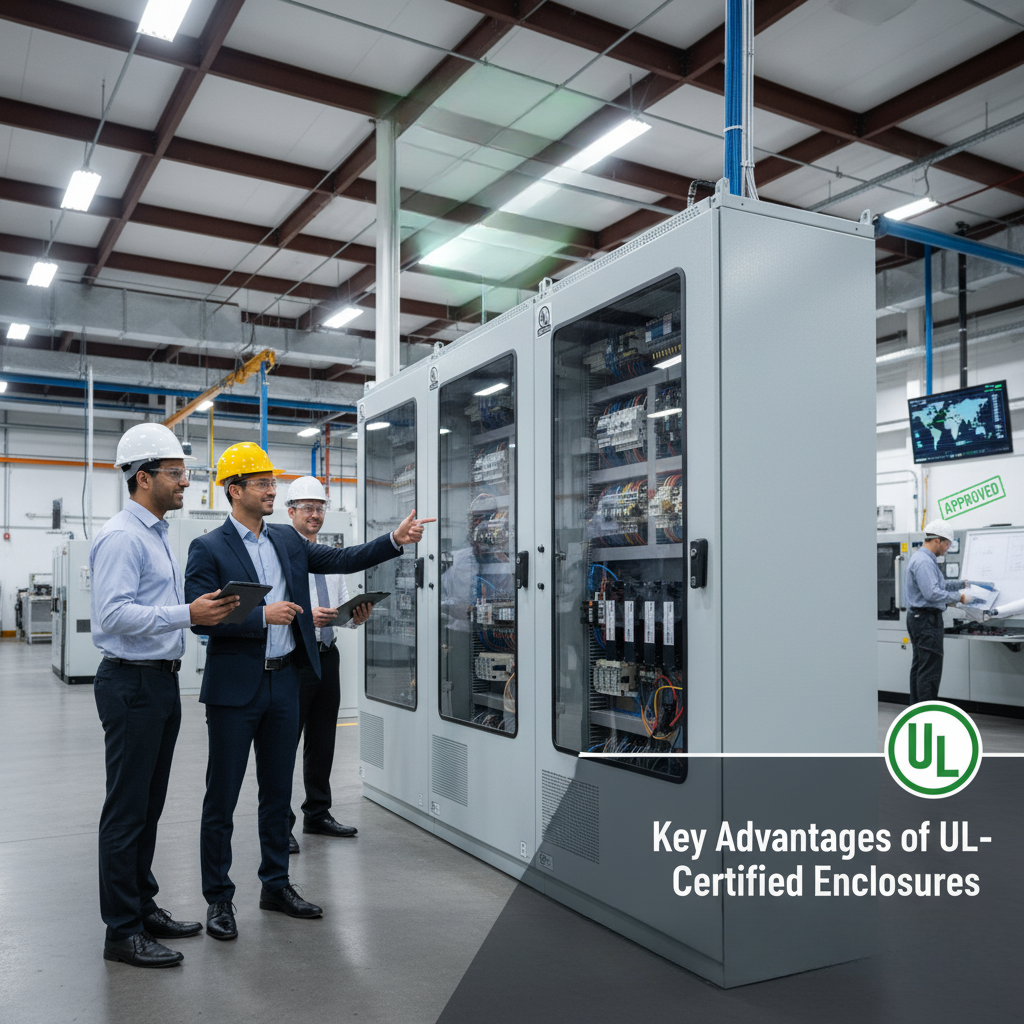
Enhanced Safety and Risk Reduction
UL 508A Listed panels ensure specific electrical safety requirements are met, helping make equipment safer for operators by reducing the risk of electrical issues such as electric shock and arc flash, fire, and other hazards.
Systematic safety design addresses:
- Proper grounding and bonding throughout the panel
- Adequate working space for safe maintenance
- Clear identification of voltages and circuits
- Appropriate overcurrent protection for all circuits
- Fire-resistant construction materials
Regulatory and Inspection Approval
Inspectors won’t approve non-certified panels – many jurisdictions simply won’t sign off on new installations without UL 508A certification, which can stop projects cold and create expensive delays.
UL 508A certification streamlines:
- Initial electrical inspections for new installations
- Modification approvals when expanding or upgrading systems
- Insurance underwriting and risk assessment processes
- Customer procurement requirements and specifications
Market Access and Customer Requirements
Many industries, geographic regions and customers (especially in the U.S.) require industrial equipment to comply with safety standards before approving it for use, with UL 508A Listed panels maximizing market opportunities by making it easier to gain approval.
Customer specifications frequently mandate UL 508A for:
- Pharmaceutical manufacturing with FDA-regulated facilities
- Food processing plants with stringent safety requirements
- Aerospace manufacturing with quality system demands
- Automotive assembly plants with standardized equipment specifications
Legal Protection and Liability Mitigation
If something goes wrong, having UL 508A certified panels shows you followed recognized safety standards, while non-certified panels can create serious liability issues.
Proper certification provides:
- Documented compliance with industry-recognized standards
- Evidence of due diligence in equipment specification
- Protection against negligence claims in incident investigations
- Support for worker’s compensation and insurance claims defense
NEMA vs. UL Type Ratings: Understanding the Relationship
While NEMA and UL Type ratings appear similar, the standards for each enclosure type are independent from each other, though the protection expectations are mostly the same, with UL ratings often described in more technical language.
Equivalent Protection Levels
For most applications, NEMA and UL Type ratings provide comparable protection:
| NEMA Rating | UL Type | Protection Level | Typical Use |
|---|---|---|---|
| NEMA 1 | Type 1 | Indoor, dust | General purpose indoor |
| NEMA 2 | Type 2 | Indoor, dripping water | Near indoor water sources |
| NEMA 12 | Type 12 | Indoor, dust/dripping liquid | Industrial dusty environments |
| NEMA 4/4X | Type 4/4X | Water/dust/corrosion | Outdoor or washdown areas |
Testing Methodology Differences
While many manufacturers simply apply a gasket to their enclosure and label it as NEMA 12, the UL test is more complicated, requiring the enclosure to undergo rigorous testing in an airtight chamber with circulated dust for 5 minutes.
UL Type 12 testing protocol:
- Enclosure placed in airtight chamber with internal volume not less than 0.169 m³ (6 cubic feet), with chamber volume not less than 150 percent of enclosure volume
- At least 1.5 kilograms of dry Type 1 general-purpose Portland cement per cubic meter circulated by blower suction unit for 5 minutes to completely envelop the enclosure
- Air velocity at blower outlet maintained at approximately 305 meters per minute (1000 feet per minute)
- Visual inspection confirms no dust or water entered the enclosure
This rigorous testing ensures claimed ratings reflect actual performance under controlled conditions rather than theoretical design capabilities.
EVS Metal’s UL 508A Authorization: New Jersey Facility Capabilities
EVS Metal’s New Jersey facility maintains UL authorization specifically for UL 508A industrial control panel enclosures using Type 1 ratings, combining certified manufacturing processes with comprehensive metal fabrication capabilities.
Certified Manufacturing Process for UL 508A Panels
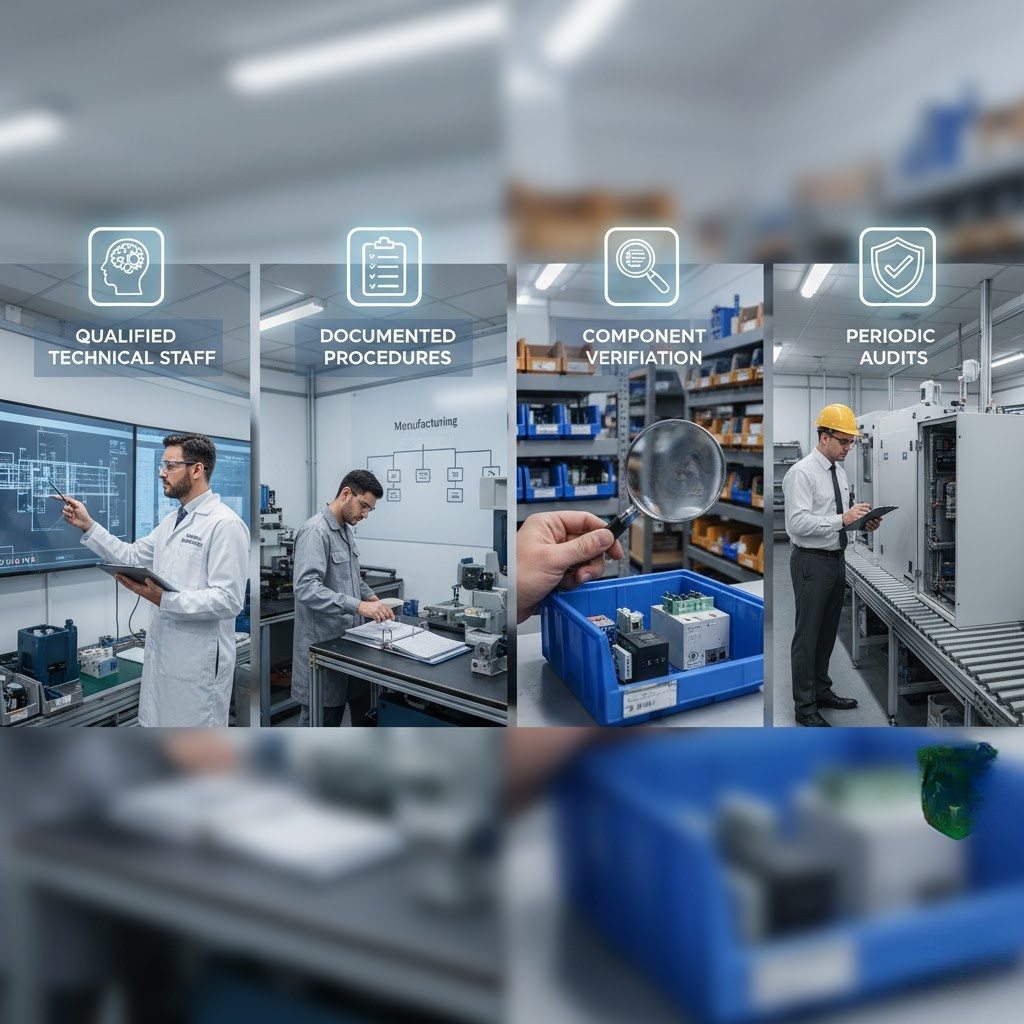
Our New Jersey facility’s UL 508A authorization encompasses:
Qualified Technical Staff
Maintaining UL 508A qualified Manufacturer Technical Representatives ensures in-house expertise for standards interpretation and application throughout the manufacturing process for industrial control panel enclosures.
Documented Procedures
Systematic manufacturing procedures cover material handling, fabrication sequences, quality checkpoints, and final inspection protocols specific to UL 508A industrial control panel requirements, ensuring consistent compliance across production runs.
Component Verification
Incoming inspection processes verify UL recognition or listing for all components incorporated into UL 508A control panel enclosures, maintaining traceability documentation for audit purposes.
Periodic Audits
UL’s unannounced facility audits verify ongoing adherence to UL 508A certification requirements, process documentation, and quality systems for industrial control panel fabrication.
Comprehensive Fabrication Services for Industrial Control Panels
Our UL 508A authorized New Jersey facility provides complete industrial control panel enclosure fabrication from design through finishing:
Precision Sheet Metal Fabrication
- Laser cutting for precise panel dimensions and component cutouts
- CNC punching for consistent hole patterns and mounting locations
- Press brake forming for accurate bends and structural reinforcement
- Hardware installation including hinges, latches, and mounting hardware
Welding Capabilities
- TIG and MIG welding for structural integrity
- Spot welding for internal mounting brackets
- Robotic welding for high-volume production consistency
Finishing Options
- Powder coating for corrosion resistance and professional appearance
- Silk screening for permanent labeling and identification
- Hardware installation and final assembly
Engineering Support
- Design for manufacturability consultation for UL 508A compliance
- Material selection guidance
- Thermal management analysis for heat-generating equipment
- Value engineering for cost optimization without compromising UL 508A compliance
Material Options for UL 508A Industrial Control Panel Enclosures
Standard enclosure materials for UL 508A panels include:
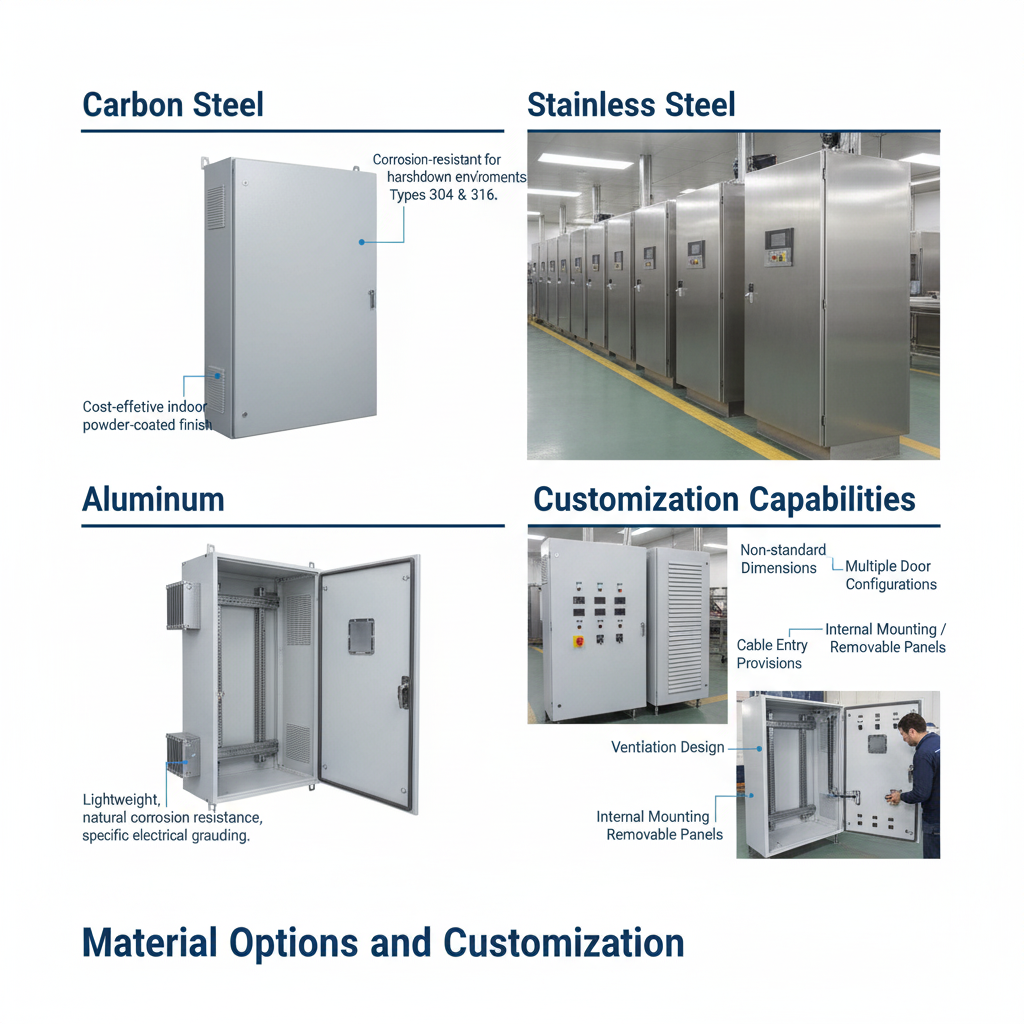
Carbon Steel
Cost-effective option for indoor Type 1 applications where corrosion resistance isn’t critical. Powder coating provides attractive finish and basic protection.
Stainless Steel
Excellent corrosion resistance for harsh environments, washdown applications, or aesthetic requirements. Types 304 and 316 available depending on corrosion exposure.
Aluminum
Lightweight alternative with natural corrosion resistance. Suitable for applications where weight reduction matters or specific electrical grounding requirements exist.
Customization Capabilities for Industrial Control Panels
Our New Jersey facility’s UL 508A authorization supports customization including:
- Non-standard dimensions accommodating specific equipment layouts
- Multiple door configurations for access optimization
- Ventilation design for thermal management
- Cable entry provisions for field wiring requirements
- Internal mounting rails and brackets for component installation
- Removable panels for maintenance access
Choosing the Right Enclosure for Your UL 508A Industrial Control Panel
Selecting appropriate enclosure ratings for industrial control panels requires understanding installation environment, equipment requirements, and regulatory context:
Environmental Assessment
Consider these factors:
- Indoor vs. Outdoor: Type 1 suits indoor environments; outdoor applications require higher ratings (Type 3R, 4, or 4X)
- Dust Exposure: Manufacturing environments with airborne particles need Type 12 or higher
- Moisture Presence: Any liquid exposure requires sealed designs beyond basic Type 1
- Temperature Extremes: Equipment heat generation and ambient conditions affect ventilation requirements
- Corrosive Atmosphere: Chemical exposure necessitates stainless steel construction and Type 4X rating
Regulatory Requirements
Verify applicable codes and standards:
- NEC Article 409: Industrial control panel requirements including SCCR marking
- NFPA 79: Electrical standards for industrial machinery
- Local Amendments: Some jurisdictions modify NEC requirements
- Industry-Specific Standards: Food processing, pharmaceutical, and other industries may impose additional requirements
Equipment Considerations
Match enclosure characteristics to installed equipment:
- Heat Dissipation: VFDs, servo drives, and power supplies generate heat requiring ventilation
- Component Count: Dense equipment packing affects layout and accessibility
- Maintenance Access: Consider how often technicians need entry and what tools they’ll use
- Expansion Capability: Future equipment additions benefit from oversized enclosures
- Mounting Requirements: Wall-mount vs. floor-mount vs. machine-mount affects design
The Bottom Line: UL 508A Certification Provides Peace of Mind
For industrial applications requiring electrical control panels, UL 508A certification offers more than regulatory compliance – it provides systematic safety assurance backed by independent verification and ongoing oversight.
With UL 508A undergoing significant revision in 2025 to align with NFPA 79, the NEC, and evolving automation technologies, staying current with certification requirements ensures your control panels meet modern safety standards while supporting efficient facility inspections and equipment approval.
At EVS Metal, our New Jersey facility’s UL 508A authorization combined with comprehensive metal fabrication and machining services enables us to deliver industrial control panel enclosures meeting UL 508A certification requirements with Type 1 ratings. From initial design consultation through final finishing and assembly, our certified manufacturing processes ensure your industrial control panel enclosures provide the safety, quality, and regulatory compliance your applications demand.
Whether you need industrial machinery control panels, custom HVAC system control enclosures, specialized automation panel housings, or service equipment panels, our New Jersey facility’s UL 508A authorization provides the expertise and capabilities to deliver compliant solutions.
Contact EVS Metal today to discuss your UL 508A industrial control panel enclosure requirements. Our engineering team can help you navigate UL 508A certification requirements, select appropriate materials and Type 1 ratings, and design enclosures that protect your equipment while meeting all applicable safety standards.
EVS Metal’s New Jersey facility operates under UL 508A authorization for industrial control panel enclosures meeting Type 1 rating standards. Our comprehensive capabilities include metal fabrication, CNC machining, welding, finishing, and engineering services to support your industrial control panel requirements.
Frequently Asked Questions about UL Type 1 Enclosures
What is a UL Type 1 enclosure?
A UL Type 1 enclosure provides basic indoor protection for electrical equipment. It prevents accidental contact with energized components and protects against falling dirt or dust in controlled indoor environments.
What does UL 508A certification cover?
UL 508A certification governs industrial control panels and covers electrical safety design, approved component selection, SCCR calculation, enclosure construction methods, environmental performance, and required documentation for inspection and compliance.
What changed in the 2025 update to UL 508A?
Key 2025 updates include new voltage limits for control circuits, optional emergency stop requirements, updated HVAC equipment standards (transitioning from UL 1995 to UL 60335-2-40), acceptance of UL 60947-4-1 for motor controllers, clarified rules for voltage detection and test points, and updated fiber optic cable specifications.
How do NEMA ratings compare to UL Type ratings?
NEMA and UL Type ratings often correspond in protection level, but UL ratings require independent third-party testing while NEMA ratings do not. UL verification ensures tested performance, while NEMA compliance is self-declared by manufacturers.
Why choose UL 508A certified control panels?
UL 508A certified panels provide validated electrical safety, simplified inspections, NEC and NFPA 79 compliance, reduced liability, and broader market acceptance. Many industries, customers, and insurance providers require UL 508A certification for industrial equipment.
What UL 508A capabilities does EVS Metal’s New Jersey facility provide?
EVS Metal’s New Jersey facility maintains UL 508A authorization, qualified Manufacturer Technical Representatives, documented manufacturing procedures, component verification processes, and successful periodic UL audits. The facility provides full fabrication, machining, welding, finishing, labeling, and engineering services for compliant Type 1 industrial control panel enclosures.
What’s the difference between UL Type 1 and UL 508A?
UL Type 1 is an enclosure rating focused on protecting personnel from accidental contact and preventing ingress of falling dirt. UL 508A is a comprehensive industrial control panel safety standard governing electrical design, approved components, wiring methods, SCCR calculation, and documentation.
Is UL 508A required by law for all industrial control panels?
UL 508A is not federally mandated, but many authorities having jurisdiction, insurers, and large industrial customers require UL 508A for approval, installation, warranty, or liability protection.
Can a panel be UL 508A certified without being UL Type rated?
No. A UL 508A certified panel must use an enclosure with a proper UL Type rating such as Type 1, 12, 4, or 4X. However, an enclosure with a UL Type rating alone does not make the panel UL 508A compliant.