

 For procurement teams, engineers, and manufacturers selecting fabrication partners, understanding the distinctions between general metal fabrication and precision sheet metal fabrication directly impacts project success and cost-effectiveness. While often used interchangeably, these approaches differ significantly in capabilities, tolerances, and applications.
The Fabrication Spectrum
General Metal Fabrication
Metal fabrication covers all processes transforming raw metals into finished products. This broad category includes cutting, welding, bending, forming, machining, and assembly across various metals.
Standard tolerances: ±1/16″ to ±1/8″ (±1.6mm to ±3.2mm)
Applications: Construction frameworks, basic enclosures, general brackets, and structural components
Equipment: Standard cutting tools, manual welding stations, basic press brakes
Sheet Metal Fabrication
Sheet metal fabrication focuses specifically on thin, flat metal stock processing (typically 0.006″ to 0.25″ thick).
Improved tolerances: ±1/32″ to ±1/16″ (±0.8mm to ±1.6mm)
Primary processes: Laser cutting, plasma cutting, punching, forming, and bending optimized for thin materials
Common applications: HVAC ductwork, electrical enclosures, appliance components, automotive panels
Precision Sheet Metal Fabrication
Precision sheet metal fabrication represents engineering-grade manufacturing with the highest accuracy and quality standards.
Precision tolerances: ±0.005″ to ±0.010″ (±0.13mm to ±0.25mm)
Advanced processes: Laser cutting with micro-joint technology, precision forming with sophisticated tooling, automated bending systems, and integrated quality control
Material expertise: Deep understanding of alloy behavior, spring-back calculations, and grain direction considerations
Quality systems: Complete traceability, statistical process control, first article inspection, and regulated industry documentation
Key Differentiators in Precision Work
Equipment and Measurement Systems
Standard fabrication: Basic calipers, rulers, and visual inspection focusing on overall dimensional accuracy.
Precision fabrication: Coordinate measuring machines (CMM), optical comparators, and laser measurement systems ensuring consistent accuracy across complex geometries. In aerospace applications, a 0.020″ deviation might render a component unusable, while in general construction, the same variance would be acceptable.
Material Selection and Processing
General approach: Materials selected primarily on cost and availability, with standard processing methods.
Precision approach: Materials chosen for specific properties (tensile strength, corrosion resistance, thermal expansion), with processing parameters optimized for each alloy’s characteristics.
Example: Precision fabrication of medical device components requires understanding how 316L stainless steel behaves differently than 304 stainless during forming operations, affecting both dimensional accuracy and surface finish.
Tooling Investment and Capabilities
Standard operations: General-purpose tools suitable for a wide range of applications, with acceptable variation in results.
Precision operations: Application-specific tooling, precision fixtures, and advanced equipment capable of repeatable accuracy across production runs. Precision tooling may cost 3-5 times more than standard tools, but enables consistent quality that eliminates rework and waste.
 Industry Applications and Requirements
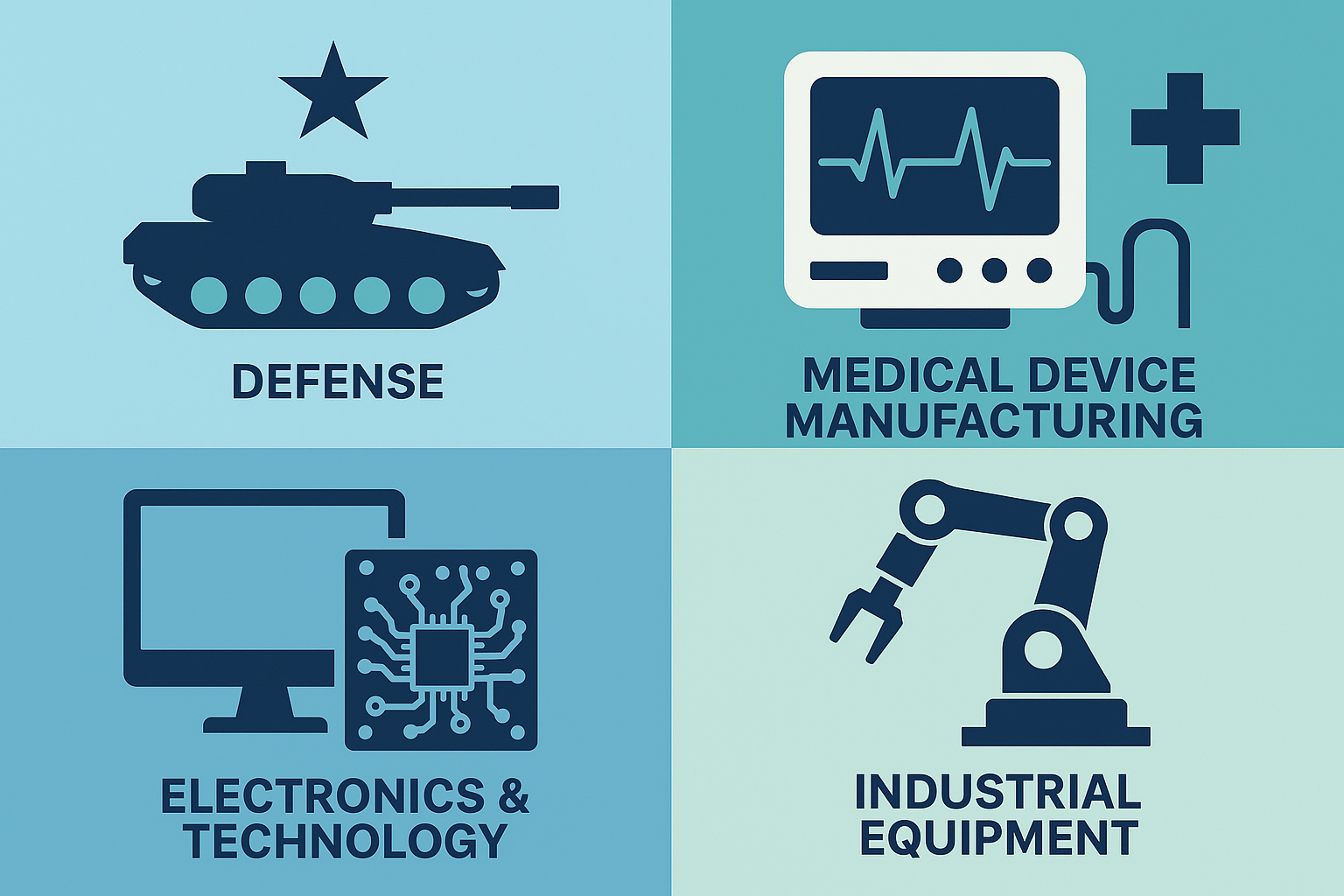 Industry Applications and Requirements
Defense and Military Applications
Defense manufacturing requires precision fabrication for mission-critical equipment where component failure can have life-or-death consequences, military specifications demanding exact dimensional tolerances for weapons systems and communication equipment, stringent quality standards including complete material traceability and ITAR compliance, and reliable performance in extreme environments where dimensional stability directly impacts operational effectiveness.
Medical Device Manufacturing
Medical device applications require precision fabrication because human safety depends on exact dimensional accuracy, FDA regulations demand consistent manufacturing processes, biocompatible materials require specialized processing knowledge, and sterilization requirements affect material selection.
Electronics and Technology
Electronics manufacturing increasingly requires precision fabrication for electromagnetic interference (EMI) shielding requiring precise gap control, heat dissipation components where dimensional accuracy affects thermal performance, and miniaturized enclosures demanding maximum space utilization.
Industrial Equipment
Industrial equipment manufacturing benefits from precision fabrication through improved equipment performance and longevity, reduced maintenance requirements due to better component fit, enhanced safety through more reliable assemblies, and cost reduction through elimination of field modifications.
Cost Considerations and Value Analysis
Initial Investment vs. Long-Term Value
General fabrication: Lower upfront costs, but potential for increased downstream expenses through rework, field modifications, and quality issues.
Precision fabrication: Higher initial investment offset by reduced total project costs through elimination of rework, improved assembly efficiency, and enhanced product performance.
Hidden Costs of Inadequate Precision
Components that don’t fit properly require field modifications, increasing labor costs and project timelines. Dimensional variations can lead to product failures, warranty claims, and reputation damage. Industries requiring precise tolerances may face costly delays or rejections when working with inadequate fabrication capabilities.
Manufacturing Process Differences
Cutting Technologies
Standard sheet metal:
- Basic laser cutting with standard kerf compensation
- Mechanical shearing for straight cuts
Precision sheet metal:
- Advanced fiber laser systems with micro-joint cutting
Forming and Bending Operations
Standard operations:
- Manual or semi-automatic press brakes with basic angle control
- Standard tooling suitable for general applications
- Visual inspection for angle accuracy
Precision operations:
- Robotic CNC press brakes with angle measurement systems
- Precision tooling designed for specific applications
- Automated angle correction based on material spring-back characteristics
Welding and Joining
General approach:
- Standard welding techniques
- Visual inspection of weld quality
- Basic fixture systems for part positioning
Precision approach:
- Advanced welding processes
- Automated positioning systems ensuring consistent joint placement
- Non-destructive testing verification of critical welds
Quality Control Systems
Standard Quality Measures
Basic dimensional verification, visual inspection, and functional testing sufficient for general applications.
Precision Quality Systems
Statistical Process Control (SPC): Continuous monitoring of critical dimensions with automatic alerts for out-of-specification trends.
First Article Inspection (FAI): Complete dimensional analysis and documentation of initial production parts, ensuring process capability before full production.
Certificate of Compliance: Detailed documentation supporting regulatory requirements and customer specifications.
Traceability Systems: Complete material traceability from raw stock through finished product, supporting recalls and regulatory audits.
Selecting the Right Fabrication Approach
Project Assessment Criteria
Tolerance requirements: Can your application function within ±1/16″ tolerances, or do you need ±0.005″ precision?
Regulatory environment: Does your industry require documented quality systems and complete traceability?
Assembly complexity: Will precise component fit reduce overall assembly time and costs?
Performance criticality: Do dimensional variations directly impact product performance or safety?
Cost-Benefit Analysis Framework
Include initial fabrication, assembly time, potential rework, and long-term performance implications. Consider consequences of dimensional variations, including safety, performance, and regulatory compliance risks. Precision fabrication may cost more initially but can reduce project timelines through elimination of rework and modifications.
EVS Metal’s Precision Capabilities
EVS Metal specializes in precision sheet metal fabrication, serving clients who require the highest levels of accuracy and quality.
Tolerance capabilities: Consistent ±0.005″ tolerances across complex geometries using advanced measurement and control systems.
Advanced equipment: Fiber laser cutting systems, precision CNC forming equipment, and automated welding systems optimized for precision work.
Quality systems: AS9100 and ISO 9001 certified quality management systems supporting aerospace, medical device, and other regulated industries.
Material expertise: Deep understanding of how various alloys behave during precision processing, enabling optimal results across steel, aluminum, stainless steel, and specialty materials.
Multi-location capabilities: Facilities in New Jersey, Pennsylvania, New Hampshire, and Texas provide geographic diversity while maintaining consistent precision standards.
Precision Applications We Serve
Medical device housings: Biocompatible enclosures meeting FDA requirements for dimensional accuracy and surface finish.
Electronics enclosures: EMI shielding and thermal management components where precision directly impacts performance.
Industrial automation: Components for automated systems where precise fit ensures reliable operation and easy maintenance.
Making the Right Choice for Your Project
This decision should be based on comprehensive analysis of project requirements, not simply initial cost considerations.
Choose general metal fabrication when:
- Tolerances of ±1/16″ or greater are acceptable
- Regulatory documentation requirements are minimal
- Cost is the primary selection criterion
- Applications are non-critical or easily field-adjustable
Choose precision sheet metal fabrication when:
- Tight tolerances are essential for function or assembly
- Regulatory compliance requires documented quality systems
- Total project cost (including assembly and lifecycle costs) is the priority
- Product performance or safety depends on dimensional accuracy
Industry Trends Affecting Fabrication Choices
Miniaturization demands: Increasing product miniaturization across industries drives demand for precision fabrication capabilities.
Regulatory expansion: Growing regulatory requirements in more industries increase the value of precision fabrication and documentation systems.
Supply chain resilience: Companies prioritize fabrication partners who can maintain consistent quality across changing conditions.
Automation integration: Precision fabrication enables automated assembly processes, reducing labor costs and improving consistency.
Conclusion
Precision fabrication is a comprehensive manufacturing approach that includes advanced equipment, sophisticated quality systems, extensive material knowledge, and detailed documentation capabilities. For applications where dimensional accuracy, regulatory compliance, or total project cost optimization are priorities, precision sheet metal fabrication provides value extending well beyond the fabrication process itself. The investment in precision capabilities pays dividends through reduced assembly time, eliminated rework, improved product performance, and enhanced regulatory compliance. Understanding these differences enables better supplier selection, more accurate project budgeting, and ultimately, more successful product outcomes.
Ready to discuss your precision fabrication requirements? Contact EVS Metal to explore how our precision capabilities can support your project goals while optimizing total cost and performance.
Frequently Asked Questions
What’s the main difference between metal fabrication and precision sheet metal fabrication?
General metal fabrication handles a wide range of metalworking processes with standard tolerances, while precision sheet metal fabrication focuses on tight tolerances, advanced equipment, and engineered consistency. Precision methods support industries where dimensional accuracy and documentation are critical.
Why would a project require precision sheet metal fabrication instead of standard fabrication?
Projects that demand tight tolerances, regulatory compliance, repeatable accuracy, or complex assemblies benefit from precision fabrication. It reduces rework, improves part fit, and ensures reliable performance—especially in medical, aerospace, electronics, and high-tech applications.
Are precision fabrication services more expensive?
The initial cost is higher because of specialized equipment, skilled labor, inspection systems, and documentation. However, precision fabrication often lowers total project cost by reducing rework, speeding assembly, and preventing quality failures downstream.
What tolerances can precision sheet metal fabrication achieve?
Precision fabrication typically maintains tolerances between ±0.005″ and ±0.010″ across complex parts. General fabrication, by contrast, usually ranges from ±1/16″ to ±1/8″.
Which industries rely most on precision sheet metal fabrication?
Industries with strict performance or regulatory requirements rely heavily on precision fabrication, including aerospace, defense, medical devices, electronics, industrial automation, and advanced energy systems.
How do I decide whether my project needs precision fabrication?
Evaluate the required tolerances, regulatory environment, assembly complexity, functional performance needs, and long-term cost impact. If dimensional accuracy directly affects product reliability or safety, precision fabrication is the appropriate choice.
What advantages do precision fabricators offer over standard metal shops?
Precision fabricators offer advanced cutting and forming equipment, automated welding, robust quality systems (ISO, AS9100), CMM inspection, material traceability, and engineering support. These capabilities ensure consistent quality and efficient production across prototypes and full-scale runs.