

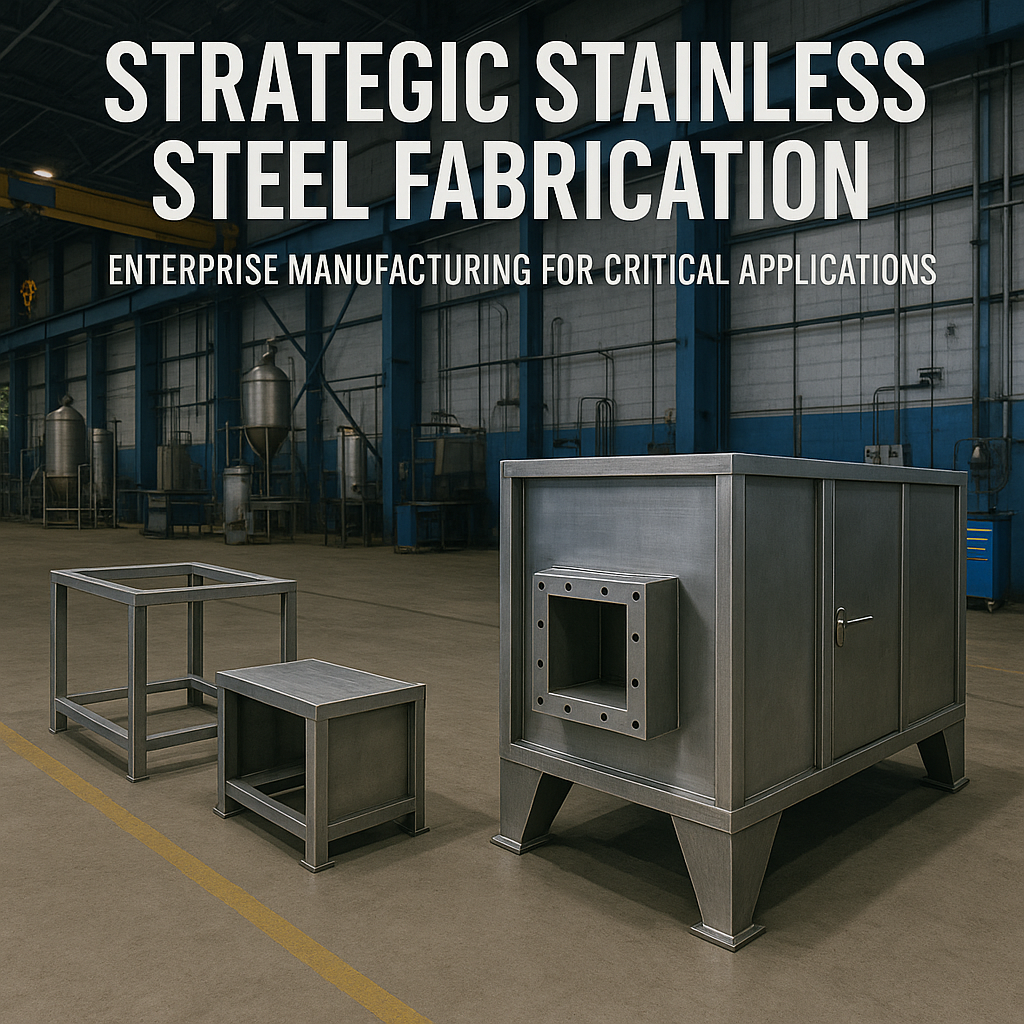
 When procurement teams evaluate material choices for mission-critical applications, the initial cost comparison often favors carbon steel or aluminum. However, enterprise manufacturers understand that total cost of ownership—including maintenance, replacement cycles, and operational disruption—often makes stainless steel fabrication a strategic investment rather than an expense.
Why Enterprise Manufacturers Choose Stainless Steel
Corrosion Resistance That Reduces Lifecycle Costs
Stainless steel’s chromium content (typically minimum 10.5%) creates a passive oxide layer that self-repairs when exposed to oxygen. This isn’t marketing terminology—it’s metallurgy that translates to measurable cost savings. While carbon steel components require regular replacement in corrosive environments, properly specified stainless steel maintains structural integrity for decades.
For pharmaceutical manufacturers operating under FDA regulations, this means fewer production shutdowns for equipment replacement. For chemical processing facilities, it means reduced contamination risk and extended equipment lifecycles.
Strength-to-Weight Optimization for Engineering Applications
Modern duplex stainless steel grades like 2205 and 2507 can deliver yield strengths exceeding 65,000 psi—often nearly double that of standard austenitic grades. This allows design engineers to specify thinner wall sections while maintaining structural requirements, reducing both material costs and finished weight.
For industrial equipment manufacturers, this translates to reduced shipping costs and simplified installation procedures. For structural applications, it enables designs that would be impossible with heavier materials.
Precision Fabrication Capabilities at Scale
Enterprise stainless steel fabrication requires more than material selection—it demands manufacturing precision that maintains tolerances across high-volume production runs. Advanced laser cutting systems can typically maintain ±0.005″ accuracy on stainless steel up to 1″ thick, while robotic welding ensures consistent penetration and minimal heat-affected zones.
Strategic Applications Across Industries
Commercial Food Service Equipment
Commercial kitchens and food processing facilities require stainless steel fabrication that meets NSF standards while withstanding constant cleaning, temperature fluctuations, and heavy use. Restaurant equipment, industrial dishwashers, and food preparation surfaces demand precise fabrication and finished areas that maintains hygiene standards without compromising durability.
Stainless steel’s non-porous surface prevents bacterial growth and withstands aggressive cleaning chemicals, making it essential for equipment that processes food products at commercial scale. From precision fabricated work surfaces to specialized processing equipment, food service applications require both precision manufacturing and understanding of sanitary design principles.
Technology and Semiconductor Applications
The technology sector relies on stainless steel for applications where precision, cleanliness, and electromagnetic compatibility are critical. Server racks and equipment enclosures require exact dimensional tolerances while providing EMI shielding and thermal management.
Semiconductor manufacturing environments demand stainless steel components that won’t outgas or introduce contaminants during wafer processing. Clean room equipment, gas delivery systems, and process chambers often specify 316L stainless steel with specific surface finishes to maintain the ultra-clean environments required for chip fabrication.
Data center infrastructure depends on precisely fabricated server cages and rack systems that provide both structural support and airflow management. The combination of corrosion resistance and dimensional stability makes stainless steel ideal for mission-critical computing environments where equipment failure means significant downtime costs.
Industrial Equipment and Automation
Manufacturing automation systems increasingly rely on stainless steel components for their combination of strength, precision, and resistance to industrial environments. Custom fabricated brackets, housings, and structural components support robotic systems, conveyor equipment, and automated production lines.
Chemical processing equipment requires stainless steel fabrication that can withstand aggressive chemicals while maintaining structural integrity. From tank fabrication to specialized piping systems, these applications demand both metallurgical expertise and precision manufacturing capabilities.
Defense and Industrial Applications
ITAR-registered facilities enable stainless steel fabrication for defense applications where material traceability and quality documentation are non-negotiable. From robots to naval applications, these projects require manufacturers who understand both metallurgy and regulatory compliance.
Energy and Industrial Process Equipment
Power generation facilities operate stainless steel components in environments where failure isn’t an option. Steam generators, heat exchangers, and pressure vessels require fabricators who can deliver both precision and reliability at scale.
 The Manufacturing Partnership Advantage
Enterprise procurement teams often recognize that material cost typically represents only 30-40% of total fabrication expense. The remaining costs—engineering support, quality systems, delivery reliability, and post-delivery service—often determine project success more than raw material pricing.
Successful stainless steel fabrication partnerships deliver:
Design for Manufacturability consultation that optimizes designs before production begins, reducing both cost and timeline. Learn more about our design and engineering services.
Quality systems integration including material certifications, dimensional inspection reports, and process documentation that supports your quality audits. Review our quality certifications and capabilities.
Supply chain coordination that manages material procurement, inventory, and delivery schedules to support your production requirements.
Technical expertise in alloy selection, welding procedures, and finishing processes that ensures optimal performance in your specific application.
Making Strategic Material Decisions
The question isn’t whether stainless steel costs more initially—it does. The strategic question is whether the long-term operational benefits justify the investment for your specific application.
For applications involving corrosive environments, hygiene requirements, or structural loads, stainless steel often delivers the lowest total cost of ownership. For projects where initial cost is the primary consideration, other materials may be appropriate.
Your Manufacturing Partner for Stainless Steel Excellence
EVS Metal combines 30 years of precision fabrication experience with modern manufacturing capabilities across four ISO 9001:2015-certified facilities in New Jersey, New Hampshire, Pennsylvania, and Texas. Our 250,000+ square feet of manufacturing space houses advanced laser cutting systems, robotic welding cells, and automated finishing lines designed for both prototype development and high-volume production. As a FAB 40-ranked fabricator serving Fortune 1000 clients, we understand that your stainless steel fabrication requirements extend beyond material properties to encompass quality systems, delivery reliability, and technical support throughout your product lifecycle.
Ready to discuss your stainless steel fabrication requirements? Contact EVS Metal at (973) 839-4432 or request a detailed quote online. Our engineering team can review your specifications and recommend the optimal approach for your application.
Frequently Asked Questions
Why do enterprise manufacturers choose stainless steel despite its higher upfront cost?
Because stainless steel reduces long-term expenses. Its corrosion resistance, durability, and low maintenance requirements often result in lower total cost of ownership compared to carbon steel or aluminum—especially in regulated or corrosive environments.
Which stainless steel grades are best for industrial and commercial applications?
Austenitic grades like 304 and 316L dominate food service, medical, and semiconductor applications, while duplex grades such as 2205 and 2507 offer superior strength-to-weight ratios for heavy-duty industrial and structural environments.
What industries benefit most from stainless steel fabrication?
Major adopters include food service, pharmaceutical and biotech, semiconductor manufacturing, data centers, industrial automation, chemical processing, and defense—industries where reliability, hygiene, corrosion resistance, or dimensional precision are mission-critical.
How does stainless steel improve equipment lifecycle and performance?
Its passive oxide layer resists corrosion, maintains structural integrity, and tolerates harsh cleaning chemicals, heat, and environmental exposure. This reduces failure rates, extends service life, and minimizes operational disruptions.
Can stainless steel fabrication scale for enterprise-level production?
Yes—modern fabrication facilities with advanced laser cutting, robotic welding, and ISO-certified quality systems can hold tight tolerances across high-volume production runs, ensuring consistency for large or multi-location OEM programs.