

Industries We Serve
Precision Sheet Metal Fabrication for Warehouse Automation
Automation deployments move on integrator schedules.
EVS Metal manufactures the frames, guarding, chassis, and precision components behind automated warehouses — fabricated, finished, and assembled at production volume across four U.S. facilities.
What We Build for Warehouse Automation Systems
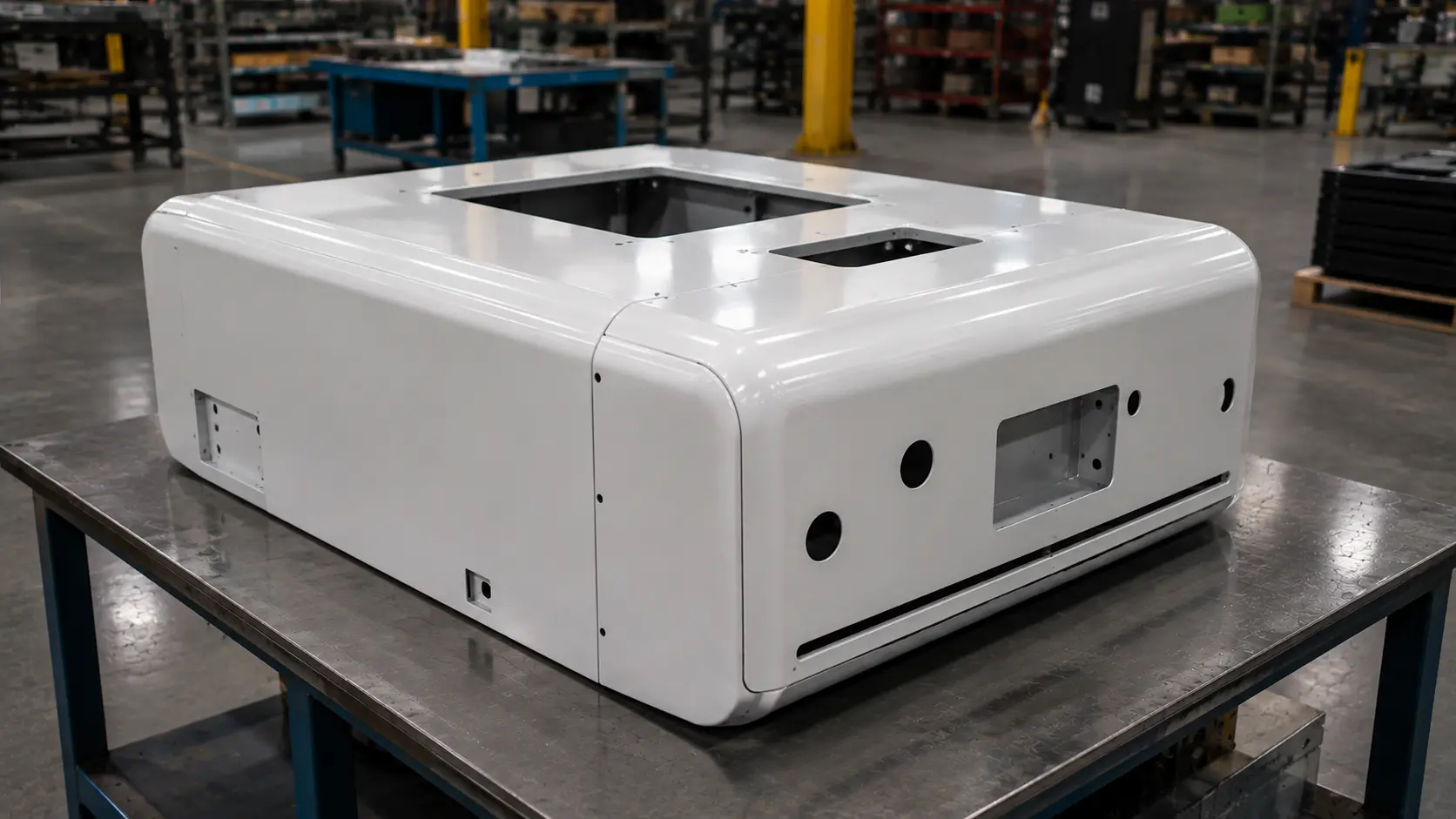
From precision guide rails and robot chassis to conveyor frames, safety guarding, electrical enclosures, and integrated assemblies, EVS Metal manufactures the custom sheet metal components behind today’s warehouse automation systems. With in-house fabrication, machining, welding, finishing, and assembly under one roof, we help OEMs reduce lead times, simplify supply chains, and scale production with confidence.

Guide Rails & Lift Frames
Precision-machined tracks and elevator-style lift frames that carry stacker cranes and robotic shuttles through AS/RS systems — where rail accuracy is system reliability.

Conveyor Frames & Supports
Large-scale fabrication of side rails, support legs, and structural members — formed and welded to print, produced at the run lengths conveyor programs demand.
Chutes, Diverters & Sortation Components
Complex-formed sheet metal, often stainless, that guides and diverts packages to their lanes — smooth surfaces and deburred edges that protect what they carry.

Robot Chassis & Frames
Custom-welded aluminum and steel frames forming the structural body of AGVs and AMRs — fixtured for repeatability across production quantities.

Grippers & End-Effectors
Lightweight CNC-machined aluminum plates and suction manifold blocks — precision components where weight and accuracy both matter.

Exterior Skins & Covers
Cosmetic sheet metal skins that protect internal electronics and define the finished product — powder coated in-house for a uniform, brand-matched appearance.

Docking & Charging Stations
Charging bases and alignment targets fabricated to spec — the fixed infrastructure your mobile fleet returns to, built to hold its geometry.

Machine Guarding & Safety Components
Perimeter guarding, fixed guards, and mounting components for automated cells — fabricated flat-pack or welded, finished to survive the floor.

Hardware-Inserted Components
PEM fasteners, standoffs, and captive hardware installed to print on 33 insertion presses — parts that arrive assembly-ready.

Powder Coated Parts
In-house powder coating in standard and custom colors — applied in the same facility that formed the metal, for finish quality that survives installation and service.

Integrated & Custom Assemblies
Multi-component assemblies built, hardware-installed, and packaged deployment-ready — including one-off and custom infrastructure parts engineered from your CAD data.

Control Consoles & Enclosures
Operator consoles, HMI enclosures, and electrical enclosures for automation lines — ventilated or sealed, with doors, locks, and cutouts to spec.


Built for How Warehouse Automation Projects Actually Run
Integrator schedules don't wait
When an automation system ships, every bracket, guard, and frame ships with it. Four U.S. facilities mean capacity near your project, domestic logistics instead of ocean freight, and output that scales when a deployment accelerates.
Hundreds of parts, one spec
Automation programs run on repeatability. The five hundredth guide rail has to fit like the first. CNC fabrication, fixtured welding, and ISO 9001-registered process control make consistency a system rather than a hope.
Finish that survives the floor
Warehouse equipment gets bumped, cleaned, and serviced for years. In-house powder coating delivers a durable, uniform finish, applied in the same facility that formed the metal.
Designs that keep evolving
New end-effectors, revised chassis, mid-program updates. In-house engineering works from your CAD data, flags manufacturability issues early, and turns revisions around in days.
351,000
sq ft of U.S. manufacturing capacity
Every Capability, Under One Roof
The full process chain a warehouse automation program needs — backed by in-house engineering that works from your CAD data and turns revisions around in days.

Metal Fabrication

CNC Machining

Welding

Finishing

Assembly / Integration

Engineering
Standards That Matter Here
ISO 9001:2015
Registered quality management across all four facilities — on high-volume programs, documented process control makes consistency a system rather than a hope.
Dock-to-Stock Capability
Parts that go from receiving directly into production, no incoming inspection — a step removed from your critical path.
Recognized Among North America’s Top Fabricators
EVS has appeared on The Fabricator’s Fab 40 list of the top sheet metal fabricators in North America for 17 consecutive years — a track record built on long-term production partnerships, not one-off jobs.
Four U.S. Facilities
351,000+ sq ft of combined manufacturing capacity — production near your project, redundancy in your supply chain.
Warehouse & Automation Fabrication FAQ
What warehouse automation components does EVS Metal fabricate?
EVS Metal manufactures precision sheet metal components and assemblies for warehouse automation systems, including guide rails and lift frames for AS/RS systems, conveyor frames and supports, chutes, diverters, sortation components, robot chassis, exterior skins, grippers, electrical enclosures, docking stations, machine guarding, and integrated assemblies. We support everything from individual fabricated parts to welded, hardware-installed, powder-coated assemblies ready for final integration into automated material handling systems.
How does EVS support warehouse automation programs from prototype through production?
Warehouse automation products often evolve through multiple engineering iterations before reaching full-scale production. EVS supports the entire product lifecycle, from prototype fabrication and design refinement through pilot builds and repeatable production, helping OEMs maintain consistent quality, documentation, and manufacturing processes as programs grow.
What tolerances are typical for warehouse automation components?
Tolerance requirements depend on each component’s function and application. Alignment-critical parts such as guide rails, lift frames, and robot mounting features often require tighter tolerances than cosmetic covers or general structural components. During design review, EVS works with customers to apply tolerances that balance fit, function, manufacturability, and cost while helping ensure reliable system performance.
How does EVS approach design for manufacturability (DFM)?
EVS works with customers early in the design process through a collaborative design for manufacturability (DFM) review, identifying opportunities to simplify fabrication, improve assembly, optimize material selection, apply appropriate tolerances, and reduce overall manufacturing costs. Addressing manufacturability before production begins often shortens lead times, improves quality, minimizes engineering revisions, and helps products move more efficiently from prototype into production.
Which manufacturing processes are performed in-house?
EVS offers integrated manufacturing capabilities including laser cutting, CNC punching, precision forming, CNC machining, welding, hardware insertion, powder coating, screen printing, assembly, and quality inspection. Keeping these processes under one roof helps improve quality control, reduce lead times, simplify project management, and deliver finished components ready for installation.
What production volumes can EVS support?
EVS supports programs ranging from prototype quantities and low-volume production to high-volume manufacturing. With four manufacturing facilities, more than 351,000 square feet of production space, and integrated fabrication, machining, finishing, and assembly capabilities, we have the capacity to grow alongside our customers as automation programs expand.
What other industries does EVS serve that require similar manufacturing capabilities?
Many of the manufacturing capabilities used to produce warehouse automation equipment also support kiosk manufacturing and data center infrastructure, medical equipment, industrial machinery, transportation, electronics, and other OEM industries. These markets share similar requirements for precision fabrication, repeatable quality, scalable production, and integrated assembly, allowing EVS to apply the same engineering and manufacturing expertise across a wide range of complex products.