

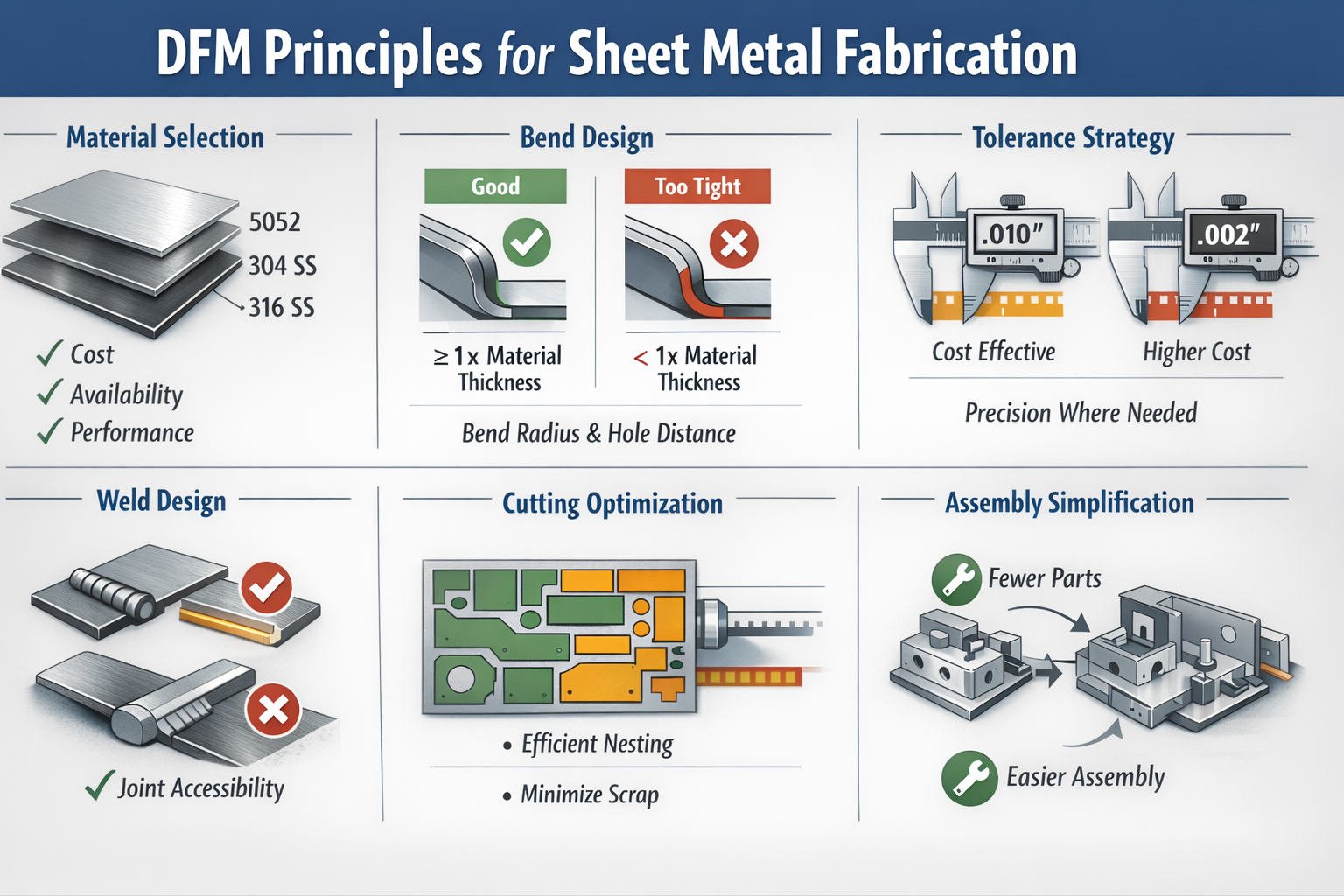
 Design for manufacturability (DFM) represents more than a checklist of manufacturing constraints. Effective DFM is a systematic approach to product design that considers manufacturing realities from the earliest concept stages, balancing functional requirements, cost targets, quality objectives, and production feasibility.
For precision sheet metal components and assemblies, DFM principles directly impact piece cost, lead time, quality consistency, and assembly efficiency. After three decades of manufacturing complex sheet metal assemblies—and reviewing thousands of designs through our DFM process—EVS Metal has observed that design decisions made early in development have exponentially greater cost impact than optimization efforts during production.
This guide examines practical DFM principles specific to sheet metal fabrication, with particular focus on design decisions that significantly affect manufacturing cost and quality.
Why DFM Matters: The Cost Amplification of Design Decisions
A design issue discovered during the concept phase costs essentially nothing to fix—it’s a CAD file modification. The same issue discovered during first article inspection might cost hundreds of dollars in scrapped material and engineering time. Discovered during production, it could cost thousands in rework, schedule delays, and customer relationship impact.
DFM frontloads this problem-solving to when changes are cheapest and fastest.
Common cost impacts from inadequate DFM:
- Unnecessarily tight tolerances requiring additional operations or slower processes
- Material selection that increases cost without improving function
- Bend sequences that require multiple setups instead of efficient single-setup forming
- Weld joint designs that slow production or compromise quality
- Features that complicate assembly or require specialized fixturing
- Finish requirements that necessitate additional masking, rework, or touch-up
These aren’t theoretical concerns—they represent the most common design-driven cost issues we encounter in manufacturing. Many of the most expensive fabrication problems stem from a small set of recurring design mistakes—unnecessarily tight tolerances applied uniformly, holes placed too close to bend lines, weld joints in inaccessible locations, and premium materials specified without functional justification. We’ll examine specific corrections for these common issues later in this guide, but first it’s important to understand how design decisions interact with manufacturing processes to create these costs.
Material Selection: Balancing Performance, Availability, and Cost
Material choice represents one of the earliest and most consequential design decisions.
Understanding material cost drivers:
Raw material pricing varies significantly by alloy, temper, and availability. For example, 5052-H32 aluminum costs roughly 30% more than 6061-T6 aluminum, despite both being common structural alloys. 304 stainless steel typically costs 40–50% more than cold-rolled steel. 316 stainless steel adds another 30–40% premium over 304.
These differences compound across production volumes. A $50 material cost difference per unit becomes $50,000 over 1,000 units—often far exceeding the cost of engineering time to optimize material selection.
When premium materials make sense:
Corrosion resistance, strength-to-weight requirements, electrical conductivity, thermal properties, or aesthetic considerations may justify premium materials. The question isn’t whether to use expensive materials when they’re required—it’s whether they’re actually required for the application. These tradeoffs are especially important for data center infrastructure, where enclosure panels, structural frames, and support components must balance strength, corrosion resistance, weight, and long-term durability without adding unnecessary cost.
Engineers sometimes default to 316 stainless when 304 would perform adequately, or specify 6061-T6 aluminum when 5052-H32 would meet structural requirements at lower cost. These decisions often result from conservative design or inadequate analysis of actual service conditions.
Material availability and lead time:
Standard alloys in common thicknesses (.060″, .090″, .125″, .250″ in aluminum; 16ga, 14ga, 11ga, 10ga in steel) ship from metal suppliers within days. Non-standard thicknesses or specialty alloys may require 4–6 weeks lead time and minimum order quantities that drive up cost.
Designing to standard material thicknesses—when functional requirements allow—significantly reduces cost and lead time. Understanding the differences between welding aluminum vs. steel or ferrous vs. non-ferrous material properties helps engineers make informed tradeoffs.
Designing for Laser Cutting and Turret Punching
Cutting represents the first operation for most sheet metal parts. Design decisions here affect both cost and quality.
Laser cutting considerations:
Kerf width and feature spacing: Laser cutting removes material through a kerf (cut width) typically .010″–.020″ depending on material thickness. Features spaced too closely may be difficult or impossible to cut reliably. Minimum spacing between features should be at least 1.5× material thickness.
Corner radii vs. sharp corners: Laser cutting naturally produces a small radius in inside corners (typically .010″–.030″). Specifying true sharp corners (zero radius) either requires secondary operations like wire EDM or acceptance of the natural laser radius. If function allows, calling out .030″ or larger radii eliminates ambiguity and potential cost.
Piercing considerations: Each hole or internal feature requires the laser to pierce through the material before cutting. Parts with hundreds of small holes take significantly longer to cut than parts with fewer, larger features. Consolidating or eliminating unnecessary holes can reduce cycle time substantially.
Nesting efficiency: Parts are nested (arranged) on sheet metal to minimize scrap. Irregular shapes nest less efficiently than rectangular or simple geometric shapes. While part shape should follow function, understanding that complex contours increase material waste helps inform design tradeoffs.
Turret punching advantages and limitations:
Turret punching can be faster than laser cutting for parts with many repetitive features (holes, slots, louvers). However, turret punching is limited to features for which tooling exists. Custom tools can be manufactured but add cost and lead time. Parts designed around standard punch tooling (common hole sizes, standard slot dimensions) can often be produced faster and cheaper than laser-cut equivalents. However, parts requiring complex contours or many unique features generally favor laser cutting.
Forming and Bending: Design Rules That Affect Manufacturability
Sheet metal forming creates three-dimensional parts from flat material. Several design factors significantly impact forming cost and quality.
Bend radius fundamentals:
Minimum bend radius relates directly to material thickness and properties. As a general rule, minimum inside bend radius should be at least 1× material thickness for soft materials (aluminum, cold-rolled steel) and 1.5–2× material thickness for harder materials (stainless steel, spring steel). Specifying bend radii tighter than material can reliably achieve causes cracking, surface damage, or inconsistent angles. Specifying bend radii larger than necessary increases cost by requiring special tooling or multiple forming operations.
Bend relief and corner treatments:
When bends intersect or terminate near edges, bend relief (small slots or holes) prevents material tearing and distortion. Without adequate bend relief, bending forces concentrate at corners and can crack material or distort part geometry. Standard bend relief designs follow simple rules: relief depth should be at least 1× material thickness + bend radius, and relief width should be at least 1.5× material thickness. Parts designed without bend relief may require secondary operations to add relief features, increasing cost.
Hole to bend edge distance:
Holes located too close to bend lines can distort during forming. As a general rule, hole edge should be at least 2.5× material thickness + bend radius from bend centerline. Holes closer than this may require post-forming operations or specialized tooling.
Bend sequence and accessibility:
Complex parts with multiple bends must be formed in sequence. Some bend sequences require multiple setups, flipping the part, or specialized tooling. Parts designed with bend accessibility in mind can often be formed in a single setup, significantly reducing cost. The most efficient parts allow all bends to be formed working from one side without tooling interference. Parts requiring bends from multiple directions, or bends that create enclosed spaces preventing tool access, increase forming cost.
Hemming and edge treatment:
Hemmed edges (material folded back on itself) provide stiffness, eliminate sharp edges, and create finished appearance. However, hemming adds operations and constrains design. Hem designs should account for material springback and thickness. A standard hem requires approximately 2.5× material thickness for the return plus bend radius.
Tolerance Rationalization: Applying Precision Only Where Required
Tolerances directly impact manufacturing cost. Tighter tolerances require slower processes, additional inspection, potential secondary operations, and higher scrap rates.
Standard vs. precision tolerances:
Industry-standard tolerances for sheet metal fabrication typically range from ±.010″ to ±.030″ depending on process and feature type. These tolerances can be held reliably without special attention or secondary operations. Tolerances tighter than ±.005″ generally require secondary operations (precision machining, grinding), significantly increasing cost. Tolerances of ±.001″ or tighter may require multiple operations and specialized equipment.
The cost difference is substantial. A feature held to ±.010″ might cost $X. The same feature held to ±.005″ might cost 2–3× more. At ±.001″, cost could be 5–10× higher.
Where to apply tight tolerances:
Tight tolerances should be applied to:
- Mating features requiring precise fit
- Mounting holes aligning with mating parts
- Critical functional dimensions affecting performance
- Features requiring interchangeability across production runs
Tight tolerances should NOT be applied to:
- Overall part dimensions where function is unaffected
- Features with clearance fit (excess precision provides no value)
- Cosmetic features
- Dimensions already constrained by other toleranced features
Geometric dimensioning and tolerancing (GD&T):
GD&T provides more precise communication of design intent than coordinate dimensioning alone. Proper GD&T application can reduce manufacturing cost by allowing looser tolerances on non-critical features while tightening only critical characteristics. For example, specifying position tolerance for a bolt pattern is often more meaningful and manufacturable than specifying tight coordinate tolerances on individual hole locations. Understanding the art of designing products for manufacturing includes effective tolerance strategy.
Welding and Joining Design Considerations
Weld joint design significantly affects manufacturing cost, quality, and strength.
Joint accessibility:
Welders and welding equipment need physical access to joints. Inside corners, deep recesses, and enclosed spaces create welding challenges. Parts designed with weld joint accessibility in mind can often be welded faster, with better quality, and lower cost. Robotic welding systems provide excellent consistency and quality but require consistent joint access and positioning. Parts designed for robotic welding benefit from uniform joint types, consistent fit-up, and accessible weld locations.
Joint types and preparation:
Different weld joint types (butt, lap, corner, edge, tee) require different preparation and have different strength characteristics. Joint selection should balance strength requirements, manufacturing cost, and assembly constraints. Butt joints generally require more precise edge preparation and fit-up than lap joints, but may provide better appearance and strength in thin materials. Lap joints are more forgiving of fit-up variation but may create crevices where corrosion can initiate.
Weld distortion management:
Welding introduces heat that causes material expansion, contraction, and distortion. Parts with long, continuous welds perpendicular to high-stiffness features tend to distort more than parts with intermittent welds or welds parallel to stiff features.
Design strategies to minimize distortion include:
- Intermittent welds (when strength allows) rather than continuous welds
- Balanced weld patterns that distribute heat evenly
- Weld sequences that allow stress relief between operations
- Stiffening features that resist distortion forces
Parts requiring welding after forming benefit from consideration of distortion during weld planning. Some parts may require post-weld stress relief or flattening operations to meet flatness specifications.
Hardware insertion and fastening:
PEM fasteners (studs, nuts, standoffs) and other pressed-in hardware provide strong, reliable attachment points without threading or welding. However, hardware insertion requires access and clearance.
Design considerations include:
- Material thickness adequate for hardware retention (typically 2× hardware shank diameter minimum)
- Clearance behind insertion location for installation tooling
- Spacing between hardware adequate for installation equipment
- Hole diameter specifications matching hardware requirements
Finishing and Coating Design Impacts
Surface finishing and coating requirements significantly affect manufacturing processes and cost.
Powder coating design considerations:
Powder coating provides durable, attractive finish at reasonable cost. However, several design factors affect powder coating success:
Faraday cage effect: Inside corners, deep recesses, and enclosed spaces are difficult to coat uniformly because powder particles follow electric field lines and may not penetrate restricted areas. Parts with many inside corners or deep pockets may require liquid coating instead of powder coating, increasing cost.
Hole and thread masking: Holes requiring precise dimensions or threads requiring functionality must be masked during coating, adding labor cost. Minimizing the number of features requiring masking reduces finishing cost. When possible, specifying that holes will be drilled or threads tapped after coating eliminates masking requirements.
Edge coverage: Sharp edges don’t hold coating as well as radiused edges. Specifying edge breaks or radii (typically .015″–.030″) on exposed edges improves coating adhesion and appearance.
Coating thickness: Standard powder coating thickness is typically 2–3 mils. Tighter dimensional requirements may require thinner coatings or pre-coating machining to account for coating thickness buildup.
For detailed information on coating options and their design implications, see our comparison of metal finishes and applications and the benefits of in-house powder coating.
Surface preparation and finish:
Different applications require different surface finishes. Mill finish (as-fabricated) is least expensive. Deburring, grinding, and polishing add cost proportional to surface area and finish quality required.
Design specifications should match finish requirements to actual needs:
- Structural components hidden in assembly: mill finish or basic deburring
- Visible components: deburring plus surface treatment (powder coating, anodizing)
- High-visibility aesthetic parts: grinding or polishing plus premium finish
- Functional surfaces: specified surface roughness or flatness
Specifying finer finish than required increases cost without adding value.
Assembly Simplification Principles
Design decisions directly affect assembly cost and quality. Several principles reduce assembly time and improve consistency.
Part count reduction:
Every additional part in an assembly adds cost: material cost, fabrication cost, inventory cost, handling cost, and assembly labor. Designing to minimize part count—while maintaining functionality—reduces total assembly cost.
Techniques include:
- Combining multiple stamped parts into a single formed part
- Using bends and forms to create features rather than separate fastened parts
- Integrating mounting features into structural parts rather than adding separate brackets
These principles are particularly important for products such as conveyors, robotic platforms, guarding, and other warehouse automation equipment, where reducing part count and simplifying assembly can significantly improve production efficiency.
Fastener accessibility and consistency:
Assemblies requiring many different fastener types, sizes, or installation methods increase assembly time and create opportunities for errors. Standardizing on fewer fastener types simplifies assembly and inventory. Fastener accessibility affects assembly time significantly. Fasteners requiring difficult access (reaching into enclosed spaces, aligning through multiple parts) take longer to install than easily accessed fasteners.
Self-locating features:
Features that provide positive location during assembly—pins, tabs, slots, reference surfaces—reduce assembly time and improve consistency by eliminating alignment uncertainty. Without self-locating features, assemblers must manually position and hold parts while installing fasteners, slowing assembly and introducing position variation.
Assembly sequence planning:
Some assemblies can only be built in one sequence. Others allow multiple sequences with very different assembly times. Designing with assembly sequence in mind—ensuring critical features can be accessed throughout the assembly process—reduces build time. Assemblies requiring disassembly and reassembly to access internal fasteners or adjust components significantly increase manufacturing cost. Our guide to design for assembly provides detailed principles.
The DFM Review Process: Collaboration Between Design and Manufacturing
Effective DFM happens through structured collaboration between design engineers who understand product requirements and manufacturing engineers who understand production realities.
Early-stage DFM review:
During concept and early design phases, DFM review focuses on major decisions with largest cost impact:
- Material selection and justification
- Overall part configuration and assembly strategy
- Manufacturing process selection (fabrication, machining, casting, etc.)
- Critical tolerance requirements and their functional justification
- Finish requirements and their drivers
Early-stage feedback can redirect design approaches before significant engineering time is invested.
Detailed DFM review:
Once design concepts are established, detailed DFM review examines specific features and dimensions:
- Bend radii, relief features, and forming sequence
- Hole sizes, locations, and tolerances
- Weld joint types and accessibility
- Hardware specifications and installation clearances
- Coating requirements and masking needs
- Assembly sequence and fixturing requirements
Detailed review identifies specific design modifications that reduce cost while maintaining function.
Iterative refinement:
DFM is iterative. Initial designs rarely achieve optimal manufacturability without refinement. Effective DFM processes include multiple review cycles as designs mature, with each cycle identifying further optimization opportunities. Companies that implement systematic DFM review processes typically achieve 15–30% cost reduction compared to designs that go directly to production without manufacturing input.
Common DFM Mistakes and Their Corrections
Certain design mistakes appear repeatedly in sheet metal designs. Recognizing these patterns accelerates DFM learning.
Mistake: Unnecessarily tight tolerances throughout
Correction: Apply ±.010″ standard tolerance as default. Specify tighter tolerances only on specific features where function requires it.
Mistake: Sharp inside corners on formed parts
Correction: Specify .030″ or larger radius on inside bends unless zero radius is functionally required.
Mistake: Holes too close to bend lines
Correction: Maintain 2.5× material thickness + bend radius minimum from hole edge to bend centerline.
Mistake: Weld joints in inaccessible locations
Correction: Design parts so weld joints are accessible from outside of assembly.
Mistake: Many different fastener types in one assembly
Correction: Standardize on 2–3 fastener types unless specific function requires variety.
Mistake: Specifying premium material without functional justification
Correction: Default to common alloys (6061-T6 aluminum, 304 stainless, cold-rolled steel) unless performance requirements drive premium material selection.
Mistake: Features requiring extensive masking during coating
Correction: Specify post-coating drilling/tapping when possible, or redesign to minimize masked features.
Additional guidance on avoiding common mistakes can be found in our tips to achieve better yield and lower costs.
DFM as Competitive Advantage
 Companies that implement effective DFM processes achieve several competitive advantages:
- Lower manufacturing cost enables competitive pricing or higher margins
- Faster time to market results from fewer design iterations and faster production ramp
- Better product quality emerges from designs optimized for consistent manufacturing
- Stronger supplier relationships develop when design and manufacturing teams collaborate effectively
DFM isn’t simply a cost-reduction exercise—it’s a systematic approach to creating products that perform well, cost less to manufacture, and can be produced consistently at scale.
Implementing Effective DFM Processes
Organizations seeking to improve DFM capabilities should consider:
- Early manufacturing involvement: Include manufacturing engineers in design reviews from concept stage, not just before production release.
- DFM training for design engineers: Provide design engineers with manufacturing process training so they understand cost drivers and constraints.
- Structured review processes: Implement formal DFM review stages with documented feedback and design iteration.
- Supplier collaboration: Work with contract manufacturers like EVS Metal who have engineering teams capable of providing detailed DFM feedback. Our design for manufacturability review process provides detailed analysis and specific recommendations.
- Design guideline documentation: Develop internal design guidelines based on manufacturing capabilities and cost drivers specific to your products and supply chain.
- Continuous improvement: Track design-driven manufacturing issues and feed learning back into design guidelines and training.
Conclusion: DFM as Engineering Discipline
Design for manufacturability represents a crucial engineering discipline that directly impacts product cost, quality, and time to market. Effective DFM requires understanding manufacturing processes, cost drivers, and quality considerations—and systematically incorporating this knowledge into design decisions.
For precision sheet metal fabrication, specific attention to material selection, forming design, tolerance strategy, joining methods, finishing requirements, and assembly simplification provides substantial cost reduction opportunities while maintaining or improving product performance.
EVS Metal’s engineering team works with customers throughout the design process to provide detailed DFM feedback, identify cost reduction opportunities, and ensure designs can be manufactured consistently at the required quality level. This collaboration—backed by manufacturing experience across more than 250,000 square feet of integrated fabrication, machining, welding, and assembly capacity—helps customers bring better products to market faster and at lower cost.
For detailed DFM review of your designs, contact EVS Metal’s engineering team. Request a quote through our online portal or call (973) 839-4432.
About EVS Metal
EVS Metal is a precision contract manufacturer specializing in sheet metal fabrication, CNC machining, welding, finishing, and complex assembly for OEM customers across North America. With four ISO 9001:2015-certified facilities totaling more than 250,000 square feet, including an ITAR-registered Texas operation, EVS Metal supports programs ranging from quick-turn prototypes to high-volume production. Recognized for 16 consecutive years on The Fabricator’s FAB 40 list, EVS Metal serves customers in electronics, medical equipment, industrial automation, defense, and other demanding industries requiring precision, quality, and design collaboration.
DFM in Sheet Metal Fabrication FAQ
What is design for manufacturability (DFM) in sheet metal fabrication?
DFM is a structured approach to designing parts and assemblies so they can be produced consistently, cost-effectively, and at the required quality using real-world manufacturing processes.
When should DFM review happen?
As early as possible—ideally during concept and early CAD iterations—because design changes are cheapest before tooling, programming, and production release.
What are the most common DFM mistakes in sheet metal parts?
Common issues include overly tight tolerances everywhere, holes placed too close to bend lines, sharp inside corners, inaccessible weld joints, and material or finish specs that add cost without adding function.
How do tolerances affect fabrication cost?
Tighter tolerances can require slower processes, additional inspection, more scrap risk, and secondary operations. Applying precision only where function requires it typically reduces cost.
How close can holes be to a bend?
A common guideline is keeping the hole edge at least 2.5× material thickness + bend radius away from the bend centerline to reduce distortion risk.
What bend radius should I specify?
As a general rule, use at least 1× material thickness for softer materials and 1.5–2× thickness for harder materials like stainless, unless function requires otherwise.
How does part design affect powder coating results?
Deep recesses and inside corners can cause uneven coverage (Faraday cage effect). Threads/holes that must remain uncoated may require masking, increasing labor and cost.
What does EVS Metal’s DFM process include?
DFM typically covers material selection, bend feasibility, hole and feature placement, tolerance strategy, weld joint accessibility, hardware insertion planning, finish considerations, and assembly sequence impacts.