


Every fabrication quote includes a lead time, and every buyer plans around it. Production schedules, installation dates, customer commitments, and downstream assembly all get built on top of that one number — which makes it worth understanding where the number comes from. A quoted lead time is a forecast somebody constructed, and like any forecast, its reliability depends entirely on what went into it. Some dates are built from a real review of the drawings, the material market, and the shop’s actual schedule. Others are a guess dressed up as a commitment, and the difference usually doesn’t reveal itself until week six of a four-week promise.
What a Real Lead Time Estimate Accounts For
A trustworthy estimate starts with the drawings actually being reviewed. Project complexity drives everything downstream — the number of components, the tightness of tolerances, the processes involved, whether the job is a batch of flat brackets or a finished assembly with welding, hardware, coating, and integration. A fabricator can’t know how long a job takes without knowing what the job is, which sounds obvious until you receive a confident date from a shop that never asked a single question about the part.
Material is the second input, and the one most exposed to forces outside the shop’s walls. Standard gauges and common alloys may be on the floor already; specific finishes, unusual thicknesses, and specialty materials may need sourcing, and the metals market has spent recent years reminding everyone that “available” and “available now” are different claims. A real estimate distinguishes between material on hand, material on order with a confirmed date, and material someone still needs to go find — because the lead time inherits whichever of those is true.
Third is capacity: the shop’s actual queue, labor, and machine availability at the moment your job would enter it. This is the input buyers can’t see and the one most often fudged, because the honest answer — “our brake department is loaded for three weeks” — is commercially inconvenient. A fabricator quoting from a real production schedule knows where your job slots in. A fabricator quoting from hope does not.
Finally, a real estimate accounts for routing — the sequence the job moves through, because fabrication is a sequence and the steps are not interchangeable. Cutting, forming, machining, welding, hardware, finishing, and assembly each carry their own time, and the dependencies between them carry more: a finishing step that has to wait on hardware decisions, a weldment that needs fixturing before it can start, an assembly that can’t begin until coated parts cure. Shops that run finishing in-house are at least quoting their own schedule for that leg; a shop that outsources coating is quoting someone else’s queue, whether they say so or not.
Why Two Shops Quote Different Dates for the Same Part
Send the same drawing package to three fabricators and you may get three meaningfully different lead times. Sometimes that reflects real capability differences — more capacity, better material position, in-house processes instead of subcontracted ones. But often it reflects different assumptions: one shop reviewed the drawings and one didn’t, one priced in the finish requirements and one will discover them later, one quoted their actual queue and one quoted the queue they wish they had.
This is where the shortest date deserves the same skepticism as the lowest piece price: both are easy to promise and expensive to believe. An optimistic date functions as a sales tool right up until it becomes your schedule problem, and a missed delivery costs most buyers far more than the week or two of margin a realistic quote would have included. The useful comparison between quotes isn’t whose number is smallest — it’s whose number is explained.
Signs the Date Is a Guess
A few patterns reliably separate constructed estimates from confident guesses. A complex part quoted instantly, with no questions asked back, means nobody examined what makes it complex. A lead time that stays identical regardless of finish, hardware, or quantity means the date was never connected to the work. No mention of material — on hand, on order, or to be sourced — means the most volatile input was skipped. And a date offered without any stated assumptions or conditions is a date that can’t be held to anything, because nothing was defined for it to depend on.
None of these automatically means a shop is being dishonest. Sometimes it just means the estimate was casual — but your production schedule isn’t casual, so the standard for the date it’s built on shouldn’t be either.
How to Pressure-Test a Quoted Lead Time
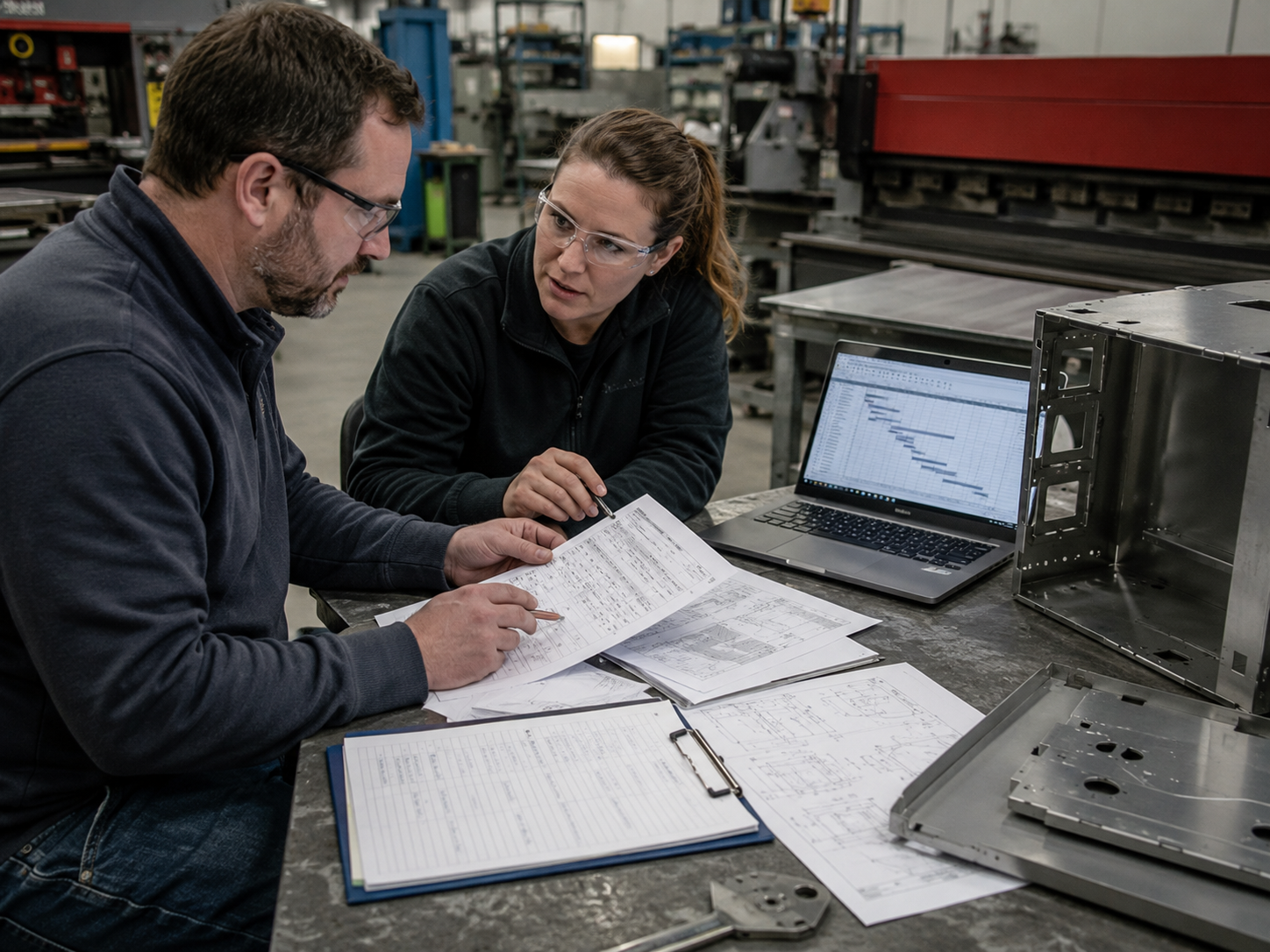 You don’t need to audit a fabricator’s scheduling system to test a date; a few direct questions do most of the work. What’s the longest leg of this job, and what drives it? Is the material on hand, on order, or to be sourced? Where does this job enter your queue, and what’s ahead of it? What assumptions is this date built on, and what would change it? A fabricator who built the estimate honestly answers those in a sentence each — and a fabricator who can’t is telling you something useful too. These questions belong in the same conversation as the rest of the RFQ diligence procurement should be doing, because a quote you can’t interrogate is a quote you can’t plan on.
It’s also worth remembering how much of the timeline was set before the RFQ ever went out. Design decisions drive lead time the same way they drive cost — material selection, tolerance choices, finish requirements, and hardware all add or remove days from every estimate any shop can give. The fastest schedule relief on many projects isn’t a faster fabricator; it’s a drawing revision.
Why Honest Dates Sometimes Slip Anyway
Even a well-constructed estimate is still a forecast. Material deliveries miss, revisions arrive mid-job, equipment goes down, another customer’s emergency lands in the queue. The difference between a good fabrication partner and a frustrating one isn’t that good partners never slip — it’s what happens next. A shop with real production visibility sees the slip coming and communicates it while there’s still time to react: resequencing operations, splitting a shipment, expediting a leg of the work. A shop that was guessing finds out when you do, which is to say, too late. Lead time reliability is ultimately a communication discipline as much as a scheduling one, and buyers should weigh it that way.
Lead Time Estimating at EVS Metal
EVS Metal builds lead time estimates from drawing review, material position, routing, and the actual production schedule across its facilities in New Jersey, Texas, Pennsylvania, and New Hampshire. With precision sheet metal fabrication, CNC machining, welding, finishing, and assembly operating under one production system, more of the core production path is quoted from EVS’s own schedule rather than dependent on outside queues — and the multi-facility footprint provides capacity flexibility when programs scale or timelines compress.
To discuss timeline requirements for an upcoming project, request a quote or contact the EVS facility best suited to support your program.
Frequently Asked Questions
How long does sheet metal fabrication take? It depends on the part and the shop’s current position. Simple parts in common materials may move quickly, while finished assemblies involving welding, hardware, coating, and integration take longer. The honest answer comes from a real estimate built on the specific drawings, material availability, and the fabricator’s actual production schedule.
Why do fabrication lead times differ between shops? Quoted lead times reflect both real differences — capacity, material position, in-house versus subcontracted processes — and different levels of estimating rigor. One shop may quote from a reviewed drawing package and an actual production schedule, while another quotes optimistically without examining the job. The most useful quote is the one whose date can be explained.
What affects fabrication lead time the most? The biggest drivers are project complexity, material availability, the fabricator’s current capacity and queue, and the routing sequence the job requires — including finishing, hardware, and assembly steps. Design decisions such as material selection, tolerances, and finish requirements also shape the timeline before any shop quotes it.
How can I get a more reliable lead time estimate? Provide complete information — drawings, materials, finish requirements, quantities, and real deadlines — and ask what the date is built on: the longest leg of the job, material status, queue position, and the assumptions behind the estimate. A fabricator who constructed the date honestly can answer those questions directly.
Why do fabrication lead times slip? Even good estimates are forecasts. Material deliveries, mid-job revisions, equipment issues, and queue changes can all move a date. The meaningful difference between fabricators is whether they see slips coming and communicate early enough for the customer to react.
Does EVS Metal provide lead time estimates? Yes. EVS Metal provides lead time estimates based on drawing review, material availability, routing requirements, and actual production schedules across its four U.S. facilities, with fabrication, machining, welding, finishing, and assembly coordinated under one production system.