

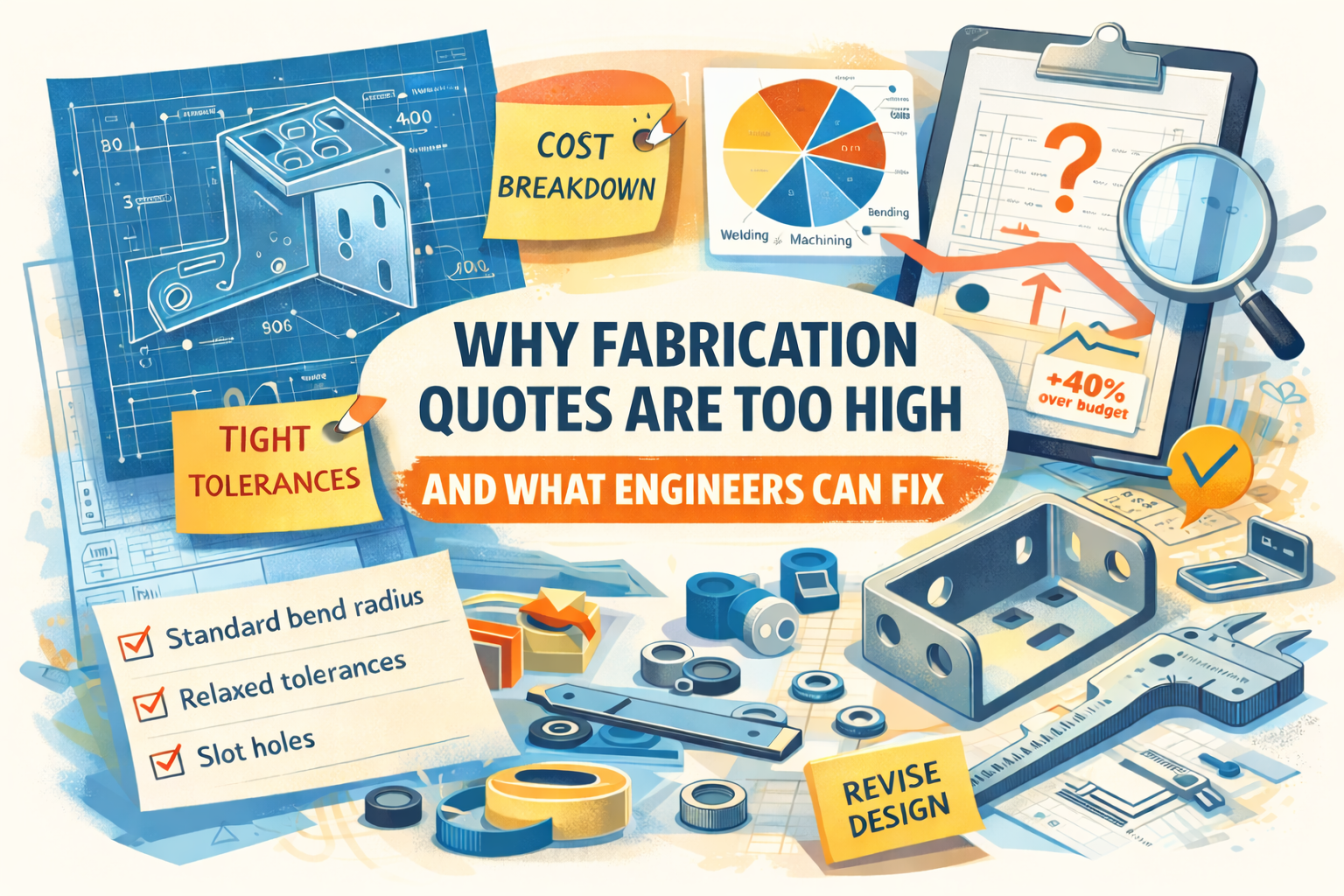
 The design review is complete. Drawings are released. Procurement sends the package to three qualified fabricators. And then the quotes come back 30-40% higher than budget.
This scenario plays out thousands of times across engineering organizations: a part that seemed straightforward to design proves expensive to manufacture. The project manager asks if anything can be changed. The schedule pressure is real. And the engineer faces an uncomfortable question: which design decisions are driving cost, and what can realistically be modified before first article?
Understanding why precision sheet metal fabrication quotes exceed expectations—and what’s still negotiable versus what requires fundamental redesign—lets engineers respond to quote shock effectively without restarting the design.
Quote Shock Quick Scan
Before diving into detailed cost analysis, run this rapid diagnostic on your drawings:
- ☐ Title block tolerances tighter than ±0.010″?
- ☐ Any custom bend radii called out?
- ☐ Holes within 3× material thickness of bend lines?
- ☐ Welds inside closed corners or tight spaces?
- ☐ Masking required for threads, precision surfaces, or contacts?
- ☐ Custom finish or color callouts?
- ☐ Non-standard material, thickness, or finish specifications?
- ☐ Inspection or documentation requirements (FAI, CMM reports, cert packages)?
If you checked three or more boxes, you’re often looking at premium operations, custom tooling, or added risk pricing.
This guide explains how to diagnose cost drivers in released designs, which modifications deliver meaningful savings without major rework, and how to have productive cost-reduction conversations with fabricators when quotes exceed budget.
The 5 Red Flags Fabricators Price Immediately
When fabricators review drawings and calculate quotes, specific features trigger cost premiums before they even run detailed estimates. These aren’t defects—they’re design choices with predictable manufacturing implications. If you see these features in your drawings, expect premium operations, added inspection, or custom tooling.
Note: Actual cost impact varies by material, volume, and fabrication method.
Red Flag 1: Blanket Tight Tolerances Applied Across All Dimensions
If you see this on your drawings:
Title block defaults set to ±0.005″ or tighter on every dimension, or GD&T callouts specifying tight positional tolerances on features that don’t interface with other components.
Expect this cost impact:
Fabricators will assume secondary machining operations after primary fabrication, CMM inspection instead of hand tool verification, and fixture-based manufacturing instead of standard tooling. Even if some of these tight tolerances are achievable with primary processes, fabricators price the risk of holding them consistently.
Typical cost multiplier can be 1.25–1.40× compared to parts with rationalized tolerances.
The diagnosis question:
“Which dimensions on this part actually require ±0.005″ to maintain assembly function or performance?”
Often, the majority of callouts can be relaxed to standard fabrication capability without affecting function.
Fastest fix: Revise title block defaults and call out tight tolerances only on critical interfaces (drawing revision only).
Red Flag 2: Non-Standard Bend Radii Specified
If you see this on your drawings:
Inside bend radii called out as tighter than material thickness, or bend radius notes like “R.030 MAX” when forming 0.060″ material.
Expect this cost impact:
Fabricators will quote custom die sets or coining operations. Standard press brake tooling produces inside radius approximately equal to material thickness—anything tighter requires specialized tooling that’s manufactured specifically for your part.
Typical cost impact: $500–2,000 for custom tooling plus 1.3–1.5× forming labor cost per part.
The diagnosis question:
“Is this tight radius driven by clearance requirements, or could we use standard tooling radius without compromising function?”
If the model was built with a tight radius that wasn’t tied to a functional requirement, standard radius will likely work fine and eliminate custom tooling cost.
Fastest fix: Replace radius callout with “standard tooling radius per fabricator” and verify clearance in CAD (requires CAD edit + clearance check).
Red Flag 3: Holes Located in the Bend Distortion Zone
If you see this on your drawings:
Holes positioned within 3× material thickness of any bend line, or hole patterns that cross multiple bends.
Expect this cost impact:
Metal stretches and compresses during bending, moving holes out of position. If tolerances on those holes are tight, fabricators must drill them after forming rather than before—adding secondary operations, fixturing, and setup time.
Post-forming drilling often adds several dollars per hole, and can compound quickly across multiple features.
The diagnosis question:
“How many holes are in the distortion zone, and what tolerance do we actually need on them?”
If holes are for clearance rather than precision mounting, fabricators can often laser-cut them before forming and accept slight distortion. If they’re precision mounting holes, post-forming drilling is unavoidable—but you’ll at least understand why the quote is higher.
Fastest fix: Slot holes for adjustment tolerance, or move holes outside distortion zone if assembly interfaces allow (CAD edit required). If interface-locked, accept post-form drilling cost.
Red Flag 4: Welds Requiring Manual Access
If you see this on your drawings:
Weld joints inside tight corners, welds requiring torch access from multiple angles, or assemblies where subcomponents must be welded, repositioned, and welded again from different orientations.
Expect this cost impact:
Robotic welding costs significantly less than manual welding. But robots need straight-line access to weld joints and consistent part positioning. If your design forces manual welding, expect premium labor rates and longer cycle times.
Typical cost multiplier can be 1.4–1.6× for assemblies requiring manual welding versus robotic welding.
The diagnosis question:
“Which welds are driving manual operations, and what would need to change to enable robotic welding?”
Sometimes the answer is “nothing can change without complete redesign.” But often, small modifications—access holes in non-structural areas, joint type changes, or weld sequence adjustments—can shift operations from manual to robotic.
Fastest fix: Change weld specification (continuous to intermittent, full-penetration to fillet) before considering geometry changes (drawing revision if geometry allows access; CAD edit if access is the problem).
Red Flag 5: Finishing Specifications Requiring Extensive Masking
If you see this on your drawings:
Powder coating notes requiring threaded holes, precision surfaces, or electrical contacts to be masked before coating. Or custom color specifications with RAL or Pantone callouts that don’t match fabricator standard colors.
Expect this cost impact:
Masking is manual labor—someone must apply tape or plugs to every feature requiring protection, then remove them after coating. Custom colors require formulation, testing, and inventory management that standard colors avoid.
Masking often adds meaningful per-part labor cost, especially on complex geometries. Custom colors add setup cost plus ongoing premium pricing.
The diagnosis question:
“Can any of these masked features be processed after coating instead of protected during coating? And would a standard color from your inventory meet our aesthetic requirements?”
Often, threaded holes can be tapped post-coating, and “charcoal gray” from stock looks identical to the custom RAL specification once installed in the product.
Fastest fix: Tap threads after coating; consolidate masked features to one side of the part; switch to fabricator stock color (drawing revision only).
What’s Still Fixable (and What Isn’t): Post-Release Triage
Not all cost-driving features are equally negotiable once drawings are released. This framework helps engineers prioritize modifications based on what’s actually feasible under schedule pressure.
Changes Requiring Only Drawing Revisions (Fastest ROI)
These modifications can reduce cost meaningfully and require only PDF updates, not CAD rework:
Tolerance rationalization
Review every dimension and identify which tolerances are functionally critical versus conservatively tight. Relaxing non-critical dimensions to ±0.010″ (cut features) or ±0.030″ (formed features) is the highest-impact change available post-release.
- Engineering effort: Hours, not days (drawing revision)
- Cost reduction: Can be substantial on parts with blanket tight tolerances
- Schedule impact: Minimal (ECO/doc revision only)
Finishing specification adjustments
Switch from custom color to fabricator standard colors, eliminate masking by specifying post-coating operations for threaded features, or reduce surface finish callouts on non-visible surfaces.
- Engineering effort: Light drawing revision
- Cost reduction: Often meaningful in finishing operations
- Schedule impact: Minimal (ECO/doc revision only)
Weld callout optimization (when geometry allows access)
Change continuous welds to intermittent welds (specifying length and spacing) where structural analysis supports it, or modify full-penetration weld callouts to fillet welds if load requirements allow. If the cost driver is weld access or fixturing rather than specification, this becomes a CAD change requiring geometry modifications.
- Engineering effort: Half-day for structural review
- Cost reduction: Can significantly impact welding operations
- Schedule impact: Minimal (doc revision only, if geometry isn’t the issue)
Changes Requiring CAD Model Edits (Moderate Effort)
These modifications require reopening CAD files and making geometry changes, but don’t cascade into other components:
Bend radius standardization
Replace custom radius callouts with “standard radius per tooling” notes. Requires clearance verification to confirm standard radius doesn’t create interference.
- Engineering effort: Several hours for CAD updates and clearance checking
- Cost reduction: Eliminates custom tooling plus reduces forming operations
- Schedule impact: Days for CAD revision and drawing re-release
Hole repositioning
Move holes outside the bend distortion zone (minimum 3× material thickness from bend centerline). Feasible only if new hole positions don’t affect assembly interfaces.
- Engineering effort: Several hours for CAD edits and assembly verification
- Cost reduction: Eliminates secondary drilling operations
- Schedule impact: Days for revision cycle
Hardware substitution
Replace custom-designed brackets or fastening features with commercial off-the-shelf hardware that performs the same function.
- Engineering effort: Several hours identifying alternatives and validating fit
- Cost reduction: Can be meaningful through eliminated custom fabrication
- Schedule impact: Days for sourcing and design validation
Changes That Cascade Into Mating Parts (High Risk)
These modifications affect other components in the assembly and may delay first article significantly:
Material substitution
Switching from stainless steel to coated carbon steel, or from 7075 to 6061 aluminum, reduces material cost but requires strength validation, corrosion testing, and potentially affects fastener selection, surface preparation, and finishing processes.
- Engineering effort: Weeks of analysis and testing
- Cost reduction: Can be substantial if substitution is viable
- Schedule risk: May require complete redesign if substitute doesn’t meet requirements
Envelope or mounting interface changes
Repositioning mounting holes, changing part outline dimensions, or modifying mating features to simplify fabrication affects every component that interfaces with the part.
- Engineering effort: Weeks of cascading updates across assembly
- Cost reduction: Potentially significant
- Schedule risk: Delays first article significantly
Manufacturing process changes
Switching from welded sheet metal fabrication to casting or machining fundamentally changes manufacturing strategy and requires process re-evaluation.
- Engineering effort: Weeks to months for process comparison and redesign
- Cost reduction: Highly variable—depends on volume and complexity
- Schedule risk: Essentially restarting the manufacturing planning process
Ask for the Cost Breakdown: The Conversation That Changes Everything
Most engineers receive a total quote number and immediately ask “Can you do better?” But the most effective cost-reduction conversations start with a different question: “What’s driving the cost?”
Request the Top Cost Buckets
Fabricators track labor and material cost across multiple operations. They know which processes dominate total cost. Asking for a breakdown doesn’t require proprietary pricing—just operational visibility:
“Can you share which operations are consuming the most labor cost?”
Typical categories:
- Cutting/punching time
- Forming setups and operations
- Welding labor (manual vs. robotic)
- Secondary machining operations
- Finishing (masking, coating, inspection)
- Hardware insertion or assembly
- Quality inspection and documentation
From the shop floor: In most quote reviews, 2–3 features account for most of the delta. If you eliminate one premium operation—custom tooling, post-form drilling, manual welding, or masking—you often recover a substantial portion of the overage.
Understanding that “welding is consuming most of the labor” versus “tight tolerances are driving secondary operations” focuses the engineering discussion on high-impact targets.
Clarify What “Expensive” Actually Means
Sometimes features aren’t expensive in absolute terms—they’re expensive relative to standard operations:
“Is this expensive because it’s slow, or because it requires specialized equipment?”
A weld that takes longer with manual labor costs more than a quick robotic operation, yet the manual weld might still be modest in absolute terms. Meanwhile, custom tooling for non-standard bends can add significant cost regardless of labor time.
Understanding whether cost is driven by labor intensity, custom tooling, material waste, or process risk helps engineers evaluate whether design changes are worth schedule impact.
Identify the Threshold: What Changes Cost vs. What Changes Price
Some modifications reduce actual manufacturing cost (fewer operations, less labor, cheaper materials). Others simply shift risk or timing without changing fabricator cost structure.
“If we make these changes, what’s the real cost reduction versus quote adjustment?”
This separates:
- Real cost reduction: Tolerance relaxation that eliminates CMM inspection saves actual labor cost
- Risk pricing adjustment: Tightening up geometric tolerancing that reduces scrap risk without changing process may reduce quote conservatism but not base cost
Both are valuable, but understanding the difference helps engineers and procurement evaluate tradeoffs.
What to Send Back With Your Revision
Once you’ve identified which changes to make, communicate them clearly to get accurate revised quotes:
- Updated drawing package (PDF) with revision cloud or markup highlighting what changed
- Brief summary note explaining modifications:
- “Relaxed tolerances on dimensions A, B, C to ±0.010″ (non-critical features)”
- “Changed bend radius callout to ‘standard tooling radius per fabricator'”
- “Modified finishing spec: tap threads post-coating, switched to stock charcoal gray”
Request for revised quote + cost delta summary showing before/after comparison
This documentation creates a clear record of what changed and why, preventing confusion during quote revision and establishing a baseline for future designs.
The Quote Review Meeting: Questions That Diagnose Cost
When quotes exceed budget, productive conversations focus on diagnosis rather than negotiation.
Questions That Reveal Cost Drivers
“Which three features on this design are driving cost most?”
This open-ended question lets fabricators identify expensive elements without defensive framing. You’ll often discover most of the cost premium comes from a small number of specific features.
“What would you change if this were your part to manufacture?”
Fabricators see hundreds of designs. They know which alternatives achieve functional requirements with reduced complexity. This question gives them permission to suggest modifications.
“What’s achievable with standard processes versus what requires custom operations?”
This identifies the line between routine fabrication and premium services—the primary target area for cost reduction.
“If we modified these tolerances [specific callouts], what’s the cost impact?”
Quantifying specific changes focuses discussion on actionable modifications rather than theoretical improvements.
What Not to Ask (and Why)
“Can you sharpen your pencil?”
This assumes fabricators padded quotes. Most quote actual manufacturing cost plus standard margins. Price negotiation without design changes rarely produces significant savings.
“Why didn’t you flag these issues during RFQ?”
Fabricators quote what’s specified. What procurement should ask during RFQs is important, but post-quote conversations should focus on solutions, not blame.
The Structured Cost-Reduction Process
- Fabricator identifies top cost drivers with approximate cost contribution for each
- Engineer evaluates feasibility: Which changes are drawing-only vs. CAD rework vs. cascading redesign?
- Both parties propose alternatives: Fabricator suggests process changes; engineer identifies design flexibility
- Cost impact is quantified: “If we make these changes, what’s the revised quote?”
- Trade-offs are assessed: Does the cost reduction justify design revision time?
This process often results in meaningful reductions, commonly in the double-digit percentage range, through targeted modifications without compromising function.
Prevention: Avoiding Quote Shock on the Next Design
Engineers who involve fabricators during design development rather than after release consistently achieve lower cost with zero schedule penalty. The same tolerance rationalization that takes time post-release happens faster during design phase and avoids quote iteration entirely.
For the proactive version of this playbook, see how engineers can reduce fabrication cost before first article. That guide covers how to prevent quote shock by building cost-awareness into the design phase. Understanding how design decisions drive cost, lead time, and risk during development prevents expensive surprises when quotes arrive.
The Diagnostic Mindset: Learning From Quote Shock
Quote shock is a symptom. The underlying issue is the gap between what engineers assume about fabrication cost and what actually drives manufacturing expense.
The features that drove cost on this project will drive cost on the next project unless engineering teams internalize the patterns. Organizations that document cost drivers, share learnings across projects, and build cost-awareness into design standards compound knowledge across programs.
The question after expensive quotes isn’t just “What can we fix now?” It’s “What do we learn that prevents this on the next design?”
Our engineering team provides quote review consultation and cost reduction analysis when fabrication quotes exceed budget. We help identify which design modifications deliver maximum cost reduction with minimal schedule disruption. Request a quote through our online portal or call (973) 839-4432.
About EVS Metal
EVS Metal is a precision contract manufacturer providing sheet metal fabrication, machining, welding, finishing, and complex assembly across four ISO 9001:2015-certified U.S. facilities. We support OEM programs from prototypes through production, including ITAR-controlled manufacturing in Texas.