

The precision sheet metal fabrication supplier who’s perfect for your first 10 prototype units may not be right for your first 1,000 production units. The manufacturer ideal for ramping to 10,000 units per year may struggle if you suddenly need 50,000. Yet many engineering and operations teams treat supplier selection as a one-time decision — then struggle with quality issues, cost overruns, and delivery problems as their programs scale.
Manufacturing strategy must evolve as products move from concept to mature production. The capabilities, cost structures, and supplier relationships that optimize each stage are fundamentally different — and recognizing when to transition between stages can mean the difference between a successful product launch and a costly program failure.
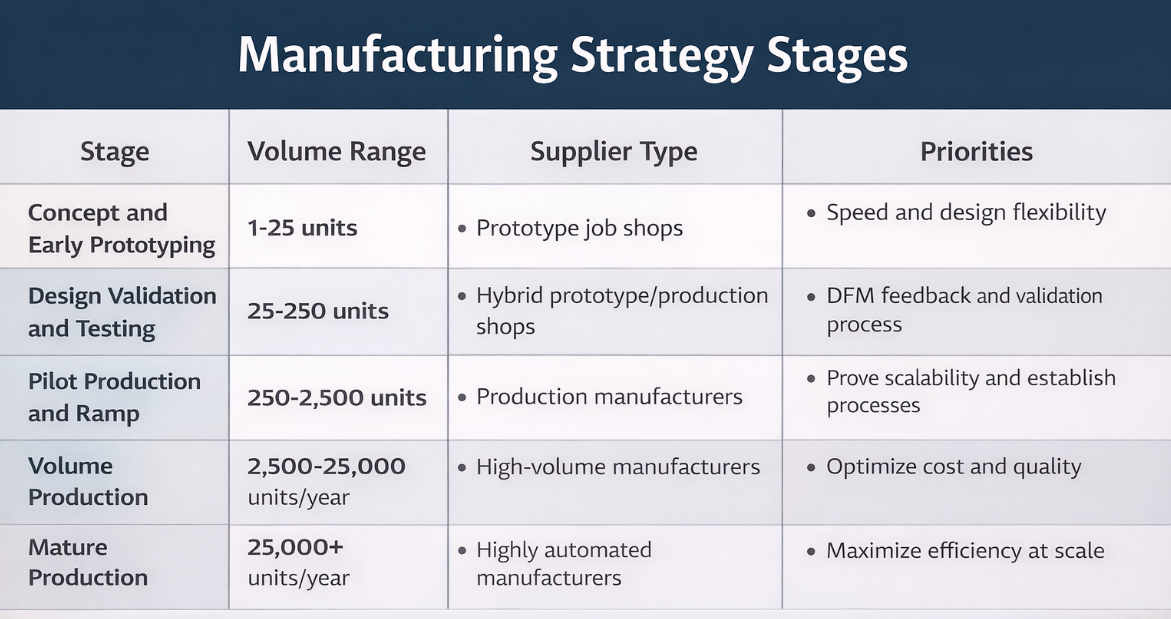
The Five Stages of Product Development and Manufacturing Strategy
Stage 1: Concept and Early Prototyping (1–25 units)
Primary goal: Prove the design concept works. Speed and design flexibility matter more than cost optimization.
Ideal supplier profile:
- Small job shops with flexible equipment and experienced machinists
- Rapid prototyping services with 3–5 day lead times
- Local suppliers for easy iteration and direct communication
- Shops comfortable with frequent design changes
Cost reality: Per-part costs are high and variable. Pricing reflects engineering time and iteration speed, not efficiency. Prototype parts often cost several times more than production equivalents — and that’s expected.
Supplier expectations: Manual or semi-automated processes, minimal tooling, and one-off builds. These shops solve “how do we make this?” problems but cannot scale economically.
Strategic mistakes:
- Demanding production pricing on prototype quantities
- Selecting suppliers for capabilities you won’t use yet
- Over-specifying tolerances and finishes
When to transition: After concept validation and before committing to production tooling.
Stage 2: Design Validation and Testing (25–250 units)
Primary goal: Validate real-world performance while design changes are still expected.
Ideal supplier profile:
- Mid-size fabricators supporting both prototype and low-volume production
- Suppliers providing design for manufacturability feedback
- Revision and configuration control capability
- Willingness to work with soft or minimal tooling
Cost reality: Costs decline as designs stabilize, but pricing still reflects process development and validation.
Supplier expectations: Documented processes, work instructions, and early quality systems.
Critical capabilities:
- Design review participation
- Systematic ECO tracking
- Quality systems supporting validation
- Flexibility without constant re-quoting
Strategic mistakes:
- Staying with prototype shops too long
- Jumping to production suppliers too early
- Failing to document process parameters
- Excluding production suppliers from design reviews
When to transition: When designs are ~80% frozen and tooling investment is justified.
Stage 3: Pilot Production and Ramp (250–2,500 units)
Primary goal: Prove the manufacturing process is repeatable and scalable.
Ideal supplier profile:
- Production manufacturers supporting pilot and volume
- ISO 9001:2015 quality systems
- Tooling investment capability
- Contract manufacturers offering
integrated services
Cost reality: Tooling, batching, and repeatability begin driving meaningful cost reductions.
Supplier expectations:
- Stable drawings and revision control
- Forecast commitments
- Tooling investment
- Longer lead times (4–8 weeks)
Critical capabilities:
- Statistical process control
- Scalable capacity
- Raw material planning
- Process optimization support
Strategic mistakes:
- Underestimating tooling cost and lead time
- Switching suppliers mid-ramp
- Failing to plan for demand variability
Stage 4: Volume Production (2,500–25,000+ units annually)
Primary goal: Optimize cost, quality, and delivery at scale.
Ideal supplier profile:
- Dedicated production cells
- Lean manufacturing and CI programs
- Automation investment
- Vertically integrated manufacturers offering
value-added services
Cost reality: Improvements come from automation and process optimization, not design changes.
Supplier expectations:
- Annual agreements and release schedules
- Vendor-managed inventory
- Ongoing cost reduction commitments
- Formal performance scorecards
Stage 5: Mature Production (25,000+ units annually)
Primary goal: Maximize efficiency and minimize risk.
Ideal supplier profile:
- Highly automated manufacturers
- Global footprint where appropriate
- Advanced manufacturing capabilities
- Support for both current and next-generation products
Cost reality: Further reductions depend on capital investment and long-term partnerships — not quote shopping.
The Bottom Line: Manufacturing Strategy Must Evolve
The supplier and processes that work at 10 units will fail at 1,000. Treating supplier selection as static guarantees friction as your product scales.
- Match suppliers to your current stage
- Plan transitions proactively
- Optimize for total program success, not transaction cost
Our engineering team helps OEMs navigate the transition from prototype to production across four ISO 9001:2015-certified facilities. Request a quote or call (973) 839-4432.