Value-added services in precision sheet metal fabrication extend beyond basic cutting, forming, and welding to include secondary operations, finishing, assembly, and logistics that transform raw components into finished products ready for installation or integration. For OEMs and product manufacturers, understanding which value-added services to integrate with fabrication versus managing separately directly impacts project timelines, quality consistency, and total cost of ownership.
What Are Value-Added Services in Metal Fabrication?
Value-added services encompass any operation performed on fabricated metal components beyond primary manufacturing processes. These services add functional capability, aesthetic value, or logistical convenience to basic fabricated parts.
Common Value-Added Services Include:
Hardware installation: PEM fasteners (nuts, studs, standoffs), rivets, threaded inserts, and captive hardware enabling assembly without additional fastening operations
Welding and assembly: Joining multiple components into complete assemblies, reducing customer assembly requirements and shipping complexity
Powder coating and finishing: Corrosion protection, aesthetic appearance, and surface durability through powder coating, wet painting, anodizing, or plating
Kitting and packaging: Custom packaging, protective materials, and component kitting for efficient receiving and assembly operations
Direct shipping: Finished assemblies shipped directly to end customers or installation sites, bypassing OEM warehousing
When Integrated Value-Added Services Make Strategic Sense
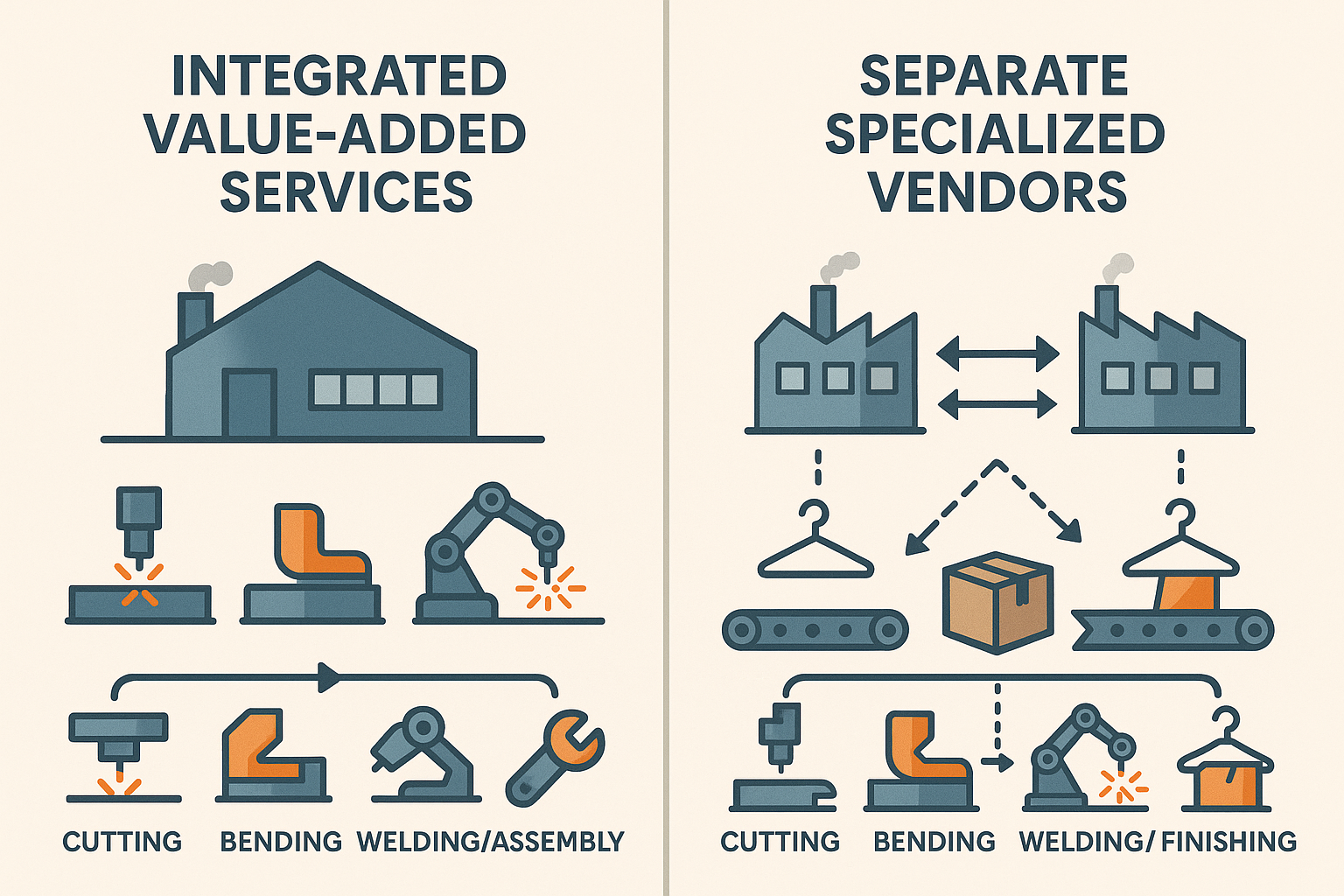
Consolidating value-added services with your fabrication partner versus managing multiple specialized vendors involves trade-offs in cost, quality control, timeline management, and coordination complexity.
Advantages of Integrated Value-Added Services:
Single-Point Accountability: One supplier manages quality, timeline, and problem resolution across all operations. When powder coating defects appear, you contact one company rather than determining whether the issue originated in fabrication or finishing.
Reduced Logistics Complexity: Eliminating inter-vendor shipping, handling, and coordination reduces transit time, freight costs, and damage risk. Parts move directly from fabrication through finishing to final assembly without intermediate shipping steps.
Timeline Compression: Sequential operations within one facility eliminate shipping delays and vendor scheduling coordination. Total lead time often reduces 2–4 weeks compared to managing separate vendors.
Quality Control Integration: Fabricators performing their own finishing understand how fabrication decisions impact finishing outcomes. Design for manufacturability extends through the entire process rather than stopping at bare metal parts.
Cost Transparency: Single quotes encompassing all operations provide clear total cost visibility. Managing multiple vendors can hide true costs in coordination overhead, expedite fees, and rework for cross-vendor compatibility issues.
Engineering Collaboration: Fabricators offering integrated services can optimize designs across all operations — recommending bend sequences that facilitate powder coating coverage, or suggesting hardware installation methods that don’t interfere with finishing processes.
When Separate Specialized Vendors Make Sense:
Extremely Specialized Processes: Highly specialized finishing (electropolishing, passivation, specialized coatings) may require dedicated specialists beyond most fabricators’ capabilities.
Very High Volumes: Production exceeding fabricator capacity for secondary operations may necessitate dedicated finishing suppliers with higher throughput capabilities.
Existing Vendor Relationships: Established quality approval, color matching, or specification compliance with current finishing vendors may outweigh consolidation benefits.
Geographic Requirements: Final assembly or installation locations may favor local finishing vendors versus shipping finished assemblies long distances.
Common Value-Added Service Categories
Hardware Installation and Fastening
Hardware installation during fabrication creates assemblies ready for final integration without additional fastening operations:
PEM Fasteners: Self-clinching nuts, studs, standoffs, and threaded inserts installed during fabrication provide permanent, high-strength threaded attachment points. Installation requires specialized equipment and trained operators to ensure proper clinching without damaging base material.
Riveting: Solid rivets, blind rivets, and structural rivets join components permanently. Automated riveting equipment ensures consistent installation quality across production quantities.
Spot Welding: Resistance spot welding joins sheet metal components quickly for assemblies requiring multiple attachment points. Provides strong structural joints with minimal heat-affected zones.
Captive Hardware: Spring-loaded fasteners, quarter-turn fasteners, and access hardware installed during fabrication enable tool-free panel removal and maintenance access.
Hardware installation during fabrication eliminates secondary assembly operations, reduces labor costs, and ensures consistent installation quality impossible with field assembly.
Welding and Assembly Services
Assembly services transform individual fabricated components into complete functional units:
MIG and TIG Welding: Manual and semi-automated welding for complex geometries and mixed material assemblies requiring skilled welders and process control.
Robotic Welding: Automated welding cells provide consistent weld quality, faster cycle times, and repeatability for production quantities. Ideal for assemblies with repetitive weld patterns and predictable fixturing.
Structural Assembly: Joining frame components, mounting brackets, and support structures into complete assemblies. Includes fit-up, tack welding, final welding, and post-weld cleanup.
Sub-Assembly Integration: Installing purchased components (hinges, latches, gaskets, cable management systems, mounting hardware) into fabricated assemblies. Reduces final assembly complexity and provides tested, functional assemblies.
Assembly services consolidate multiple fabricated components into shippable units, reducing customer assembly requirements and enabling functional testing before delivery.
Finishing and Coating Services
Finishing services provide corrosion protection, aesthetic appearance, and durability:
Automated Powder Coating: Electrostatic powder application with thermal cure provides durable, uniform coating in wide color range. Typical coating thickness 2–4 mils provides excellent corrosion and impact resistance. Requires proper surface preparation, masking for selective coating areas, and curing ovens.
Wet Paint Application: Liquid paint systems for specialized coatings, texture finishes, or applications requiring thinner coating thickness than powder coating. Includes primer application, color coats, and clear protective topcoats.
Anodizing (Aluminum): Electrochemical surface treatment creating protective oxide layer on aluminum components. Available in clear, color dyed, or hard coat formulations. Provides corrosion protection without adding coating thickness.
Plating: Electroplating services (zinc, nickel, chrome) for corrosion protection and aesthetic finish. Includes rack plating for larger parts and barrel plating for small components.
Surface Preparation: Deburring, grinding, sanding, and finishing preparing parts for coating application or final assembly. Critical for coating adhesion and finished appearance quality.
Finishing services protect investment in fabricated components while meeting aesthetic and durability requirements without managing separate coating vendors.
Kitting, Packaging, and Logistics
Logistics services streamline receiving, inventory management, and final assembly:
Custom Kitting: Grouping related components, hardware, and purchased parts into assembly kits. Reduces assembly line inventory management and ensures all components available for each assembly operation.
Protective Packaging: Custom foam inserts, edge protection, and packaging materials preventing damage during shipping and handling. Particularly important for finished assemblies with exposed painted surfaces.
Kanban and Just-In-Time Delivery: Scheduled deliveries coordinated with customer assembly schedules, reducing inventory carrying costs and storage requirements.
Direct-to-Customer / Dock-to-Stock Shipping: Finished assemblies shipped directly to end customers or installation sites, bypassing OEM warehousing and handling. Includes packaging, labeling, and freight coordination.
Vendor-Managed Inventory: Fabricator maintains inventory of finished components with scheduled releases based on customer consumption. Transfers inventory carrying costs while ensuring availability.
Logistics services integrate fabrication with customer supply chain operations, reducing handling, storage, and coordination overhead.
Cost Structure and Pricing Models
Understanding contract fabrication pricing enables better cost management and negotiation:
Material Costs (typically 30–40% of total): Raw material pricing based on sheet size, gauge, and material grade. Fabricators purchasing in bulk may offer lower material costs than customer-supplied material after handling charges.
Setup Costs (fixed per production run): Programming, machine setup, tooling preparation, and first article inspection. Setup costs spread across larger production quantities reduce per-piece costs significantly.
Runtime Costs (per-piece variable): Machine time, operator labor, and consumables (gases, tooling wear). Modern equipment reduces runtime costs through faster processing and automation.
Secondary Operations: Welding, hardware installation, finishing, and assembly add per-piece costs varying by complexity and specification requirements.
Cost Reduction Strategies:
Design optimization: Reducing bends, eliminating tight tolerances on non-critical features, and standardizing hole sizes can significantly reduce manufacturing costs
Volume consolidation: Combining multiple small orders into larger releases reduces setup cost allocation per piece
Material standardization: Using common gauges and materials across products enables material inventory optimization and bulk purchasing leverage
Annual pricing agreements: Long-term commitments often secure pricing advantages versus transactional quoting
Lead Time Expectations
Realistic lead time planning prevents schedule disruptions:
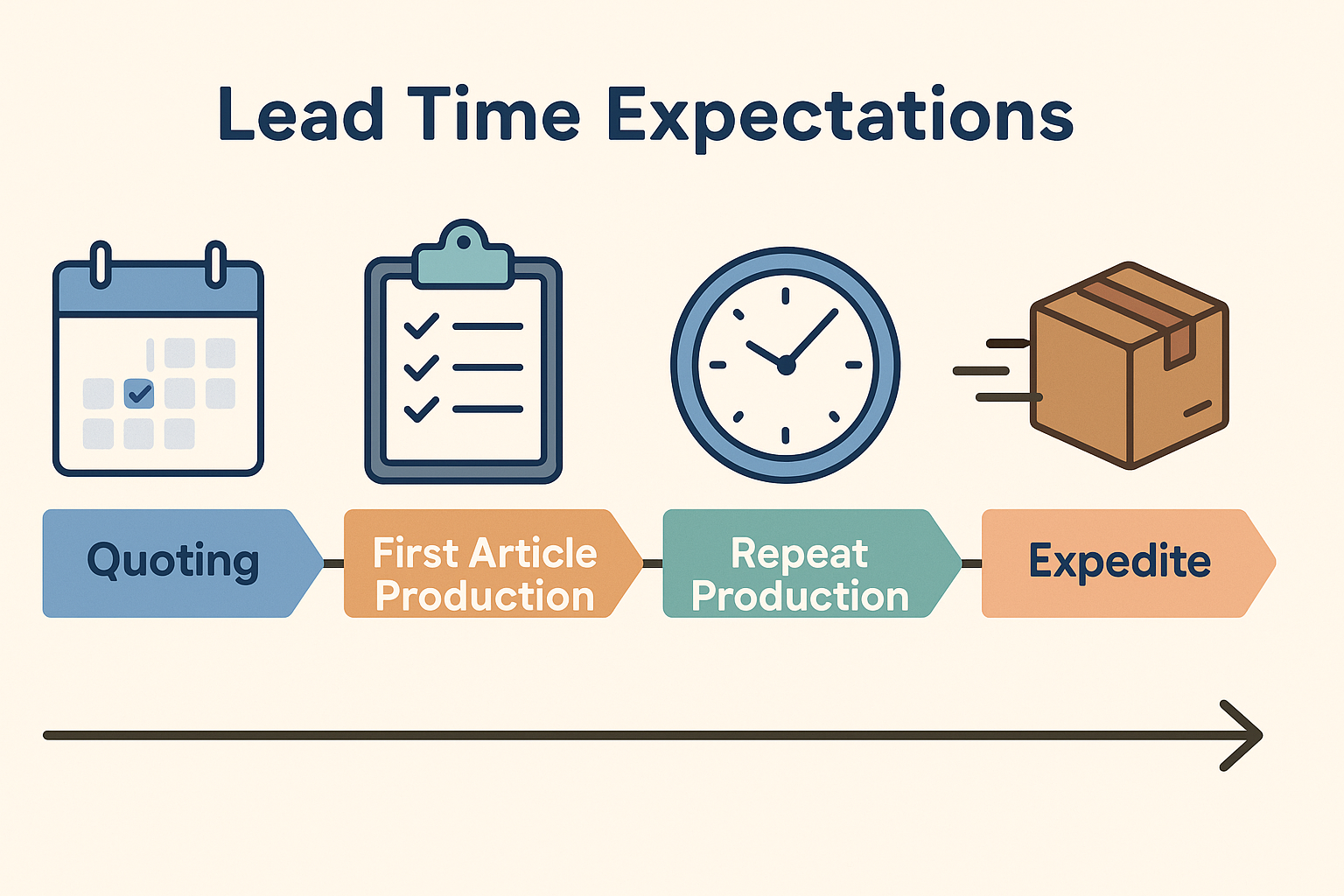
Quoting Phase: Complex assemblies requiring weld time estimation, finishing specifications, and DFM analysis need additional time for thorough evaluation. Simple flat patterns can often quote more quickly.
First Article Production: Initial production includes programming, tooling setup, first article inspection, customer approval, and production run. Complex assemblies with finishing require longer lead times than simple parts.
Repeat Production: Established parts with approved programs and proven tooling ship faster than first articles. Lead times vary based on part complexity and finishing requirements.
Expedite Capabilities: Established manufacturers can often accommodate rush requirements for premium charges. Frequent expedites signal planning problems; reserve expedited services for genuine emergencies.
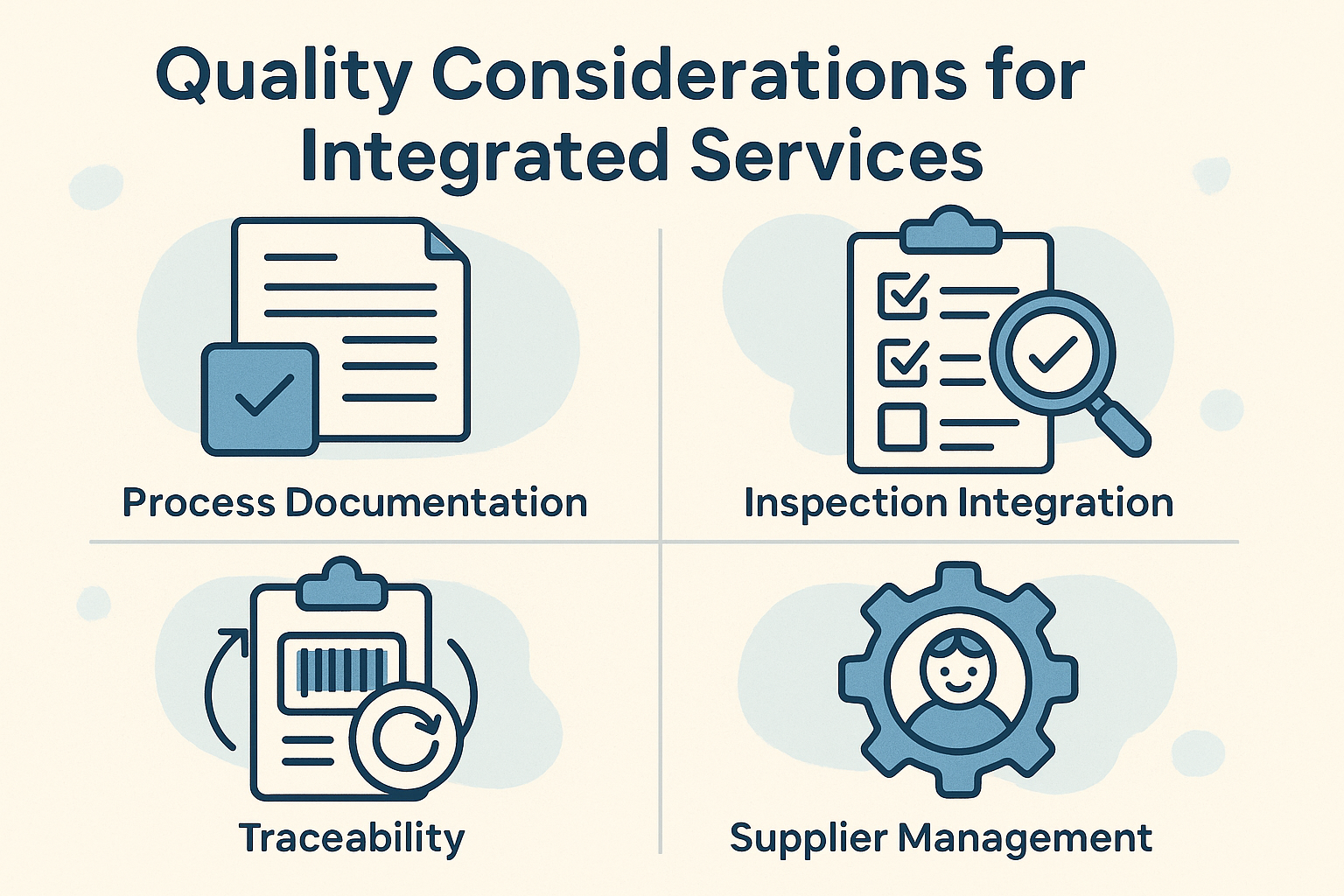
Quality Considerations for Integrated Services
Quality management across multiple operations requires systematic approaches:
Process Documentation: Written procedures for all value-added operations ensure consistency across production runs and operator changes. Critical for maintaining finish quality, hardware installation torque specifications, and assembly procedures.
Inspection Integration: Quality checkpoints between operations catch problems before additional value is added. Inspecting parts before powder coating prevents finishing defective components.
Traceability: Maintaining component and assembly traceability through all value-added operations enables root cause analysis for quality issues and supports recall capability if needed.
Supplier Management: For sub-assemblies incorporating purchased components, fabricators must maintain supplier quality controls ensuring purchased parts meet specifications before integration.
Final Inspection: Comprehensive inspection of completed assemblies including dimensional verification, finish quality assessment, hardware installation verification, and functional testing where applicable.
Design for Value-Added Services
Design decisions significantly impact value-added service feasibility and cost:
Hardware Installation Considerations:
Specify appropriate material thickness for PEM fastener clinching (typically 0.040″–0.250″ depending on fastener type)
Provide adequate edge distance for hardware installation (typically 2–3x fastener diameter)
Consider accessibility for installation tooling in complex assemblies
Finishing Design Guidelines:
Avoid sharp corners and edges where powder coating builds up or thin coverage occurs
Specify masking requirements clearly for areas requiring selective finishing
Design drainage holes for liquid coating processes preventing fluid entrapment
Consider coating thickness impact on tolerance-critical features (add 0.003″–0.005″ per surface for powder coating)
Assembly Design Optimization:
Design welded assemblies with accessible weld joints for robotic or manual welding
Minimize weld distortion through symmetric design and appropriate material gauges
Consider assembly sequence when designing multi-component assemblies
EVS Metal’s Value-Added Service Capabilities
EVS Metal provides comprehensive value-added services supporting complete assembly manufacturing:
Finishing Services: Automated powder coating lines with extensive color library, wet paint application capabilities, and pre-treatment systems ensuring coating adhesion and durability.
Assembly and Welding: Robotic welding cells for production assemblies, skilled manual welders for complex geometries, and assembly capabilities integrating purchased components into finished assemblies.
Hardware Installation: PEM fastener installation equipment, riveting capabilities, and spot welding systems providing permanent attachment solutions.
Quality Management: ISO 9001:2015 certified quality systems with documented procedures across all value-added operations, comprehensive inspection capabilities, and traceability systems.
Multi-Facility Capacity: Four manufacturing locations (New Jersey, Texas, Pennsylvania, New Hampshire) providing geographic distribution for logistics optimization and production capacity flexibility.
Ready to integrate value-added services with your precision sheet metal fabrication projects? Request a quote to discuss your assembly and finishing requirements, or call EVS Metal at (973) 839-4432.
Frequently Asked Questions
What’s the cost difference between integrated value-added services versus managing separate vendors?
While integrated services may appear more expensive on a per-operation basis, total cost of ownership often favors consolidation when including coordination overhead, shipping between vendors, quality issues from vendor handoffs, and timeline delays. Request comparative quotes for both approaches with identical specifications to evaluate true cost differences.
How do I know if a fabricator’s finishing quality matches dedicated finishing shops?
Request samples of finished work in your required specifications, ask for customer references with similar finishing requirements, and verify finishing equipment capabilities and certifications. Quality fabricators maintain finishing operations comparable to dedicated shops for standard applications.
Can value-added services be added after initial fabrication if not originally planned?
Yes, though adding services after parts are fabricated may increase costs and timelines. Some operations (like welding accessibility or powder coating masking) benefit from design consideration during initial fabrication. Discuss potential future services during design phase even if not immediately needed.
What information should I provide when requesting quotes for assemblies with value-added services?
Provide complete assembly drawings showing all components, hardware specifications and callouts, finish requirements with color/texture specifications, any masking or selective finishing needs, inspection requirements, and packaging/shipping specifications. More detail enables more accurate quotes and reduces revision cycles.
How do volume requirements affect value-added service pricing?
Setup costs for finishing (masking, color changes, quality checks) spread across larger quantities significantly reduce per-piece costs. Hardware installation may require dedicated fixtures for efficient high-volume production. Discuss anticipated volumes and potential growth to ensure the fabricator can scale services economically.
We use cookies to ensure that we give you the best experience on our website. Continuing to use the site gives us permission to continue to collect information in this way.


 Logistics services streamline receiving, inventory management, and final assembly:
Custom Kitting: Grouping related components, hardware, and purchased parts into assembly kits. Reduces assembly line inventory management and ensures all components available for each assembly operation.
Protective Packaging: Custom foam inserts, edge protection, and packaging materials preventing damage during shipping and handling. Particularly important for finished assemblies with exposed painted surfaces.
Kanban and Just-In-Time Delivery: Scheduled deliveries coordinated with customer assembly schedules, reducing inventory carrying costs and storage requirements.
Direct-to-Customer / Dock-to-Stock Shipping: Finished assemblies shipped directly to end customers or installation sites, bypassing OEM warehousing and handling. Includes packaging, labeling, and freight coordination.
Vendor-Managed Inventory: Fabricator maintains inventory of finished components with scheduled releases based on customer consumption. Transfers inventory carrying costs while ensuring availability.
Logistics services integrate fabrication with customer supply chain operations, reducing handling, storage, and coordination overhead.
Logistics services streamline receiving, inventory management, and final assembly:
Custom Kitting: Grouping related components, hardware, and purchased parts into assembly kits. Reduces assembly line inventory management and ensures all components available for each assembly operation.
Protective Packaging: Custom foam inserts, edge protection, and packaging materials preventing damage during shipping and handling. Particularly important for finished assemblies with exposed painted surfaces.
Kanban and Just-In-Time Delivery: Scheduled deliveries coordinated with customer assembly schedules, reducing inventory carrying costs and storage requirements.
Direct-to-Customer / Dock-to-Stock Shipping: Finished assemblies shipped directly to end customers or installation sites, bypassing OEM warehousing and handling. Includes packaging, labeling, and freight coordination.
Vendor-Managed Inventory: Fabricator maintains inventory of finished components with scheduled releases based on customer consumption. Transfers inventory carrying costs while ensuring availability.
Logistics services integrate fabrication with customer supply chain operations, reducing handling, storage, and coordination overhead.
 Lead Time Expectations
 Lead Time Expectations
 Quality management across multiple operations requires systematic approaches:
Process Documentation: Written procedures for all value-added operations ensure consistency across production runs and operator changes. Critical for maintaining finish quality, hardware installation torque specifications, and assembly procedures.
Inspection Integration: Quality checkpoints between operations catch problems before additional value is added. Inspecting parts before powder coating prevents finishing defective components.
Traceability: Maintaining component and assembly traceability through all value-added operations enables root cause analysis for quality issues and supports recall capability if needed.
Supplier Management: For sub-assemblies incorporating purchased components, fabricators must maintain supplier quality controls ensuring purchased parts meet specifications before integration.
Final Inspection: Comprehensive inspection of completed assemblies including dimensional verification, finish quality assessment, hardware installation verification, and functional testing where applicable.
Quality management across multiple operations requires systematic approaches:
Process Documentation: Written procedures for all value-added operations ensure consistency across production runs and operator changes. Critical for maintaining finish quality, hardware installation torque specifications, and assembly procedures.
Inspection Integration: Quality checkpoints between operations catch problems before additional value is added. Inspecting parts before powder coating prevents finishing defective components.
Traceability: Maintaining component and assembly traceability through all value-added operations enables root cause analysis for quality issues and supports recall capability if needed.
Supplier Management: For sub-assemblies incorporating purchased components, fabricators must maintain supplier quality controls ensuring purchased parts meet specifications before integration.
Final Inspection: Comprehensive inspection of completed assemblies including dimensional verification, finish quality assessment, hardware installation verification, and functional testing where applicable.