

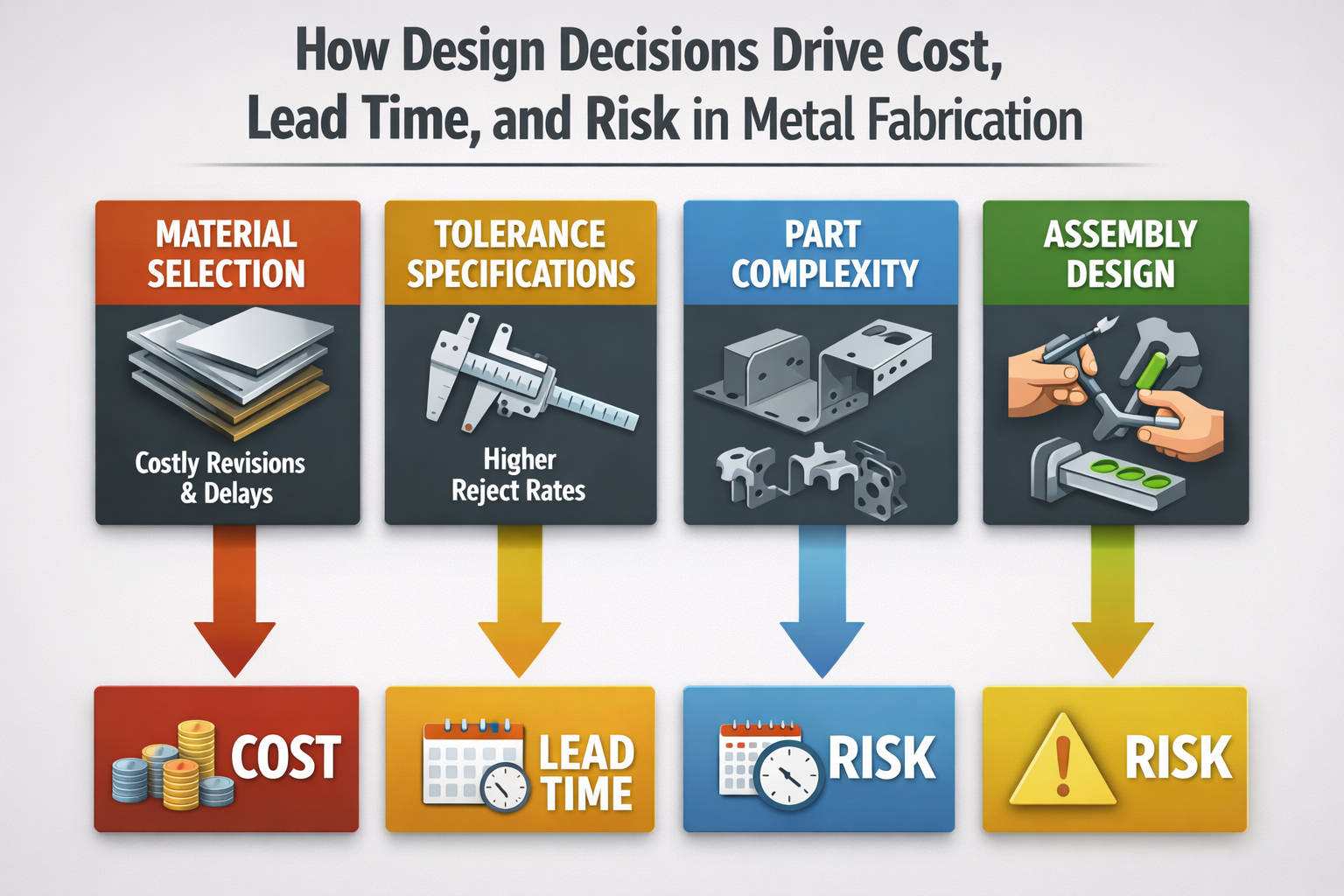
When engineering teams design precision metal components and assemblies, each design decision creates ripple effects that extend far beyond the CAD file. Material selection, tolerance specifications, part complexity, and assembly architecture fundamentally shape manufacturing cost, production lead time, supply chain risk, and quality consistency.
This guide explains how design choices in sheet metal fabrication affect total cost, lead time, quality outcomes, and supply chain risk—so engineering and procurement teams can make informed tradeoffs rather than optimizing individual dimensions in isolation.
If you only take one thing from this: the “best” engineering decision is rarely the one that optimizes a single metric. The right choice balances cost, lead time, quality, and risk as one interconnected system.
 In this guide:
- How design decisions cascade through manufacturing
- Material selection and its system impacts
- Tolerance strategy and cost multiplication
- Part complexity and manufacturing economics
- Supply chain architecture tradeoffs
- What really drives lead time, cost, and risk
- Design maturity and changing strategies
- Decision framework for balanced optimization
- Quick examples of better tradeoffs
The Design-Manufacturing System: How Decisions Cascade
Product design represents a series of choices—material, geometry, tolerances, finishes, assembly methods. Each choice constrains or enables certain manufacturing approaches, which in turn determine cost structures, achievable lead times, and risk exposure. This isn’t simple cause-and-effect. Design decisions interact with manufacturing capabilities, supply chain structure, and volume characteristics to create system behaviors that aren’t always intuitive.
EXAMPLE: How a Single Tolerance Decision Cascades
An engineer specifies ±.002″ tolerance on a bracket mounting hole. This decision triggers:
- Manufacturing impact: The part may require CNC machining instead of standard punching or laser cutting. Cycle time and setup time increase, and per-piece cost rises.
- Lead time impact: CNC machining schedules may have less available capacity than sheet metal fabrication. Lead time can extend from about 1 week to 2–3 weeks.
- Supply chain impact: Fewer suppliers can meet the tighter tolerance requirement. Supplier options narrow considerably, and alternatives may be limited when capacity is tight.
- Risk impact: Tighter tolerances increase scrap risk. A process control variation acceptable at ±.010″ may create scrap at ±.002″, making quality-related delays more likely.
The tolerance decision—made in perhaps 30 seconds during design—creates cost, schedule, and risk implications that persist throughout the product’s lifecycle.
Material Selection: Foundation of Cost and Lead Time Structure
Material choice represents one of the earliest and most consequential design decisions, establishing baseline cost structures and constraining manufacturing approaches.
Direct cost impact:
Raw material costs vary significantly by alloy and form. Stainless steel costs substantially more than cold-rolled steel. Specialty alloys command premiums over common grades. Standard thicknesses of 6061-T6 aluminum may be readily available, while specialty alloys can require weeks of lead time and minimum quantities.
These differences compound across production volumes and often exceed the cost of engineering time invested in material optimization. Understanding material properties and tradeoffs enables informed decisions.
Manufacturing process implications:
Material selection constrains manufacturing processes. Some materials weld easily; others require specialized techniques or filler materials. Some materials form readily; others crack or require annealing. Some materials machine cleanly; others produce poor surface finish or accelerate tool wear.
These processing differences affect which suppliers can manufacture the part, how quickly it can be produced, and how consistently quality can be maintained. Different welding approaches for aluminum vs. steel illustrate how material choice shapes manufacturing strategy.
Supply chain availability:
Standard materials in common forms maintain broad supplier availability and short lead times. Specialty materials, custom thicknesses, or unusual forms narrow supplier options and extend lead times. This supply chain constraint becomes a risk factor—fewer alternatives mean less flexibility when disruptions occur.
Tolerance Strategy: Balancing Precision, Cost, and Schedule
Tolerance specifications directly determine manufacturing processes, cycle times, inspection requirements, and achievable lead times.
Cost multiplication from tolerance tightening:
Standard sheet metal fabrication tolerances (±.010″ to ±.030″) can be held reliably without special operations. As tolerances tighten, costs increase rapidly:
- Tolerances of ±.005″ typically require additional process control or secondary operations, often doubling or tripling feature cost
- Tolerances of ±.001″ may require multiple operations, specialized equipment, and extensive inspection, potentially increasing cost by an order of magnitude
Cost increases accelerate as tolerances tighten because progressively more sophisticated processes and controls are required.
Lead time impact:
Tighter tolerances often require different manufacturing processes with different capacity and scheduling characteristics. A part that could be laser cut and formed quickly may require CNC machining taking considerably longer when tolerances tighten. Secondary operations add both processing time and queue time.
Quality risk amplification:
As tolerances tighten, the proportion of production falling outside specification increases even with good process control. Scrap rates rise. Rework becomes more common. These quality issues create schedule variability—some runs complete smoothly, others face delays from quality problems.
The tolerance rationalization opportunity:
Most parts contain a mix of critical dimensions requiring precision and non-critical dimensions where excess precision adds cost without value. Effective design for manufacturability applies tight tolerances only where function demands it, allowing looser tolerances elsewhere to reduce cost and improve manufacturability.
When evaluating quotes, understand that suppliers quoting higher prices for tight-tolerance parts may simply provide realistic pricing, while low quotes may indicate inadequate understanding of requirements or optimistic assumptions about yield.
If quotes have already come back higher than expected, this diagnostic framework helps identify which features are driving cost and which post-release modifications deliver maximum savings with minimal rework.
Part Complexity: Geometry’s Impact on Manufacturing Economics
Part geometry—the number of features, complexity of contours, bend sequences, and assembly architecture—directly affects manufacturing cost, cycle time, and quality consistency.
Feature count and cycle time:
Each hole, slot, bend, or formed feature adds processing time. A laser-cut part with many small holes takes substantially longer to cut than a part with fewer large holes, even if total cut length is similar, because each hole requires piercing time. More features mean longer cycle times, higher costs, and more opportunities for quality variation.
Complexity and setup requirements:
Complex parts may require multiple setups, specialized fixturing, or sequential operations that simple parts avoid. Each setup adds time and cost. Complex bend sequences may require multiple forming operations or custom tooling.
Assembly architecture implications:
Assembly design—part count, fastener types, joining methods, assembly sequence—determines assembly labor content and quality consistency. Designs requiring many unique fasteners, difficult access, or complex alignment procedures increase assembly time and create variation. Design for assembly principles can dramatically reduce these impacts.
Supply Chain Architecture: Integration vs. Fragmentation Tradeoffs
How manufacturing operations are distributed across suppliers—integrated under one roof or fragmented across specialized vendors—creates fundamentally different cost structures, lead time characteristics, and risk profiles.
The fragmented supply chain model:
Distributing fabrication, machining, welding, finishing, and assembly across multiple specialized vendors can provide access to best-in-class capabilities for each process. However, this fragmentation introduces coordination overhead, quality handoff gaps, accumulated lead times, and inventory at each transfer point.
The integrated manufacturing model:
Consolidating operations under one quality system eliminates vendor coordination overhead, removes quality handoff gaps, compresses lead times by eliminating shipping between operations, and simplifies change management. However, integrated suppliers may not have best-in-class capabilities in every process.
The optimal choice depends on product characteristics, volume profile, and strategic priorities. Our guide to contract sheet metal fabrication examines these tradeoffs systematically.
Key considerations:
- Lead time: Fragmented supply chains add lead times sequentially. Integrated manufacturing often compresses timelines by eliminating shipping delays and optimizing production flow across operations.
- Risk distribution: Fragmented supply chains appear to distribute risk across multiple suppliers, but this is offset by coordination complexity and the reality that problems at any supplier can halt the entire chain. Integrated suppliers concentrate operations but provide clearer accountability and faster problem resolution.
What Really Drives Lead Time, Cost, and Risk
Understanding the actual drivers of lead time, cost, and risk allows more effective optimization strategies.
Lead Time Drivers
Lead time results from the interaction of multiple factors: process cycle times, queue times, setup requirements, material availability, supplier capacity, and supply chain structure.
Process vs. queue time: Actual manufacturing cycle time often represents a relatively small portion of total lead time. Queue time—waiting for capacity, waiting for material, waiting between operations—frequently dominates.
Material availability impact: Standard materials in common forms ship within days. Non-standard materials, specialty alloys, or custom thicknesses may require weeks or months.
Volume and setup economics: Low-volume production amortizes setup across few pieces; high-volume production amortizes setup across many pieces.
Change management and iteration: Integrated domestic manufacturers can often implement changes quickly, while multi-vendor or offshore chains may require longer coordination cycles.
Risk Dimensions
Quality risk: Tight tolerances, complex geometries, difficult-to-weld materials, and challenging finishing requirements increase the probability that production doesn’t meet specifications on first pass.
Schedule risk: Long lead times, material constraints, tight capacity at critical suppliers, and complex coordination increase the probability that delivery dates slip.
Supply chain disruption risk: Long, complex international supply chains can face disruption from logistics, geopolitics, and capacity shocks. Our case study on onshoring manufacturing documents how companies have responded.
Intellectual property risk: For defense applications, ITAR requirements mandate domestic manufacturing under controlled conditions.
Volume Effects on Economics
Prototype economics (1–10 units): setup time often dominates, and iteration speed matters.
Mid-volume economics (100–1,000 units): setup is amortized but still matters; coordination and quality consistency influence total cost.
High-volume economics (10,000+ units): process cycle time and material cost dominate; however, total landed cost analysis often narrows apparent savings when all cost elements are included.
Design Maturity Stages: Matching Strategy to Development Phase
Concept and early development: prioritize flexibility, fast iteration, and manufacturing input.
Design validation and pre-production: evaluate supply chain alternatives using rigorous total cost analysis.
Production and scale: optimization matters, but changing suppliers introduces qualification and transfer risk.
Decision Framework: Balancing Cost, Lead Time, Risk, and Performance
Design Decisions
- Which tolerances are functionally critical vs. inherited from similar designs?
- Does material selection reflect actual service conditions or conservative defaults?
- Can part count be reduced or assembly simplified without compromising function?
- Are we designing for development flexibility or production efficiency—and is that appropriate for current product maturity?
Supply Chain Structure
- Does product complexity justify integrated manufacturing or favor specialized vendors?
- How much coordination overhead does our current supply chain structure create?
- What proportion of lead time is process vs. queue time and logistics?
- How quickly can we implement engineering changes—and how often do we expect changes?
Cost Analysis
- Are we comparing piece price or total landed cost including all elements?
- Have we quantified coordination overhead, quality costs, and inventory carrying costs?
- What is our actual cost of schedule delays and quality problems?
- How much is development speed worth relative to piece price?
Risk Assessment
- How many alternative suppliers exist if our primary supplier faces problems?
- What disruptions could halt production—and how likely are they?
- How much quality risk exists at vendor handoff points?
- What IP protection do we need—and do manufacturing locations provide it?
Quick Examples of Better Tradeoffs
Real optimization happens through specific design and sourcing decisions that balance competing priorities. Here are concrete examples:
Tolerance rationalization:
- Change: Loosen tolerance on non-mating holes from ±.002″ to ±.010″
- Impact: Reduce or eliminate secondary machining, lowering cost and lead time
- Tradeoff: No functional impact when holes are clearance features
Material standardization:
- Change: Switch from 316 stainless to 304 where the environment allows
- Impact: Lower material cost and improved availability
- Tradeoff: Reduced corrosion resistance in certain environments
Assembly simplification:
- Change: Reduce part count by combining components into formed/welded subassemblies
- Impact: Fewer parts to purchase/inventory, faster assembly, better consistency
- Tradeoff: Higher fabrication complexity that may be offset by lower labor and handling
Finishing optimization:
- Change: Tap critical holes post-coating instead of masking during powder coat
- Impact: Less masking labor and more consistent coating
- Tradeoff: Added post-finish operation, often net savings
Applying Systems Thinking in Practice
EVS Metal’s integrated manufacturing approach is designed to reduce coordination overhead, compress lead times, and improve consistency—especially for complex sheet metal components and assemblies.
- Design collaboration: early DFM feedback to improve manufacturability before release
- Integrated operations: fewer handoffs and less waiting between processes
- Quality system: ISO 9001:2015-driven repeatability across facilities
- Domestic flexibility: faster iteration and controlled manufacturing for regulated programs (including ITAR)
- Value-added services: assembly, hardware insertion, kitting to simplify supply chains
Conclusion: Design as Strategic Manufacturing Decision
Every design decision represents a strategic manufacturing choice. Material selection, tolerance specification, part complexity, and assembly architecture determine cost structures, establish feasible lead times, create risk profiles, and constrain supply chain options.
The companies achieving the best total outcomes integrate manufacturing input early, use total cost analysis (not piece price alone), and choose supply chain structures based on product characteristics and strategic priorities.
For engineering and procurement teams seeking to improve outcomes, the opportunity lies not in optimizing any single dimension but in understanding the system—how design decisions propagate through manufacturing operations to create emergent cost, schedule, and risk characteristics that determine total program success.
For detailed analysis of how design decisions affect manufacturing cost, lead time, and risk for your specific products, contact EVS Metal’s engineering team. Request a quote through our online portal or call (973) 839-4432.
About EVS Metal
EVS Metal is a precision contract manufacturer providing sheet metal fabrication, machining, welding, finishing, and complex assembly across four ISO 9001:2015-certified U.S. facilities. We support OEM programs from prototypes to production, including ITAR-controlled manufacturing in Texas.