

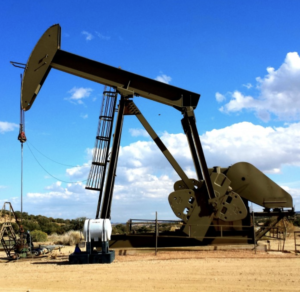
 The energy sector is undergoing its most significant transformation in a century. Traditional oil and gas infrastructure requires ongoing maintenance, upgrades, and expansion while renewable energy systems demand unprecedented manufacturing scale and technical precision. For fabricators serving this sector, the challenge isn’t choosing between traditional and renewable energy—it’s developing the capabilities to support both simultaneously.
At EVS Metal, we’ve observed that the most sophisticated energy companies aren’t betting exclusively on one future. They’re managing complex portfolios that include conventional production, natural gas infrastructure, renewable generation, and energy storage systems. This portfolio approach creates distinct precision sheet metal fabrication requirements that demand both technical versatility and deep understanding of what makes energy infrastructure different from other industrial applications.
The Current Energy Infrastructure Landscape
Energy infrastructure investment in 2025 reflects a sector managing multiple simultaneous transitions. Natural gas continues growing as a transition fuel and baseload generation source. Oil production maintains strategic and economic importance even as consumption patterns evolve. Meanwhile, renewable energy deployment accelerates across wind, solar, and emerging technologies like hydrogen production and battery storage.
This isn’t an either-or environment. It’s a both-and reality where fabricators must understand requirements across diverse applications:
Midstream Infrastructure: Compression stations, pipeline systems, metering stations, and processing facilities require fabricated components built for decades of reliable operation in demanding conditions.
Upstream Equipment: Wellhead systems, production platforms, and extraction equipment face some of the most corrosive, high-pressure environments in industrial manufacturing.
Renewable Energy Systems: Wind tower components, solar mounting structures, and energy storage enclosures demand precision fabrication at scale, often with aggressive delivery timelines.
Power Generation: Combined-cycle facilities, turbine enclosures, and auxiliary systems require fabricated components meeting strict performance specifications and regulatory standards.
Each application brings distinct technical requirements, but certain themes emerge consistently across energy infrastructure fabrication.
What Makes Energy Infrastructure Fabrication Distinct
Precision sheet metal fabrication for the energy sector differs fundamentally from general industrial fabrication. Understanding these distinctions separates capable fabricators from those truly qualified for critical energy applications.
 Environmental Severity and Material Selection
 Environmental Severity and Material Selection
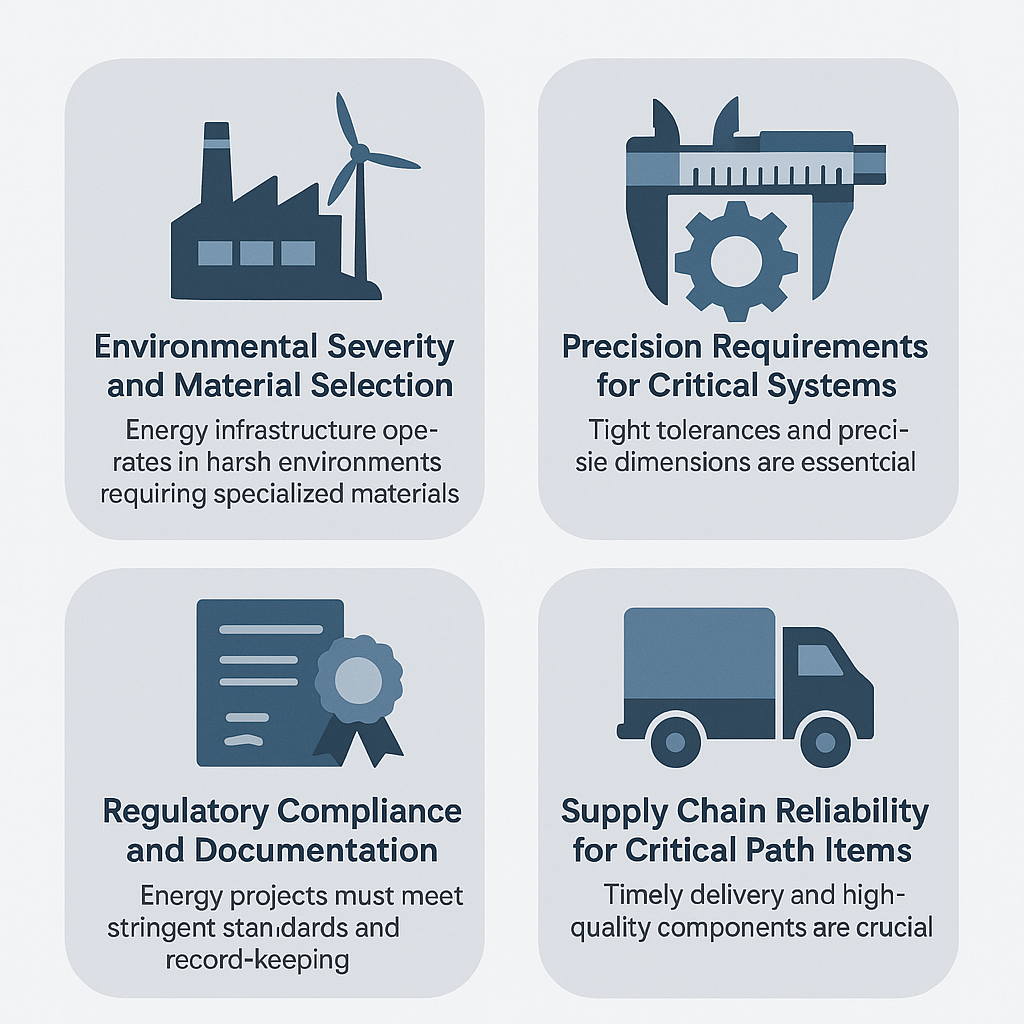
Energy infrastructure operates in conditions most industrial equipment never encounters. Offshore platforms face saltwater corrosion combined with mechanical stress from wave action. Pipeline systems experience pressure cycling, temperature extremes, and potentially corrosive contents. Desert solar installations endure UV exposure, thermal cycling, and abrasive dust. Arctic natural gas facilities manage temperatures that make many materials brittle.
Material selection becomes critical. Standard carbon steel may suffice for general structural applications, but energy infrastructure often requires specialized alloys, corrosion-resistant coatings, or materials engineered for specific environmental challenges. The fabricator’s metallurgical knowledge and material sourcing capabilities directly impact component longevity and system reliability.
Precision Requirements for Critical Systems
Energy infrastructure doesn’t tolerate dimensional variance the way less critical applications might. Compression station components must maintain precise tolerances to ensure proper sealing and mechanical function. Pipeline systems require exact dimensional control for field assembly and pressure integrity. Wind tower sections must meet tight tolerances for structural loading and tower verticality. Advanced fabrication capabilities—precision laser cutting, CNC machining, controlled forming processes—aren’t luxury upgrades in energy applications. They’re baseline requirements for meeting specifications and ensuring field installation success.
Regulatory Compliance and Documentation
Energy infrastructure faces extensive regulatory oversight. Pressure vessels require ASME certification. Pipeline components must meet DOT specifications. Offshore equipment answers to Coast Guard requirements. Renewable energy projects face state and federal standards for structural integrity and safety systems. Beyond meeting these standards, fabricators must provide documentation proving compliance—material certifications, dimensional inspection reports, weld procedure qualifications, non-destructive testing results. The paperwork supporting a component can be as critical as the component itself.
Supply Chain Reliability for Critical Path Items
Energy projects operate on compressed timelines with significant financial consequences for delays. A fabricated component that arrives late or fails inspection can stall multi-million dollar projects and impact delivery commitments to end customers or utilities. Fabricators serving this sector successfully maintain supply chain reliability through several mechanisms: qualified material suppliers with documented quality systems, internal quality processes that minimize rework and rejection, capacity planning that prevents scheduling conflicts, and communication systems that provide visibility into production status.
Technical Capabilities That Matter in Energy Applications
When energy companies evaluate fabrication partners, certain capabilities consistently differentiate qualified suppliers from those lacking critical competencies.
Complex Geometry and Assembly
Energy infrastructure rarely involves simple rectangular enclosures. Curved pipes, angled brackets, multi-plane assemblies, and interference-fit components create geometric complexity requiring both advanced equipment and skilled craftspeople. The fabricator’s ability to interpret engineering drawings, optimize manufacturing sequences, and maintain dimensional control through multiple operations directly impacts both quality and cost.
Welding Expertise Across Materials and Processes
Welding represents perhaps the most critical fabrication process in energy applications. Failed welds cause leaks, structural failures, and safety incidents. Different materials, thicknesses, and applications require specific welding processes—MIG, TIG, stick, submerged arc—each with process parameters affecting weld integrity. Fabricators serving energy infrastructure maintain certified welders, qualified weld procedures, and inspection capabilities ensuring weld quality meets specifications. This expertise isn’t universal among metal fabricators, even those otherwise technically capable.
Surface Treatment and Coating Systems
Raw fabricated steel won’t survive decades in harsh environments. Protective coatings extend component life and reduce maintenance requirements. However, coating selection and application require understanding of environmental exposure, substrate materials, and performance requirements. Energy applications might require hot-dip galvanizing, powder coating, specialized paint systems, or metallic coatings depending on the specific service conditions. The fabricator’s coating capabilities and quality control processes directly impact long-term component performance.
Volume Flexibility from Prototype Through Production
Energy infrastructure projects vary dramatically in scale. A custom compression station might require unique fabricated components in quantities of two or three. A solar farm deployment could need hundreds of identical mounting assemblies. Pipeline projects might require both—unique specialty items plus volume production of standardized components. Fabricators succeeding in this sector demonstrate flexibility across this volume spectrum. They can prototype complex custom designs while also scaling to production quantities when projects require volume manufacturing.
The Energy Transition Creates New Fabrication Opportunities
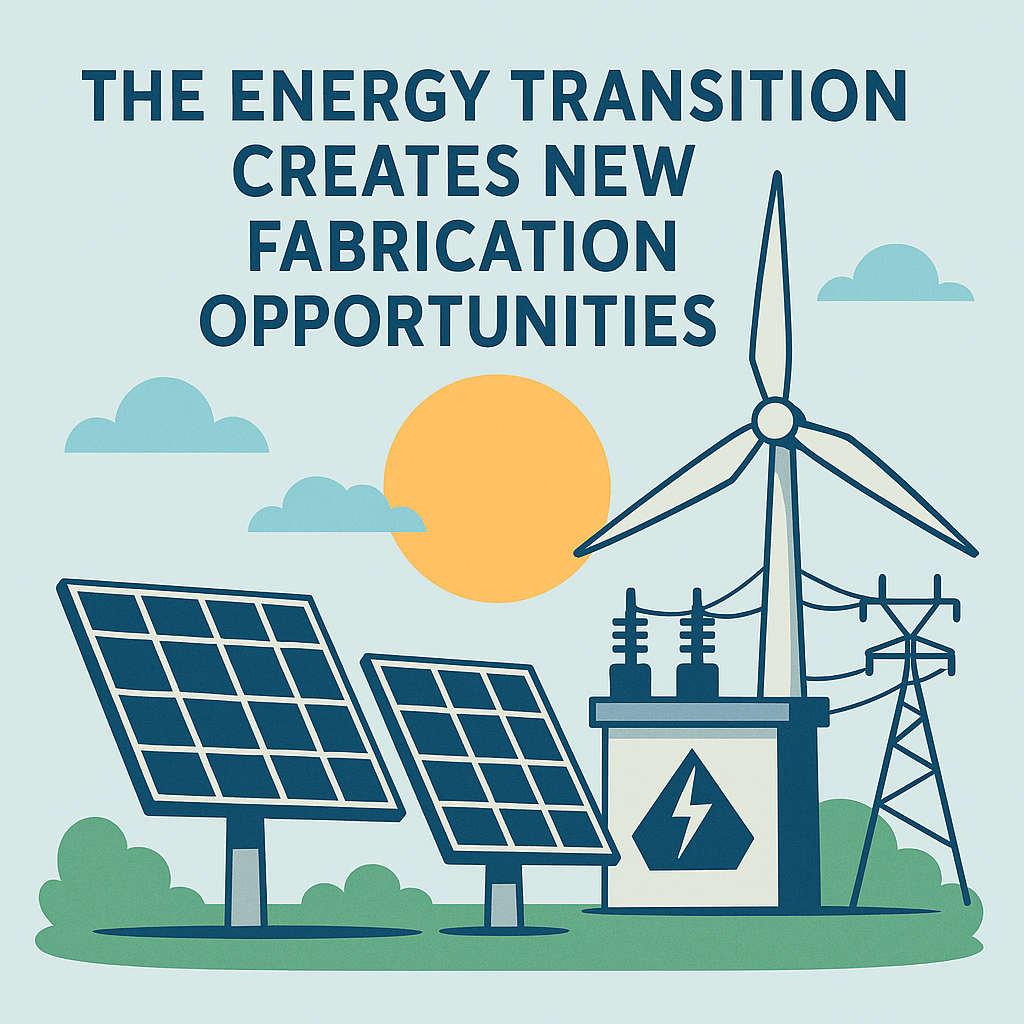 The shift toward renewable energy and grid modernization is creating sheet metal fabrication demand across applications that didn’t exist a decade ago.
Renewable Energy Infrastructure
Wind and solar deployment continues accelerating, creating sustained demand for fabricated components. Wind installations require tower sections, turbine nacelle components, and foundation systems. Solar projects need mounting structures, tracker systems, and electrical enclosures. Both require fabricated components at scale, often with delivery timelines measured in weeks rather than months.
The technical requirements mirror traditional energy applications—precision tolerances, environmental durability, structural integrity—but the volume dynamics differ. Renewable projects often involve deploying similar designs across multiple sites, creating opportunities for fabricators who can balance repeatability with customization for site-specific conditions.
Energy Storage Systems
Battery storage systems supporting grid stability and renewable integration require substantial fabricated content. Container-based systems need structural modifications, HVAC integration, and electrical infrastructure. Larger installations require custom enclosures, rack systems, and thermal management components. These applications blend precision fabrication with systems integration expertise—understanding not just how to fabricate components but how they function within larger systems.
Hydrogen Production and Distribution
Hydrogen infrastructure represents an emerging opportunity as industries and utilities explore hydrogen as an energy carrier and industrial feedstock. Production facilities require pressure vessels, piping systems, and process equipment. Distribution infrastructure needs compression systems, storage vessels, and specialty components handling hydrogen’s unique properties. Fabricators positioning for this market need capabilities similar to traditional natural gas infrastructure but with additional consideration for hydrogen embrittlement and material compatibility challenges.
Grid Modernization and Transmission
Expanding transmission capacity and modernizing distribution infrastructure creates demand for substations, switchgear enclosures, and utility-scale equipment. These applications require heavy fabrication capabilities, precision assembly, and understanding of utility specifications and standards.
Strategic Considerations for Energy Infrastructure Fabrication
Energy companies evaluating fabrication partners should consider factors beyond price per pound and lead time.
Domestic Manufacturing for Critical Infrastructure
Energy security considerations increasingly favor domestic manufacturing for critical infrastructure components. Fabricators with multiple U.S.-based facilities and domestic supply chains provide advantages in lead times, communication, quality oversight, and reduced geopolitical risk. For projects requiring Buy American compliance or preferring domestic sourcing for strategic reasons, the fabricator’s manufacturing location and supply chain geography matter significantly.
Engineering Support and Design Collaboration
The most valuable fabricator relationships extend beyond “build to print” manufacturing. Fabricators who can contribute design feedback, suggest manufacturing optimizations, and collaborate on value engineering create advantages beyond those offering only production services. This requires fabricators maintaining engineering capabilities—CAD modeling, finite element analysis, design for manufacturability expertise—allowing them to engage as technical partners rather than purely production vendors.
Quality Systems and Process Control
Energy infrastructure demands consistent quality across components and over time. Fabricators with documented quality management systems, statistical process control, and formalized inspection procedures deliver this consistency more reliably than those relying on individual craftsperson skill alone. Quality system certification (ISO 9001 or industry-specific standards) provides some assurance, but the real test is whether the fabricator’s processes actually prevent defects rather than just catching them through final inspection.
Capacity and Scalability
Energy projects can scale quickly as financing closes and construction schedules compress. Precision fabricators with available capacity and ability to scale production avoid becoming bottlenecks in project critical paths. This doesn’t necessarily mean the largest fabrication shops are best—it means having realistic capacity planning, transparent communication about scheduling, and operational flexibility to accommodate changing project requirements.
Looking Forward: Positioning for Energy Sector Growth
 Energy infrastructure investment shows no signs of slowing. The sector faces simultaneous demands: maintaining existing traditional energy systems, building renewable capacity at unprecedented scale, modernizing transmission and distribution, and developing emerging technologies like hydrogen and advanced storage. This creates sustained opportunity for fabricators with capabilities matching energy sector requirements. However, not all fabrication shops can serve this market successfully. The technical demands, quality requirements, regulatory complexity, and project management expectations separate energy-qualified fabricators from general industrial shops.
Organizations positioning for energy sector work should focus on several strategic priorities:
Build capabilities that matter in harsh environments: Material expertise, corrosion protection, structural design understanding, and environmental exposure knowledge differentiate energy-qualified fabricators.
Develop quality systems supporting critical applications: Documentation, traceability, inspection capabilities, and process control create confidence for risk-averse energy customers.
Maintain flexibility across traditional and renewable applications: The most successful fabricators serve diversified energy portfolios rather than betting exclusively on single technologies.
Invest in engineering capabilities enabling collaboration: Design support, value engineering, and technical problem-solving create stickier customer relationships than purely transactional manufacturing.
Communicate transparently about capabilities and capacity: Energy customers value honest assessment of what a fabricator can deliver more than optimistic promises leading to schedule failures.
The EVS Approach to Energy Infrastructure
At EVS Metal, we’ve built capabilities specifically suited to energy infrastructure demands. Our four American precision sheet metal fabrication facilities — New Jersey, Pennsylvania, New Hampshire and Texas — provide geographic flexibility and capacity across diverse project requirements. Our equipment portfolio—including advanced laser cutting, precision forming, and multi-axis machining—enables the geometric complexity and tight tolerances energy applications demand. We understand that energy projects involve more than fabricating components to drawings. They require understanding how components function within larger systems, anticipating field installation challenges, maintaining quality through rigorous process control, and delivering on committed schedules because project timelines rarely accommodate supplier delays.
Whether supporting midstream natural gas infrastructure, renewable energy deployment, power generation facilities, or emerging energy technologies, we bring consistent focus to understanding requirements fully, communicating transparently about schedules and capabilities, and delivering components that meet specifications and support successful project completion. The energy sector’s complexity creates challenges—but it also creates opportunities for fabricators willing to develop the capabilities, quality systems, and technical expertise these demanding applications require.
Exploring fabrication partnerships for energy infrastructure projects? EVS Metal’s team can discuss your specific requirements and how our capabilities might align with your needs. Request a personalized quote online or call (973) 839-4432 to start the conversation.
Frequently Asked Questions About Energy Infrastructure Fabrication
What makes energy infrastructure fabrication different from general industrial fabrication?
Energy infrastructure fabrication demands higher material performance, tighter tolerances, and far more rigorous documentation than standard industrial fabrication. Components often operate in harsh environments, requiring specialized alloys, corrosion-resistant coatings, advanced welding expertise, and precision manufacturing that meets regulatory and safety standards.
Which materials are commonly used for energy infrastructure components?
Materials depend on environmental conditions and system requirements. Common options include carbon steel, stainless steel, high-strength alloys, corrosion-resistant materials for offshore environments, and specialized coatings for UV, chemical, or temperature exposure. Material selection directly affects durability, safety, and system performance.
Why do energy projects require fabricators with advanced precision capabilities?
Energy systems—such as pipelines, compression stations, wind towers, and grid equipment—must meet strict engineering tolerances to ensure proper sealing, structural stability, and long-term reliability. Precision laser cutting, CNC machining, controlled forming, and certified welding processes are essential to meet specification requirements and reduce field installation issues.
What regulatory and documentation requirements apply to energy infrastructure fabrication?
Energy infrastructure components often require ASME certification, DOT compliance, Coast Guard standards for offshore equipment, or state and federal renewable energy regulations. Documentation may include material certifications, dimensional inspection reports, weld procedure qualifications, and non-destructive testing results to verify compliance.
What manufacturing capabilities matter most for energy infrastructure projects?
Important capabilities include advanced welding across materials, precision cutting and forming, CNC machining for tight-tolerance components, surface treatment expertise, and the ability to manage both low-volume custom fabrication and high-volume production. Complex assemblies and multi-process integration are often required.
How is renewable energy driving new demand for metal fabrication?
Wind, solar, and grid-scale battery systems require large-scale, repeatable fabrication of mounting structures, enclosures, thermal management components, and structural assemblies. These markets require both precision and the ability to scale production rapidly. Emerging sectors such as hydrogen infrastructure and grid modernization create additional fabrication demand.
Why is domestic manufacturing becoming more important for energy infrastructure?
Energy security, Buy American requirements, quality oversight, shorter lead times, and reduced geopolitical risk all drive companies toward domestic manufacturing. U.S.-based fabricators also provide better communication, easier site audits, and more reliable scheduling for critical infrastructure projects.
How does EVS Metal support energy infrastructure fabrication?
EVS Metal provides precision fabrication for midstream, upstream, renewable energy, power generation, and emerging technologies. With four U.S. facilities, advanced laser cutting, machining, forming, and assembly capabilities, EVS supports tight tolerances, rigorous quality documentation, and reliable delivery schedules required for energy sector applications.