

Industry 4.0 has moved from future vision to operational reality. What began a decade ago as predictions about smart factories and connected systems is now standard practice for competitive manufacturers and precision sheet metal fabricators supporting industries such as warehouse automation. The question is no longer whether manufacturers should implement Industry 4.0, but how quickly they can scale these capabilities while maintaining quality, continuity, and return on investment.
EVS has been writing about Industry 4.0 since 2016—long enough to compare early predictions with what actually happened and to discuss implementation from practical manufacturing experience rather than marketing promises.
What Industry 4.0 Actually Means Now
Industry 4.0 is the integration of digital technologies, artificial intelligence, and physical manufacturing systems into adaptive, data-driven production environments. Earlier generations of automation primarily replaced or accelerated manual tasks. Industry 4.0 systems go further by using production data, demand signals, equipment conditions, and quality feedback to improve decisions in real time.
In practice, Industry 4.0 is not a single technology but a connected ecosystem of tools working across manufacturing operations. Sensor-equipped equipment continuously reports machine status, tool wear, cycle times, and quality metrics through the Industrial Internet of Things (IIoT). Machine learning models identify patterns in production data that would be difficult or impossible for people to detect manually. Cloud platforms support enterprise-wide analysis, while edge computing handles time-sensitive decisions directly on the shop floor.
Digital twins allow manufacturers to test process changes before applying them to physical equipment. Collaborative robots take on repetitive, hazardous, or precision-oriented work while skilled employees remain responsible for judgment, troubleshooting, and oversight. Additive manufacturing complements conventional fabrication when it offers a better path for prototyping, low-volume production, or complex geometry.
None of these technologies are especially exotic anymore—which is precisely the point. Modern smart automation systems combine them into connected production environments that improve efficiency, quality, visibility, and responsiveness across the shop floor. These capabilities have become increasingly important for manufacturers producing infrastructure for industries such as data centers, where precision, traceability, and production consistency are essential.
A Decade of Predictions vs. Reality
When Industry 4.0 emerged as a major manufacturing concept in the mid-2010s, manufacturers faced real uncertainty about technology maturity, implementation costs, workforce readiness, and return on investment. A decade later, there is enough operating history to compare those early projections with actual results.
What PwC’s 2016 global Industry 4.0 survey predicted—and what happened:
- Predicted: Manufacturers expected roughly 2.9% annual digital revenue gains through 2020. Reality: Companies that implemented comprehensive Industry 4.0 strategies have commonly reported double-digit productivity improvements and meaningful cost reductions, extending the value well beyond the modest revenue projections of 2016.
- Predicted: Approximately 33% of manufacturers reported high levels of digitization, with that figure projected to reach 72% by 2020. Reality: Most mid-size and large manufacturers have now adopted at least some Industry 4.0 capabilities. Full enterprise-wide integration remains much more difficult, however. Connecting individual machines is often easier than connecting departments, facilities, data systems, and decision-making processes.
- Predicted: Investment in digitization would grow aggressively. Reality: Analysts now value the global Industry 4.0 market at roughly $150 billion to $200 billion annually, with continued double-digit growth expected into the early 2030s. Broader enterprise digital transformation spending has expanded into the trillions.
The difference between prediction and reality cuts both ways. Adoption of individual technologies moved faster than many expected, while enterprise-wide data integration, cybersecurity, and workforce development moved more slowly. Both lessons matter for manufacturers planning implementation today.
Generative AI: The Development Nobody Predicted
The most significant Industry 4.0 development of the past several years was largely absent from the forecasts of 2016. Generative AI and large language models have changed how manufacturers interact with production data, technical systems, and decision-support tools.
These technologies are not replacing the underlying manufacturing systems that came before them. Instead, they are making those systems easier to query, interpret, and use. They can summarize large data sets, identify possible causes of production problems, generate process recommendations, and make complex information accessible to people who may not have specialized analytics or programming skills.
Where generative AI is earning its keep in fabrication environments:
Process optimization. AI models can analyze years of production data and recommend changes intended to reduce cycle times, improve quality, and minimize material waste. These recommendations may include parameter adjustments, tooling changes, or workflow modifications based on patterns across comparable production runs that no engineer could reasonably review one by one.
Predictive maintenance. Machine learning models can detect subtle changes in vibration, temperature, power consumption, acoustic signals, and other equipment data. These patterns may indicate a developing problem days or weeks before a traditional threshold-based system would trigger an alarm. Accuracy depends on equipment type, sensor quality, and the amount of historical data available, but the economics are straightforward: planned intervention generally costs far less than unplanned downtime.
Quality prediction. AI-enhanced vision systems can evaluate parts during production and identify trends toward out-of-tolerance conditions while there is still time to adjust the process. This shifts quality control from detecting defects after they occur to preventing them in the first place. That capability is especially valuable in precision sheet metal fabrication, where small process variations can affect fit, function, repeatability, or downstream assembly.
Natural language interfaces. Engineers, managers, and operators increasingly interact with production systems using ordinary language. Instead of writing SQL queries or waiting for a custom report, a user may ask a system to identify every run during the past month where cycle time exceeded standard by more than 10%. Removing that analyst bottleneck gives the people closest to production faster access to information they can act on.
Design optimization. Generative design tools can produce and evaluate thousands of design variations against specified criteria such as weight, strength, cost, and material efficiency. These systems may identify geometries that a human designer would not consider independently. The practical limit, however, is still manufacturability. The strongest results come from pairing generative design with an early design for manufacturability review, ensuring an optimized part can also be produced efficiently, consistently, and cost-effectively.
Supply chain intelligence. AI systems can analyze supplier performance, material availability, lead times, purchasing history, and demand forecasts to identify potential disruptions before they affect production. These capabilities became increasingly important after years of raw material pricing volatility forced manufacturers to reconsider inventory levels, procurement strategies, and supplier relationships.
What Still Makes Implementation Hard
The primary obstacles to Industry 4.0 adoption are no longer a lack of available technology. The harder problems involve integration, security, workforce readiness, and organizational change.
Data integration complexity. Most manufacturing facilities operate equipment installed across several decades, often using incompatible protocols and inconsistent data formats. Connecting a 2008 press brake and a 2024 fiber laser to the same monitoring environment is possible, but the work is rarely simple or glamorous. Integration often consumes more time and budget than the dashboards and analytics that executives initially picture.
Cybersecurity. Connected manufacturing systems expand the potential attack surface. Operational technology security also differs significantly from traditional IT security because manufacturing equipment cannot always be patched, restarted, or isolated without affecting production. Network segmentation, industrial firewalls, access controls, secure remote access, and OT-specific expertise have become essential parts of implementation.
The skills gap. Industry 4.0 requires people who can operate advanced systems, interpret data, troubleshoot connected equipment, and collaborate with AI-enhanced tools. Traditional manufacturing training pipelines have not kept pace with that need. Addressing the manufacturing skills gap has therefore become just as important as investing in new equipment.
ROI uncertainty. The aggregate benefits of Industry 4.0 are well documented, but the return on a specific implementation varies considerably based on facility maturity, production mix, data quality, system architecture, and execution. A technology that delivers rapid payback in a high-volume environment may produce a very different result in a low-volume, high-mix operation. Pilot data is often necessary before a larger capital request can be justified.
Change management. Technology deployment is only half the work. The other half is moving an organization from familiar habits and informal decision-making toward consistent, data-driven improvement. Even strong technology can fail when employees are not involved early, responsibilities are unclear, or leadership treats implementation as an equipment purchase instead of an operational transformation.
A Phased Implementation Approach That Works
Successful Industry 4.0 adoption is typically phased rather than simultaneous. Each stage should address a specific operational need while creating the foundation for the next level of capability.
Phase 1 — Data collection infrastructure (3–6 months). Start by instrumenting the equipment and processes with the highest downtime cost, greatest quality impact, or most persistent bottlenecks. Build a reliable data foundation before attempting to layer advanced analytics on top of it.
Phase 2 — Visibility and monitoring (6–12 months). Introduce real-time dashboards for production metrics, equipment performance, maintenance indicators, and quality results. At this stage, the objective is cultural as well as technical. Teams need to become comfortable using shared data during daily production conversations.
Phase 3 — Predictive analytics (12–18 months). Once enough historical data has been collected, machine learning models can begin identifying patterns associated with equipment failures, quality issues, and production constraints. These models require ongoing validation because manufacturing conditions change over time.
Phase 4 — Process optimization (18–24+ months). AI-driven systems can begin recommending changes to machine parameters, workflows, schedules, and resource allocation. Some manufacturers may move toward closed-loop systems in which approved optimizations are implemented automatically, while others may retain manual review for all changes.
Phase 5 — Autonomous operations (24+ months, ongoing). Autonomous decision-making can expand gradually as confidence in the systems grows. Human oversight generally remains in place for decisions involving quality risk, safety, customer requirements, or significant operational consequences.
The important pattern is that each phase should create value while building the foundation for the next. Attempting advanced optimization without reliable data collection is one of the most common—and most expensive—implementation mistakes.
Where the ROI Actually Shows Up
Manufacturers implementing Industry 4.0 systems tend to see gains in several recurring categories.
Unplanned downtime decreases when maintenance is driven by equipment condition rather than by fixed schedules or emergency response. Defect rates improve when systems identify trends before they produce scrap. Productivity increases through better scheduling, fewer changeovers, and faster identification of constraints. Work-in-process inventory can be reduced without sacrificing delivery performance because production status is easier to see and manage.
Energy savings may come from better load balancing, reduced idle time, and improved coordination of equipment use. Maintenance and quality teams also spend less time responding to recurring problems and more time preventing them. That last benefit is difficult to quantify precisely, but it is often one of the most noticeable operational changes.
The Workforce Question
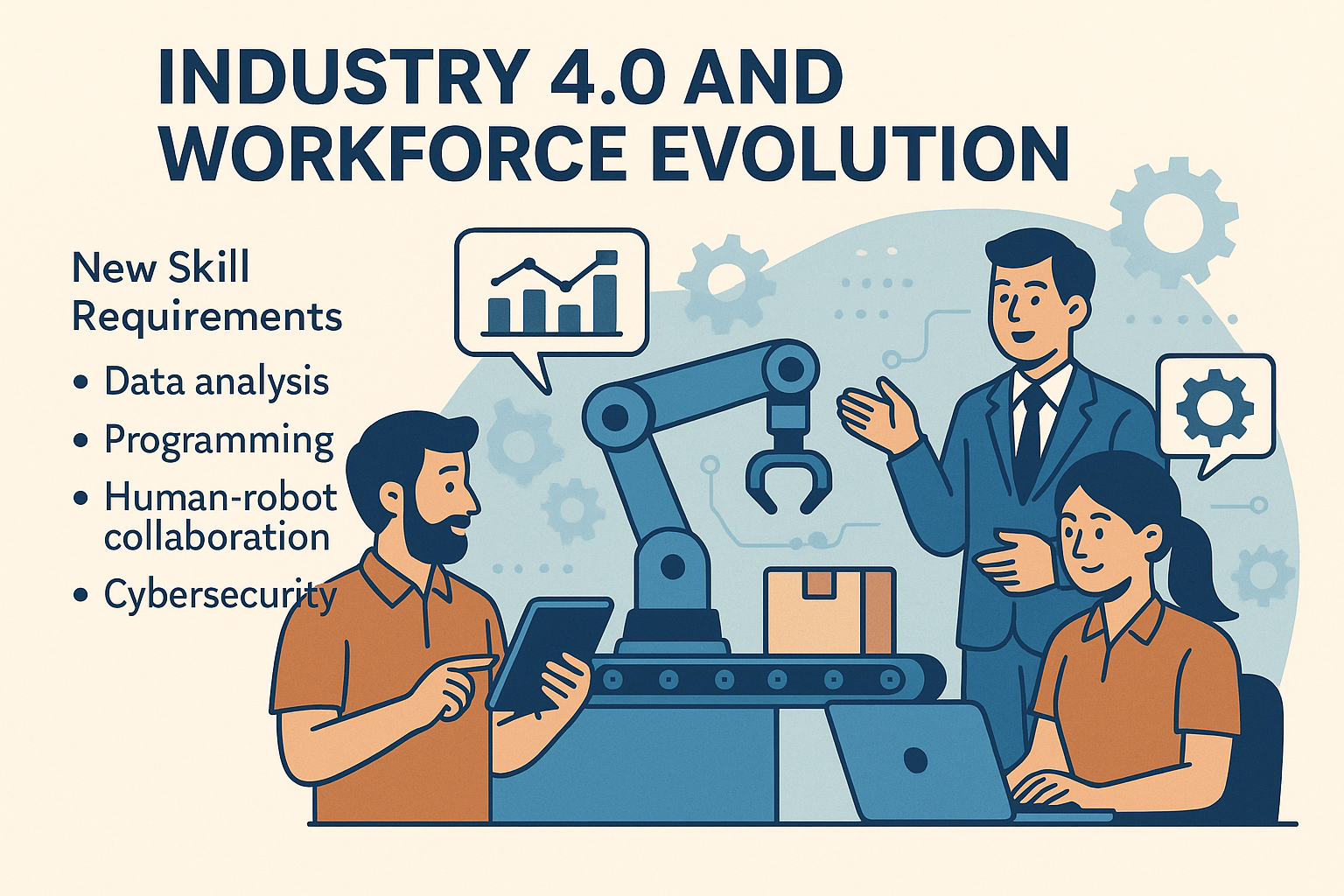
Contrary to the fears that dominated early Industry 4.0 coverage, these technologies have generally changed manufacturing roles more than they have eliminated them. Maintenance technicians are becoming mechatronics specialists responsible for integrated mechanical, electrical, and digital systems. Quality inspectors are increasingly using data to identify systemic process improvements. Production supervisors are becoming manufacturing systems coordinators who allocate labor, equipment, and capacity using real-time information.
The manufacturers handling this transition well treat workforce development as a critical success factor rather than an afterthought. They invest in technical training, data literacy, cross-functional problem solving, and clear skill-development pathways, often in partnership with community colleges and technical schools. Modern careers in metal fabrication increasingly combine traditional manufacturing expertise with automation, robotics, analytics, and digital technologies.
How EVS Approaches Industry 4.0
EVS has implemented Industry 4.0 technologies progressively across its fabrication operations, following the same phased approach described above.
- Advanced equipment: Fiber laser cutting with automated material handling, CNC press brakes with offline programming and automatic tool changing, robotic welding cells with adaptive process control, and automated deburring and finishing systems.
- Data infrastructure: Equipment monitoring across machine utilization, cycle times, quality metrics, and maintenance indicators.
- Quality systems: ISO 9001:2015-certified quality management systems supported by digital traceability and statistical process control.
- Multi-facility coordination: Four manufacturing locations in New Jersey, Texas, Pennsylvania, and New Hampshire, with enterprise-wide visibility that supports load balancing, capacity management, and geographic redundancy.
- Engineering integration: CAD/CAM systems with automated programming and design for manufacturability analysis, helping designs move efficiently from engineering into production without introducing unnecessary cost, delay, or complexity.
Evaluating Industry 4.0 for Your Operation
The pattern among successful implementations is remarkably consistent: start with the business problem, not the technology.
Identify a specific operational pain point such as unplanned downtime, excessive scrap, poor schedule visibility, slow changeovers, or recurring delivery problems. Then work backward to determine which systems and data are needed to address it. Retrofitting sensors and connectivity onto functional equipment will often produce a better return than replacing assets prematurely.
Data quality should come before advanced analytics. Models trained on incomplete or inconsistent information can produce confident but misleading recommendations. Pilot programs should use architectures that can scale across equipment, departments, or facilities rather than isolated point solutions that create another disconnected system.
Executive commitment also matters because Industry 4.0 implementation is a multi-year operational change, not a one-time equipment purchase. Manufacturers benefit from working with people who have completed similar projects because many of the most expensive implementation mistakes are predictable and avoidable.
The Competitive Reality
Industry 4.0 has crossed from competitive advantage into competitive necessity. Manufacturers without data-driven decision-making, predictive maintenance, connected quality systems, and process optimization increasingly struggle to compete on cost, quality, responsiveness, and delivery.
The open question for a manufacturer is no longer whether these capabilities will matter. It is how quickly they can be developed without disrupting current production or overextending the organization. A phased approach balances urgency with operational risk, allowing manufacturers to build momentum while creating measurable value at every stage.
Frequently Asked Questions
What’s a typical ROI timeline for Industry 4.0 investments? Data collection infrastructure often pays back within 12–18 months through downtime reduction and quality improvement. Advanced capabilities such as predictive analytics may require 24–36 months to produce a full return. A phased implementation generally delivers value earlier than attempting a complete transformation at once.
Do we need to replace all our equipment? No. Retrofitting existing equipment with sensors and connectivity often delivers a better return than replacing functional assets. Most manufacturing facilities operate equipment spanning several decades. The integration layer and data strategy frequently matter more than the age of the machine.
How do we handle cybersecurity for connected manufacturing systems? Segment operational technology networks from traditional IT networks, deploy industrial firewalls between zones, maintain patching discipline where possible, enforce access controls, and conduct regular assessments. OT security differs enough from IT security that many manufacturers engage specialists with direct industrial experience.
What if our workforce lacks the technical skills? Plan for workforce development explicitly. That may include technical training, data literacy programs, early employee involvement in implementation planning, and clear pathways for skill advancement. Many manufacturers also partner with community colleges or technical schools to create customized training programs.
Can smaller manufacturers benefit, or is this only for large enterprises? Smaller manufacturers can benefit significantly and may sometimes implement changes faster because they have fewer layers of legacy systems and organizational complexity. Cloud-based platforms and subscription pricing have also reduced many of the traditional capital barriers. The best approach is usually to focus on one high-impact opportunity rather than attempting a comprehensive transformation immediately.
How do we justify investment when ROI is uncertain? Begin with a pilot tied to a specific and measurable problem, such as unplanned downtime on one critical machine with a known cost per occurrence. Prove the value at a controlled scale before requesting enterprise-wide investment. The analysis should also consider the competitive cost of doing nothing while other manufacturers continue improving cost, quality, and delivery performance.