

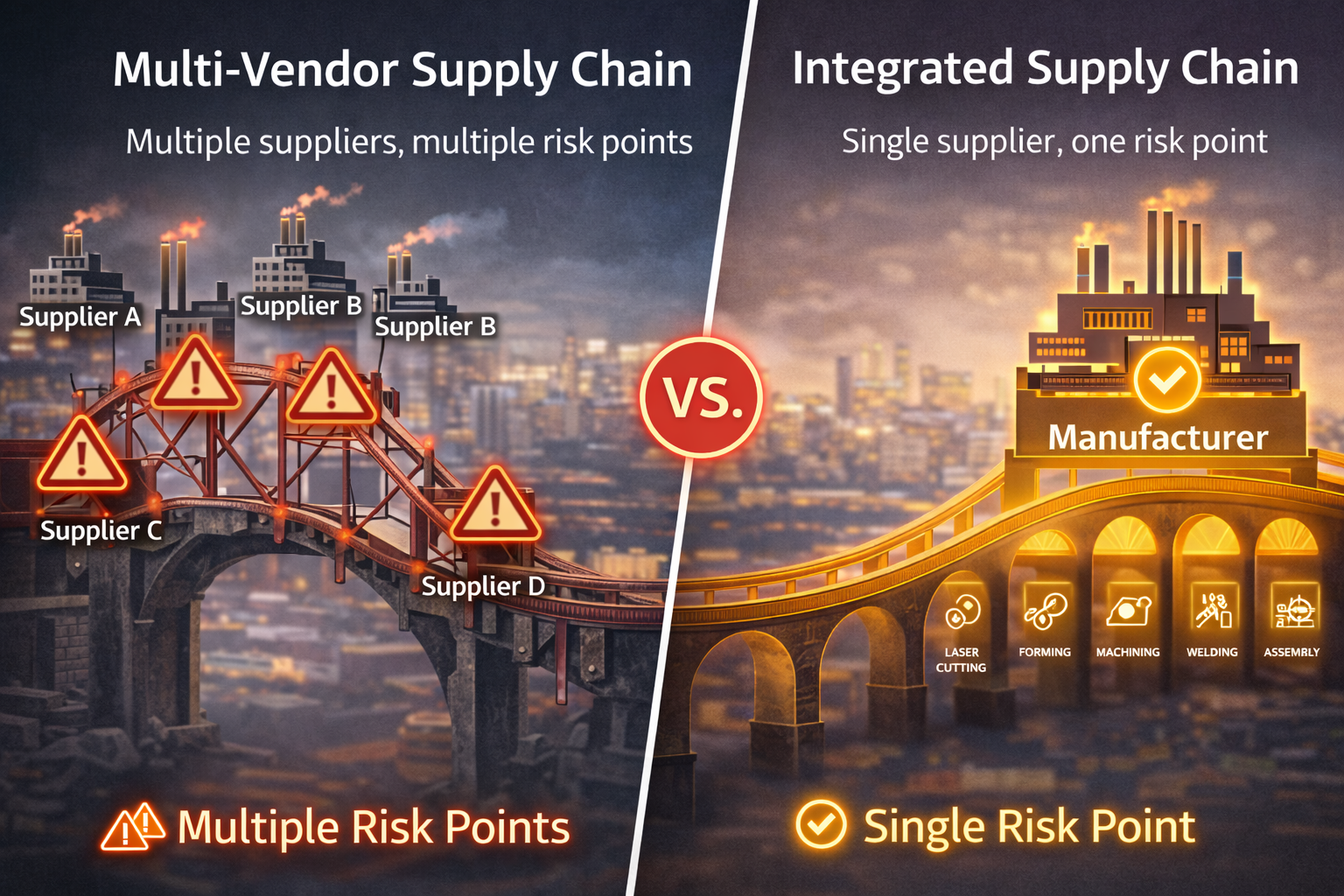
For decades, manufacturing procurement operated on a simple principle: distribute risk by distributing suppliers. Split your fabrication work across multiple vendors so no single supplier failure could shut down your production line. The 2020–2023 supply chain crisis revealed a critical flaw in this logic: fragmented supply chains don’t distribute risk — they multiply it.
When a single-source integrated manufacturer experiences a disruption, you have one problem to solve. When your product requires coordination across four specialized vendors, you have sixteen potential failure points where any single breakdown cascades through your entire supply chain. The math that seemed to reduce risk actually concentrated it.
Understanding supply chain risk requires moving beyond the outdated “don’t put all your eggs in one basket” thinking to a more sophisticated analysis:
What types of risk am I actually managing, and which supply chain architecture best addresses each risk?
The 2020–2023 Wake-Up Call: When “Diversified” Supply Chains Failed First
The COVID-19 pandemic and subsequent supply chain disruptions didn’t affect all manufacturers equally. Companies with integrated suppliers often maintained production while those with fragmented multi-vendor supply chains experienced cascading failures.
What happened: Multi-vendor supply chains experienced:
- Sequential failures: One vendor’s delay triggered downstream schedule disruptions, compounding into weeks or months of delay.
- Coordination breakdown: No vendor could commit to schedules, creating planning paralysis.
- Allocation wars: Smaller customers lost priority when materials became scarce.
- Geographic concentration risk: “Diversified” suppliers were often located in the same regions and shut down simultaneously.
Why it happened: Fragmented supply chains introduce:
- More handoff points where delays propagate
- Communication gaps where problems stay hidden
- Inventory staging vulnerabilities
- Lower customer priority at each supplier
Meanwhile, integrated manufacturers could reallocate internal resources, maintain direct schedule visibility, prioritize strategic customers, and absorb disruptions internally.
The lesson wasn’t “single-source everything” — it was that
supply chain architecture is a strategic risk decision, not just a cost optimization exercise.
The Six Types of Manufacturing Supply Chain Risk
Effective supply chain risk management starts with understanding which risks you’re actually managing — and recognizing that different architectures address different risks.
1. Operational Risk: Single Point of Failure
The risk: Equipment failure, labor shortages, or quality issues halt production.
Multi-vendor mitigation: Work can theoretically shift to another supplier.
Reality check: This only works if vendors have excess capacity, transferable tooling, qualified backups, and lead times within inventory buffers.
Integrated mitigation: Redundant equipment, preventive maintenance, cross-trained labor, and spare-parts inventory.
The trade-off: Multi-vendor adds coordination risk. Integration concentrates geographic risk but improves response speed.
2. Capacity Risk: Demand Exceeds Supply
The risk: Demand spikes beyond supplier capacity.
Multi-vendor works best for:
- Commodity parts
- Standard processes
- Markets with excess capacity
Integrated mitigation: Dedicated capacity, integrated planning, and aligned capital investment.
The trade-off: Multi-vendor offers volume flexibility; integration offers priority and certainty.
3. Quality Risk: Defects Disrupt Production
Multi-vendor profile: Accountability fragments, turning root-cause analysis into a blame exercise.
Integrated profile: Single quality owner, end-to-end SPC, faster corrective action, and stronger
design-for-manufacturability feedback.
4. Lead Time Risk: Schedule Variability
Multi-vendor lead times accumulate variability at every step, turning six-week schedules into ten-week realities.
Integrated suppliers manage lead time internally with end-to-end visibility and control.
5. Financial Risk: Supplier Failure
While multi-vendor strategies avoid total shutdown, failure still causes disruption if tooling or proprietary knowledge is lost. Integrated suppliers concentrate risk but often provide stronger financial stability and continuity planning.
6. Intellectual Property Risk
Each vendor adds another IP exposure point. Integrated suppliers consolidate exposure, simplify NDA enforcement, and support ITAR compliance.
When Multi-Vendor Supply Chains Make Sense
- True specialization provides measurable advantage
- Volumes exceed single-supplier capacity
- Products are commodity-like with standard processes
- Strategic redundancy is required for critical programs
- Geographic diversity delivers regulatory or logistics benefits
When Integrated Supply Chains Reduce Risk

- Complex, multi-process products
- Frequent design changes
- Strict quality accountability requirements
- Schedule reliability outweighs price optimization
- IP protection is critical
- Small-to-mid production volumes
The Strategic Shift: From Cost Optimization to Risk Management
Leading manufacturers no longer ask “Who has the lowest price?” They ask:
- Which architecture minimizes total cost including risk?
- Which risks truly threaten our business?
- Which partnerships improve performance over time?
Manufacturing risk is a strategic concern — not a tactical sourcing exercise solved by collecting more quotes.
At EVS Metal, we help OEMs evaluate manufacturing risk and design supply chain strategies that balance cost, resilience, and performance. We support complex programs across four ISO 9001:2015-certified U.S. facilities.