

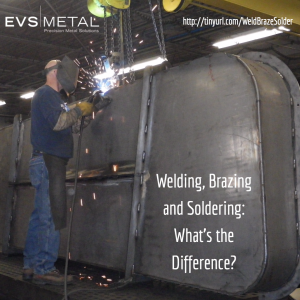
 Selecting the right metal joining process affects structural integrity, production cost, and long-term durability. Welding, brazing, and soldering each serve distinct roles in precision manufacturing—understanding when to use each method prevents costly mistakes and ensures fabrication quality.
Temperature drives the fundamental differences between these three processes. Welding uses high-energy heat sources to melt and fuse base metals at the joint interface. Brazing bonds metals using filler alloys at intermediate temperatures (450-900°C) without melting the base material. Soldering joins components at the lowest temperatures (below 450°C), making it ideal for delicate electronics and precision assemblies.
Beyond temperature, each process offers distinct advantages in joint strength, material compatibility, precision requirements, and production efficiency. This guide explains how EVS Metal’s fabrication teams select joining methods for complex sheet metal assemblies, precision enclosures, and structural weldments across aerospace, medical device, and industrial equipment applications.
| Factor | Welding | Brazing | Soldering |
|---|---|---|---|
| Temperature Range | Arc temperatures 3,000-20,000°C | 450-900°C (above 840°F) | Below 450°C (840°F) |
| Base Metal | Melts and fuses | Does not melt | Does not melt |
| Joint Strength | Strongest (equals base metal) | Strong (below base metal) | Weakest (suitable for electrical/precision) |
| Similar Metals Only? | Similar or metallurgically compatible metals | No—joins dissimilar metals | No—joins dissimilar metals |
| Typical Applications | Structural frames, pressure vessels, heavy assemblies | HVAC systems, cookware, jewelry, aerospace components | Electronics, circuit boards, delicate assemblies |
| Heat-Affected Zone | Large—requires careful control | Moderate | Minimal—ideal for heat-sensitive components |
| Filler Material | Often used (matching base metal) | Required (lower melting point than base) | Required (tin-lead, silver alloys) |
WELDING VS BRAZING VS SOLDERING: SUMMARY
Understanding the fundamental differences helps engineers select the right process:
- Welding: Strongest joining method using fusion of base metals. Best for structural loads, load-bearing frames, and applications requiring maximum joint strength. Limited to similar or metallurgically compatible metals.
- Brazing: Strong joints without melting base metals. Joins dissimilar metals (copper to steel, aluminum to brass), produces less thermal distortion than welding, and works well for thin materials and complex geometries.
- Soldering: Lowest temperature process ideal for electronics and delicate assemblies. Provides electrical conductivity and thermal transfer without mechanical strength. Reworkable and suitable for heat-sensitive components.
WELDING: FUSION JOINING FOR MAXIMUM STRENGTH
What Is Welding?
Welding joins materials through fusion—applying extreme heat to melt base metals at the joint interface. Arc temperatures can reach 3,000-20,000°C, providing the energy needed to melt steel, stainless steel, aluminum, and other metals at their respective melting points. When executed correctly, the welded connection achieves strength equal to or exceeding the surrounding material.
Most welding processes use filler material added to the joint, creating a weld pool that cools into a permanent bond. The high temperature required for welding also enables cutting applications—the same thermal energy that joins metals can slice through heavy steel structures when directed appropriately.
Common Welding Processes in Precision Manufacturing
TIG Welding (GTAW—Gas Tungsten Arc Welding)
Uses a non-consumable tungsten electrode to create precise, clean welds in thin-gauge materials. Ideal for stainless steel, aluminum, and applications requiring cosmetic appearance. EVS Metal’s TIG welding capabilities support complex enclosures, medical device housings, and aesthetic assemblies where weld quality affects both function and appearance.
MIG Welding (GMAW—Gas Metal Arc Welding)
Feeds consumable wire electrode continuously, enabling faster welding speeds for thicker materials. Commonly used for structural frames, brackets, and production assemblies requiring efficiency without sacrificing strength. EVS deploys MIG welding for steel and stainless steel fabrications across industrial equipment and material handling systems.
Robotic Welding
Automated welding systems deliver consistent quality, repeatability, and precision impossible to achieve manually. EVS Metal operates robotic welding cells for steel, stainless steel, and aluminum assemblies, supporting high-volume production with minimal variation. Robotic systems excel at repetitive welds on chassis, enclosures, and structural components.
Collaborative Robots (Cobots)
Welding cobots work alongside human operators, combining automation efficiency with human judgment for complex assemblies. This hybrid approach handles varied production runs and custom fabrications requiring both consistency and adaptability.
Spot Welding
Joins sheet metal by applying pressure and electrical current at specific points. EVS operates both gantry-style spot welding (for heavier, larger parts) and platen-style equipment (for cosmetic spot welds on visible surfaces). Spot welding is standard in chassis assembly, electrical enclosures, and automotive components.
Welding Advantages
- Maximum joint strength: Properly executed welds match or exceed base metal strength
- Permanent bonds: Welded joints withstand extreme stress, vibration, and thermal cycling
- Structural applications: Critical for pressure vessels, load-bearing frames, safety-critical assemblies
- Material efficiency: No additional bonding materials beyond optional filler (which matches base metal properties)
Welding Limitations
- Material compatibility requirements: Conventional fusion welding processes (TIG, MIG, stick) are limited to similar or metallurgically compatible metals—fusion welding cannot join dissimilar materials like steel to aluminum
- Heat-affected zone (HAZ): Extreme temperatures alter base metal microstructure near the weld, requiring careful heat management to avoid weakening
- Warping risk: Thermal expansion and contraction can distort thin materials without proper fixturing
- Skill-dependent quality: Manual welding requires certified operators (EVS welders maintain AWS certifications including D1.2, B2.1, and D9.1M minimum)
When EVS Recommends Welding
- Structural frames requiring load-bearing capacity
- Pressure vessels and sealed enclosures
- Steel-to-steel or stainless-to-stainless assemblies
- Applications where joint strength must equal base material
- High-volume production benefiting from robotic consistency
BRAZING: STRONG JOINS WITHOUT MELTING BASE METALS
What Is Brazing?
Brazing joins metals using a filler alloy that melts above 450°C (840°F) but below the solidus temperature of the base materials. The filler flows into the joint gap through capillary action, creating a metallurgical bond without melting the parts being joined. This intermediate temperature range (450-900°C) provides advantages over both welding and soldering—stronger than soldered joints while avoiding the extreme heat and HAZ issues of welding.
Brazing Advantages
- Joins dissimilar metals: Copper to stainless steel, aluminum to brass, ceramics to metal—combinations not possible with conventional fusion welding
- Lower thermal stress: Reduced warping and distortion compared to welding, making brazing suitable for thin materials and complex geometries
- Aesthetics: Often produces cleaner visual appearance than welding
- Gap-filling capability: Brazing filler flows into irregular joints, accommodating fit-up variations
Brazing Applications
- HVAC systems: Copper refrigerant lines brazed to steel or brass fittings
- Cookware: Stainless steel pots with copper or aluminum bases for heat distribution
- Aerospace components: Dissimilar metal joins in turbine assemblies and instrumentation
- Jewelry and decorative metalwork: Where appearance and delicate materials require lower-temperature bonding
Welding vs Brazing: Strength Comparison
Brazing creates joints weaker than properly welded connections—the filler alloy typically has lower strength than the base metals. However, for applications not requiring maximum strength, brazing offers faster production, less warping, and the ability to join materials that cannot be welded.
When Is Brazing Stronger Than Welding?
While brazed joints have lower absolute strength than welds, brazing can be the superior choice when:
- Thermal distortion from welding would compromise part geometry
- Dissimilar metal joining is required (where conventional welding isn’t possible)
- Joint design allows the brazed joint to distribute loads effectively
- Base material properties must be preserved (no HAZ alterations)
When Brazing Makes Sense
- Joining dissimilar metals (copper to steel, aluminum to stainless)
- Thin-gauge materials prone to welding distortion
- Applications where joint strength requirements fall below base metal strength
- Assemblies requiring precise dimensional control
- Production scenarios where lower thermal input reduces scrap
SOLDERING: PRECISION BONDING FOR ELECTRONICS AND DELICATE ASSEMBLIES
What Is Soldering?
Soldering joins materials using filler alloys that melt below 450°C (840°F)—the lowest temperature of the three processes discussed here. Solder does not melt the base materials, making this method ideal for heat-sensitive components including electronics, delicate mechanical assemblies, and precision instruments.
Soldering Applications
- Electronics assembly: Circuit boards, LED arrays, transistors, resistors, connectors
- Precision instruments: Medical devices, sensors, measurement equipment
- Jewelry: Small delicate joins requiring minimal heat
- Plumbing: Copper pipe connections in residential and commercial systems (though this application uses higher-temperature solders approaching brazing temperatures)
Brazing vs Soldering: Temperature and Strength Differences
The 450°C (840°F) temperature threshold separates brazing from soldering. Above this temperature, the process is brazing; below it is soldering. This temperature difference directly affects joint strength—brazed joints significantly outperform soldered joints in mechanical applications.
Soldered joints provide the weakest mechanical strength of the three joining methods. However, strength is not the design requirement for most soldering applications—electrical conductivity, thermal transfer, and component protection drive process selection instead.
When Soldering Is The Right Choice
- Electrical connections requiring conductivity, not mechanical strength
- Heat-sensitive components that cannot withstand brazing or welding temperatures
- Small-scale precision work where welding equipment is impractical
- Assemblies requiring future disassembly or repair
- Applications where joint appearance and minimal thermal distortion matter
WHICH JOINING METHOD SHOULD YOU USE? DECISION FRAMEWORK
Start With Your Materials
Joining similar metals (steel to steel, aluminum to aluminum)? → Welding provides maximum strength
Joining dissimilar metals (copper to stainless, aluminum to steel)? → Brazing or soldering—conventional fusion welding is not an option
Working with heat-sensitive components (electronics, plastics, delicate parts)? → Soldering minimizes thermal damage
Evaluate Strength Requirements
Structural or load-bearing application? → Welding required
Moderate strength needs, not safety-critical? → Brazing may be sufficient
Electrical or precision assembly where mechanical strength is secondary? → Soldering appropriate
Consider Production Requirements
High-volume production with consistent joints? → Robotic welding for efficiency and quality
Low-volume or custom assemblies requiring flexibility? → Manual welding, brazing, or soldering depending on strength/material needs
Thin materials prone to warping? → Brazing or soldering reduce thermal distortion vs welding. Understanding design for manufacturability helps prevent distortion issues.
Appearance and finish matter? → TIG welding for clean welds, or brazing/soldering for minimal visual impact
Assess Total Cost
Material costs: Welding uses minimal filler (or none for autogenous welds). Brazing and soldering require filler alloys.
Labor and equipment: Robotic welding reduces per-part labor cost at volume. Manual brazing/soldering may be more economical for low quantities.
Rework and scrap: Welding’s high heat increases warping risk. Brazing and soldering offer more forgiving processes for complex geometries.
Secondary operations: Welded assemblies often require grinding, finishing, or post-weld heat treatment. Brazed/soldered joints may need less cleanup.
IS WELDING THE STRONGEST METAL JOINING METHOD?
Yes—among thermal joining processes, properly executed welding creates the strongest bonds. The fusion of base metals creates a joint that can match or exceed the strength of the surrounding material.
However, “strongest” only matters if your application requires that strength level. Many applications succeed with brazing or even soldering because joint strength isn’t the limiting factor. Selecting the appropriate process based on actual requirements—rather than defaulting to “strongest”—often produces better results at lower cost.
EVS METAL’S WELDING CAPABILITIES FOR PRECISION FABRICATION
EVS Metal operates climate-controlled welding facilities supporting precision sheet metal fabrication, structural weldments, and complex assemblies across four U.S. locations. Our welding capabilities include:
Certified Welders and Quality Standards
All EVS welders maintain American Welding Society (AWS) certifications meeting D9.1M/D9.1:2006 Sheet Metal Welding Code minimum requirements. Welders hold additional certifications including AWS D1.2 (Structural Welding Code—Aluminum) and ASME B2.1 (Welding and Brazing Qualifications) depending on project specifications. When customer applications require specific code certifications, EVS welders qualify rapidly to meet project needs.
Robotic and Automated Welding Systems
Robotic welding cells deliver consistent quality for steel, stainless steel, and aluminum fabrications. Automation supports high-volume production with minimal variation, ideal for chassis, enclosures, frames, and structural components requiring repeatability across hundreds or thousands of units.
Collaborative Robots (Cobots)
Welding cobots combine automation efficiency with human oversight, handling varied production runs and custom fabrications requiring both consistency and adaptability. This hybrid approach suits mid-volume production and assemblies with complex fixtures or part variations.
TIG and MIG Welding Across Gauges
EVS operates TIG (GTAW) and MIG (GMAW) welding equipment supporting thin-gauge precision work through heavy structural welding. TIG capabilities deliver cosmetic welds for visible surfaces, medical device enclosures, and applications requiring clean appearance. MIG welding provides production efficiency for thicker materials and structural assemblies.
Spot Welding Infrastructure
Gantry-style spot welding equipment handles heavier, larger sheet metal assemblies. Platen-style spot welding systems provide efficient joining for production volumes while delivering cosmetic spot welds on visible surfaces. Spot welding capabilities span most materials and gauges used in precision fabrication.
In-House Fixture Design and Fabrication
Precision welding requires precision fixturing. EVS maintains in-house engineering capabilities for custom weld fixtures, ensuring dimensional accuracy and repeatability across production runs. Fixture design expertise supports large frames, complex enclosures, and assemblies with tight tolerance requirements.
Large Frame and Enclosure Expertise
EVS specializes in precision welding for large structural frames and fabricated metal enclosures where dimensional control across multi-foot assemblies separates acceptable from scrap. Climate-controlled welding environments maintain consistent temperatures, reducing thermal expansion variables that affect large weldment accuracy.
COMMON MISTAKES IN JOINING METHOD SELECTION
Mistake 1: Attempting Fusion Welding on Dissimilar Metals
Engineers sometimes specify welding for dissimilar metal joins—an impossibility with conventional fusion processes. Evaluate whether brazing achieves required strength while enabling the material combination needed.
Mistake 2: Ignoring Heat-Affected Zone (HAZ) Impact
Welding alters base metal microstructure near joints. For heat-treated alloys, precision-machined features near weld zones, or thin materials prone to warping, brazing or mechanical fastening may preserve material properties better than welding.
Mistake 3: Overlooking Production Volume Economics
Manual welding becomes expensive at volume. Robotic welding, brazing, or even mechanical assembly may reduce per-unit cost while improving consistency.
Mistake 4: Specifying Solder for Structural Loads
Soldered joints cannot support mechanical loads. Vibration, thermal cycling, and physical stress cause solder joint failure. If mechanical strength matters, brazing or welding is required.
Mistake 5: Assuming All Welding Provides Equal Strength
Weld quality depends on operator skill, equipment capability, filler selection, and process control. Poorly executed welds fail despite welding being the “strongest” joining method in theory. Partner with certified welders operating in controlled environments for structural applications.
FREQUENTLY ASKED QUESTIONS
What temperature is used for brazing?
Brazing occurs above 450°C (840°F) but below the melting point of the base metals being joined. Common brazing temperatures range from 450°C to 900°C depending on the filler alloy and base materials.
Can you weld dissimilar metals together?
Conventional fusion welding processes (TIG, MIG, stick welding) require similar or metallurgically compatible metals. Fusion welding cannot join dissimilar materials like steel to aluminum. Specialized solid-state methods can join certain dissimilar metals, but they’re uncommon in typical sheet metal fabrication workflows. For most dissimilar metal joints, brazing is the practical choice.
What is the strongest metal joining method?
Welding creates the strongest joints when executed properly—the weld zone can match or exceed base metal strength. However, “strongest” only matters if the application requires that strength level. Brazing and soldering may be more appropriate for applications with lower strength requirements.
Why is soldering used for electronics instead of welding?
Soldering’s low temperature (below 450°C) prevents damage to heat-sensitive electronic components like semiconductors, capacitors, and printed circuit boards. Welding arc temperatures (which can reach several thousand to 20,000°C) would destroy these components.
What is a heat-affected zone (HAZ)?
The heat-affected zone is the area of base metal near a weld that experiences thermal changes without melting. HAZ material may have altered mechanical properties (hardness, ductility, strength) compared to unaffected base metal. Proper welding procedures and post-weld heat treatment control HAZ effects.
Can brazing be as strong as welding?
Brazed joints are typically weaker than properly welded joints because the filler alloy has lower strength than the base metals. However, well-designed brazed joints can achieve strength sufficient for many applications while offering advantages like joining dissimilar metals and reduced thermal distortion.
What filler materials are used in welding vs brazing vs soldering?
Welding filler matches base metal composition (steel filler for steel welds). Brazing uses copper, silver, or nickel-based alloys with lower melting points than base metals. Soldering uses tin-lead, tin-silver, or other low-temperature alloys.
Do I need certified welders for my fabrication project?
Structural applications, pressure vessels, and safety-critical assemblies require AWS-certified welders. Less critical applications may not mandate certification, but certified welders consistently deliver higher quality and lower scrap rates regardless of specification requirements.
How does robotic welding compare to manual welding quality?
Robotic welding provides superior consistency and repeatability for production runs. Manual welding by certified operators offers flexibility for custom assemblies and complex fixtures. EVS deploys both depending on production volume, part complexity, and tolerance requirements.
Can you braze or solder in a production environment?
Yes. Both brazing and soldering scale to production volumes using automated or semi-automated equipment. Furnace brazing handles batch processing for high volumes. Wave soldering and reflow ovens support electronics manufacturing at scale.
SELECTING THE RIGHT JOINING PROCESS FOR YOUR APPLICATION
Understanding temperature ranges, strength characteristics, and material compatibility helps engineers select appropriate joining methods during design. Welding, brazing, and soldering each solve specific problems—the key is matching process capabilities to application requirements.
For precision sheet metal fabrication, structural weldments, and complex assemblies, EVS Metal’s welding teams bring AWS-certified expertise, robotic automation, and climate-controlled facilities to ensure joint quality and dimensional accuracy. Whether your application demands maximum strength through welding, dissimilar metal joining through brazing, or precision assembly, proper process selection affects manufacturability, cost, and long-term performance.
Ready to discuss welding and fabrication for your next project? Request a quote online or call 1-888-9EVSMET to connect with EVS Metal’s team.