

Laser cutting technology fundamentally shapes precision sheet metal fabrication capabilities, influencing cut quality, production speed, material versatility, and operating costs. The choice between CO2 and fiber laser systems represents one of the most significant capital equipment decisions fabricators make — investments ranging from hundreds of thousands to millions of dollars, with operational implications spanning decades.
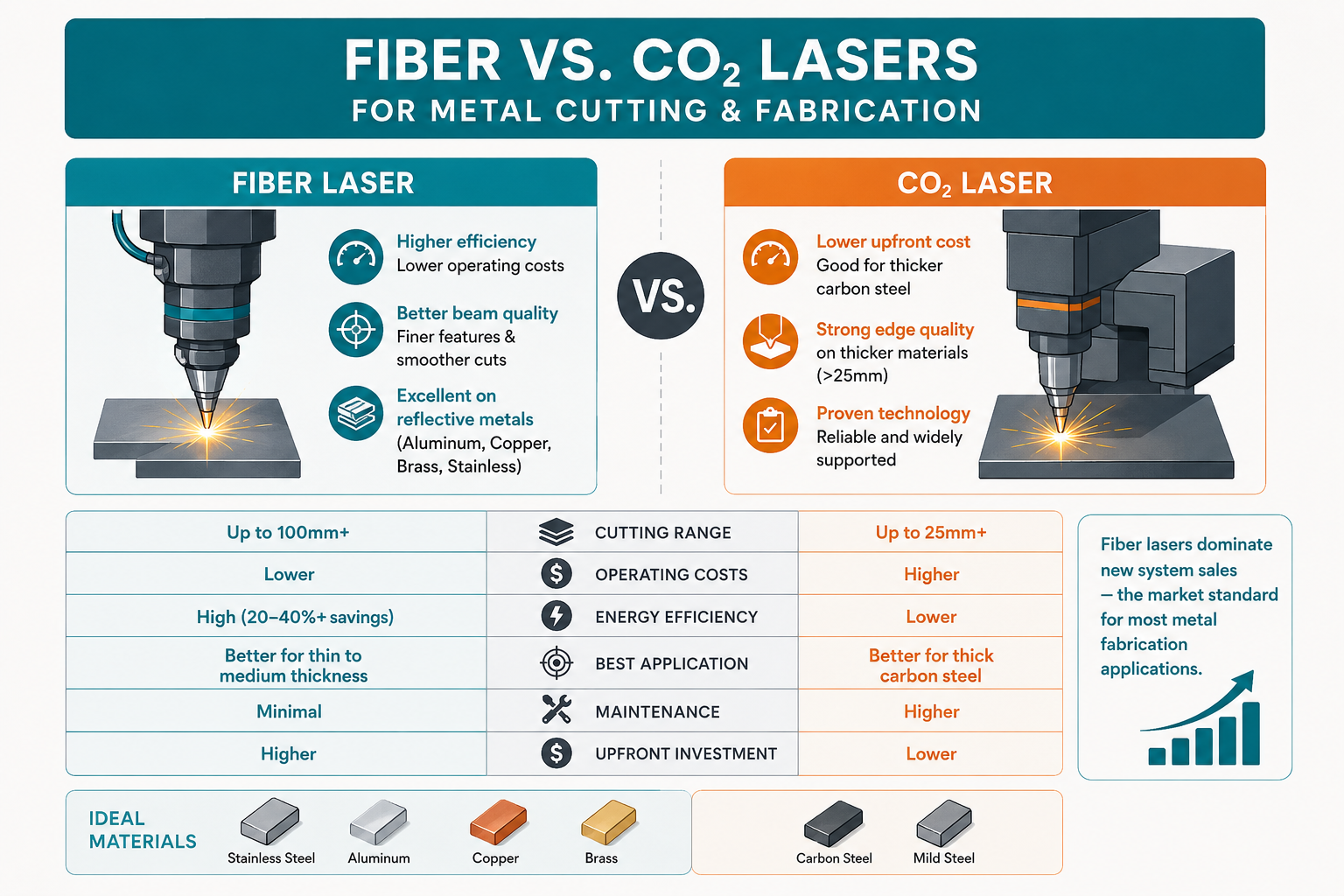
Both technologies cut metal effectively, but through different mechanisms with distinct advantages and limitations. Understanding these differences helps manufacturers make informed equipment investments and helps buyers evaluate fabrication partners’ capabilities. The “which is better” question has no universal answer — optimal technology depends on material types, thickness ranges, production volumes, quality requirements, and budget constraints specific to each operation. What has changed is the market’s center of gravity: fiber lasers now account for the clear majority of new laser cutting system sales, and the trajectory is one-directional.
 How Laser Cutting Works: The Fundamental Difference
All laser cutting systems focus high-intensity light energy onto material surfaces, heating metal to melting or vaporization point. A high-pressure assist gas (oxygen, nitrogen, or air) blows molten material from the cut path, creating precise separations. Both CO2 and fiber lasers accomplish this outcome but generate and deliver light energy differently, creating performance variations across applications.
CO2 laser technology: CO2 lasers generate light through electrically excited carbon dioxide gas mixtures inside resonator tubes. Mirrors reflect and amplify this light until reaching sufficient power for cutting, and the beam travels through the machine’s delivery system via mirrors and focusing optics to the cutting head. CO2 lasers produce infrared light at 10.6-micron wavelength — a relatively long wavelength that interacts differently with materials, affecting absorption rates and cut characteristics.
Fiber laser technology: Fiber lasers generate light through diode-pumped, fiber-optic amplification. Electrical energy pumps laser diodes, which excite rare-earth elements (typically ytterbium) doped into optical fibers. The fiber architecture amplifies light internally before delivery to the cutting head through fiber optic cables. Fiber lasers produce infrared light at 1.06-micron wavelength — ten times shorter than CO2. That single difference drives most of the real-world performance gaps: how efficiently different metals absorb energy, how reflective alloys behave, and how much of the electricity coming into the machine actually reaches the cut. Fiber systems convert electrical input to cutting energy at several times the efficiency of CO2 resonators, which is where much of the operating-cost story below begins.
Cutting Speed by Material Thickness
Thin materials (0.5mm–3mm): Fiber lasers demonstrate substantial speed advantages on thin materials, cutting 2–5 times faster than comparable-wattage CO2 systems. The shorter wavelength creates higher absorption rates in thin metals, requiring less time to melt material and complete cuts. For high-volume production of thin-gauge parts — electronics enclosures, appliance components, brackets, HVAC ductwork — the speed advantage translates directly to capacity and throughput.
Complex perforation and cutout work — like the vent patterns and display openings in kiosk enclosure fabrication — is exactly where fiber speed compounds across a production run.
Medium materials (3mm–6mm): Speed differences narrow in medium thickness ranges. High-powered fiber lasers maintain advantages, but the gap decreases; specific machine power, beam quality, and assist gas optimization determine results more than fundamental technology differences.
Thick materials (6mm+): CO2 lasers historically performed better on thick materials, particularly in the 12mm–25mm range. That advantage has largely evaporated as fiber laser power increased — modern high-power fiber systems (12kW–30kW+) cut thick materials competitive with or exceeding CO2 performance, though at higher equipment cost. For most precision sheet metal fabrication (the 0.5mm–6mm range), fiber offers measurable speed advantages; for heavy-gauge specialists, both technologies deliver acceptable performance depending on specific requirements.
Cut Quality and Edge Finish
Both technologies produce excellent cut quality when properly optimized, but edge characteristics differ. On thick mild steel, CO2 systems can sometimes produce slightly smoother edges, particularly with nitrogen assist for oxide-free finishes — at the cost of wider kerf and a larger heat-affected zone. Fiber lasers excel on thin-to-medium materials with exceptionally smooth edges, narrow kerfs, and minimal dross, and the small heat-affected zone minimizes thermal distortion. Edge quality on thick materials requires careful process optimization but equals or exceeds CO2 performance with proper parameters.
For most precision fabrication, both deliver acceptable edge quality; specific part requirements — cosmetic appearance, subsequent welding or forming, tolerance requirements — determine whether the differences matter practically.
 Material Versatility
 Material Versatility
CO2 range: all common metals plus many non-metals (acrylic, wood, plastics, composites). The longer wavelength provides relatively consistent absorption across materials.
Fiber range: fiber lasers excel at metals but are poorly absorbed by many acrylics, woods, and organics. For dedicated metal fabrication operations this limitation rarely matters; for shops where non-metal cutting is a major requirement, CO2 is generally preferred.
Reflective materials (copper, brass, aluminum): this is where fiber’s wavelength advantage is decisive. The 1.06-micron beam achieves absorption rates that make copper, brass, and aluminum reliably cuttable — materials that have historically been genuinely difficult for CO2 systems. Modern CO2 lasers handle reflective alloys better than older systems but still lag fiber performance.
Operating Costs: Where Fiber Wins Decisively
Operating cost differences significantly impact total cost of ownership, and this is the least ambiguous part of the comparison.
Electrical consumption: Fiber lasers typically use 30–70% less electricity than comparable CO2 systems depending on power levels and operating conditions. This isn’t theoretical for us: EVS Metal’s Amada LCG-3015 AJ fiber laser runs at about one-third the power of a similar-wattage CO2 laser — an operating-cost gap that compounds across every shift, every year, for the life of the machine. Depending on usage and local utility rates, annual electrical savings can reach tens of thousands of dollars per machine.
Maintenance: CO2 lasers require ongoing attention to resonator gas mixtures, mirrors, optics, and beam delivery — mirror alignment, optics cleaning, and periodic resonator rebuilds, performed by skilled technicians during scheduled downtime. Annual CO2 maintenance typically runs $15,000–$40,000+. Fiber lasers eliminate most of this: the sealed fiber architecture has no resonator gas to manage and no mirrors to align, and fiber optic beam delivery resists contamination. Annual fiber maintenance typically runs $5,000–$15,000 — and the reduced downtime matters as much as the reduced cost.
Consumables: Both systems consume cutting nozzles, lenses, and assist gas. Consumable costs correlate more with production volume than technology, though fiber efficiency can reduce assist gas consumption on some applications.
Total operating cost: Combining energy and maintenance, fiber lasers typically operate 40–60% less expensively than equivalent CO2 systems. Over 10–15 year equipment lifespans, that advantage can total hundreds of thousands of dollars — substantially offsetting fiber’s higher acquisition cost, and in high-utilization shops, more than offsetting it.
Capital Investment and ROI
 CO2 systems: entry-level industrial systems (2kW–4kW) range roughly $150,000–$300,000; high-power systems (4kW–6kW+) run $300,000–$600,000+. Lower-cost entry machines exist but may lack the reliability and support production environments require.
Fiber systems: entry-level (1kW–3kW) roughly $200,000–$400,000; mid-power (4kW–6kW) $350,000–$600,000; high-power (8kW–15kW+) $600,000–$1,500,000+. Fiber commands a 20–40% premium over equivalent-wattage CO2 — though fiber’s efficiency means lower wattage often matches higher-wattage CO2 performance, narrowing the practical difference. Fiber pricing has also fallen substantially over the past decade as manufacturing scaled, steadily lowering the entry barrier.
ROI timeline: Despite higher acquisition costs, fiber typically reaches payback faster through higher cutting speeds, lower operating costs, greater uptime, and improved material utilization from narrower kerf. Typical fiber ROI runs 18–36 months depending on production volume, material mix, and the equipment being replaced; high-volume thin-material operations often reach payback in 12–24 months, while lower-volume or heavy-gauge shops may extend to 36–48.
Which Technology for Your Operation?
Choose fiber if: your primary material range is 0.5mm–6mm (if 70%+ of your work falls here, fiber’s advantages are measurable); you run high-volume production where speed compounds; reflective materials (aluminum, copper, brass) are a significant share of your work; long-term operating cost matters to your model; and non-metal cutting isn’t a requirement.
Choose CO2 if: your focus is thick plate (10mm+), where high-power CO2 delivers strong performance at lower acquisition cost; you cut non-metals like acrylic or wood alongside metal; capital constraints outweigh operating-cost math at your volumes; or you have established CO2 infrastructure and expertise where incremental capacity beats a technology transition.
The Shift to All-Fiber Operations
As fiber technology matured and power levels climbed, many leading precision sheet metal fabricators transitioned to all-fiber fleets — and the reasoning generalizes:
- Fiber dominance in the target range: for fabricators focused on 0.5mm–6mm precision work, fiber delivers measurable advantages across virtually all applications.
- Operational simplification: one laser technology means simpler maintenance, leaner spare-parts inventory, unified operator training, and deeper technician expertise.
- Capital allocation: rather than maintaining aging CO2 systems alongside fiber, forward-looking fabricators deploy multiple fiber lasers at different power levels across facilities — redundancy, capacity, and flexibility without mixed-fleet inefficiencies.
- Thick-material capability: modern high-power fiber handles the materials that once justified keeping a CO2 machine on the floor.
Fabricators with substantial non-metal requirements or heavy-gauge specialization still maintain both technologies. But for precision sheet metal fabrication in the 0.5mm–12mm range, all-fiber operations represent current best practice — and the market agrees: fiber has grown from negligible share fifteen years ago to the strong majority of new system sales today, with analysts projecting 70–80% of metal cutting applications by 2030. CO2 sales persist primarily among thick-material specialists, non-metal applications, and budget-constrained buyers of used equipment.
Maintenance and Workforce Considerations
 CO2 systems require sustained maintenance discipline — mirror cleaning and alignment, optics inspection, resonator gas management, cooling system upkeep — much of it demanding skilled technicians. Well-maintained CO2 systems deliver 15–20+ year service lives, but the maintenance investment is real and ongoing. Fiber systems eliminate the mirrors and gas management entirely; primary upkeep is cooling systems and consumable lens/nozzle replacement, with correspondingly less downtime and lower technical demands for routine operation.
Both technologies, however, depend on skilled programmers. Nesting optimization, toolpath generation, and parameter selection determine cutting efficiency and quality regardless of which resonator is making the light — the programming seat matters more than the laser type.
Making the Investment Decision
The selection analysis comes down to a handful of questions answered honestly: What materials and thicknesses represent 70–80% of your actual production volume — not the outliers? Do your volumes amplify fiber’s speed and operating-cost advantages enough to justify the premium? Do specific edge-finish or tolerance requirements genuinely favor one technology (rarely), or is that a rationalization? Does your facility have the electrical capacity, floor space, and assist gas infrastructure? And over a 15–20 year equipment life, does the compounding operating-cost savings outweigh the acquisition delta? For most metal-focused operations, that last calculation now lands on fiber.
Evaluating Fabrication Partners: Why Laser Capability Matters
When sourcing sheet metal fabrication services, a supplier’s laser technology reveals both capability and philosophy. Fabricators investing in modern high-power fiber systems demonstrate commitment to competitive efficiency — an investment pattern that tends to correlate with broader operational excellence in quality systems, engineering support, and responsiveness. For the 0.5mm–12mm range that represents most precision work, fiber capacity matched to your material requirements matters more than a long equipment list. And distributed capacity across multiple facilities provides redundancy, geographic coverage, and load balancing that single-location shops can’t offer.
EVS Metal operates multiple fiber laser systems across our New Jersey, New Hampshire, Pennsylvania, and Texas facilities: the Amada REGIUS 3015 AJe 6kW fiber laser with linear drive technology, and multiple Amada ENSIS 3015 3kW high-speed fiber lasers with automated pallet changers. This distributed capacity lets us match each project to appropriate equipment based on material type, thickness, volume, and timeline — for both prototype and production work, including ITAR-controlled programs where our registration supports defense and aerospace requirements.
Need precision laser cutting for your sheet metal project? Request a quote online or call (973) 839-4432 to discuss your project with our engineering team.
Frequently Asked Questions About CO2 vs. Fiber Lasers
What is the difference between CO2 and fiber lasers for metal cutting? CO2 lasers generate a 10.6-micron beam using an excited gas resonator and mirror-based delivery, while fiber lasers generate a 1.06-micron beam using diode-pumped fiber amplification. That wavelength difference changes how efficiently metals absorb energy and drives real-world differences in speed, cost, and performance.
Which is better for metal fabrication: CO2 or fiber lasers? There’s no universal winner. Fiber lasers typically lead on thin-to-medium gauge metals, reflective alloys, and operating cost, while CO2 can still be a fit for certain thick-plate use cases, non-metal cutting, or tighter capital budgets. The best choice depends on your material mix, thickness range, volume, and requirements.
When should I choose a fiber laser for metal cutting? Fiber is usually the best choice when most cutting is in the 0.5–6 mm range, volumes are high, and operating cost matters. It’s also a strong option when you frequently cut reflective metals like aluminum, copper, or brass.
When does a CO2 laser still make sense? CO2 can still make sense for shops focused on thicker plate, operations that regularly cut non-metals (like acrylic or wood), or facilities working within tighter equipment budgets. Existing CO2 infrastructure and in-house expertise can also make CO2 capacity practical in some cases.
How do operating costs compare between CO2 and fiber lasers? Fiber lasers typically use significantly less electricity and require less maintenance because they eliminate resonator gas management and mirror alignment. Over the equipment’s life, that often translates to meaningfully lower total operating cost versus comparable CO2 systems.
Which laser type is faster for thin sheet metal cutting? On thin materials (roughly 0.5–3 mm), fiber lasers are generally much faster than CO2 at comparable power, making them a strong fit for high-volume thin-gauge parts like brackets, enclosures, and HVAC components.
Which laser is better for cutting thick materials? CO2 lasers historically performed well on thick mild steel, but high-power fiber lasers have largely closed that gap. Today, both technologies can cut thicker materials effectively, and the best choice depends on power level, cut-quality needs, and budget.
How do CO2 and fiber lasers handle reflective metals like aluminum and copper? Fiber lasers typically perform better on reflective metals because the shorter wavelength is absorbed more efficiently. CO2 can cut some reflective metals with the right setup, but fiber is usually more consistent and productive for these alloys.
Why are many fabricators moving to all-fiber laser fleets? Many fabricators standardize on fiber for speed on common thickness ranges, lower operating and maintenance costs, and stronger performance on reflective metals. Using one laser technology can also simplify training, maintenance workflows, and spare parts.
How does EVS Metal use fiber laser technology? EVS Metal operates multiple fiber laser systems — including a 6 kW Amada REGIUS 3015 AJe and Amada ENSIS 3015 lasers — across facilities in New Jersey, New Hampshire, Pennsylvania, and Texas. This distributed capacity helps match material, thickness, and volume to the right machine for both prototype and production work.