

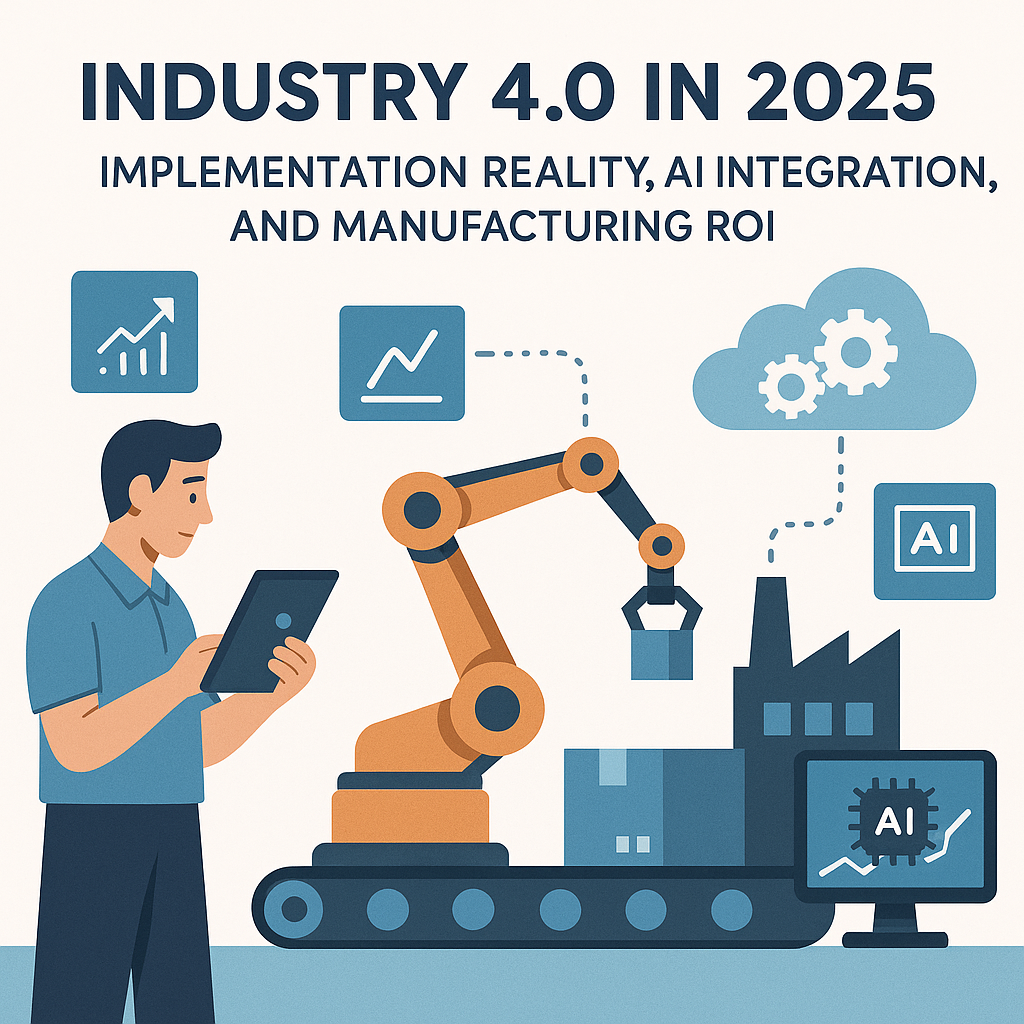
Industry 4.0 has evolved from future vision to operational reality. What began as predictions about smart factories and connected systems now represents standard practice for competitive manufacturers and precision sheet metal fabricators. In 2025, the question is no longer “should we implement Industry 4.0?” but rather “how quickly can we scale these capabilities to maintain market position?”
What Industry 4.0 Actually Means in 2025
Industry 4.0 represents the integration of digital technologies, artificial intelligence, and physical manufacturing systems creating adaptive, data-driven production environments. Unlike earlier automation focused on replacing manual labor, Industry 4.0 enables systems to optimize themselves in real time based on production data, demand signals, and quality feedback.
Core Technologies Defining Industry 4.0 Today:
Industrial Internet of Things (IIoT): Manufacturing equipment embedded with sensors continuously monitors performance, predicts maintenance needs, and optimizes operational parameters. Modern CNC machines, laser systems, and robotic cells communicate machine status, tool wear, energy consumption, and quality metrics in real time.
Artificial Intelligence and Machine Learning: AI systems analyze production data to predict quality issues, optimize schedules based on real constraints, and recommend process improvements. Modern models trained on large production datasets can predict equipment failures in advance, enabling proactive maintenance and preventing costly downtime.
Cloud Computing and Edge Computing: Manufacturing data flows to cloud platforms for enterprise-wide visibility and analysis, while edge computing handles time-critical decisions locally on the factory floor. This hybrid approach provides both real-time responsiveness and deep analytics.
Digital Twins: Virtual replicas of physical manufacturing processes enable simulation, optimization, and testing before implementing changes on real equipment. Digital twins reduce risk, accelerate process development, and support “what-if” scenario analysis without disrupting production.
Advanced Robotics and Cobots: Collaborative robots (cobots) work alongside human operators handling repetitive tasks, heavy lifting, and precision operations while humans manage complex decision-making and quality judgment. Modern cobots integrate vision systems, force sensing, and AI for adaptive behavior in less structured environments.
Additive Manufacturing Integration: 3D printing integrates with traditional manufacturing to create hybrid workflows. Metal additive manufacturing supports complex geometries, while conventional fabrication supports efficient high-volume production.
The Evolution from Prediction to Reality
When Industry 4.0 emerged as a concept in the mid-2010s, manufacturers faced uncertainty about implementation costs, technology maturity, and return on investment. A decade later, adoption is widespread, but complete enterprise integration remains an ongoing challenge.
Generative AI: The 2025 Game-Changer

The most significant Industry 4.0 development since 2020 has been the rapid adoption of generative AI and large language models—changing how manufacturers interact with data, systems, and engineering workflows.
Generative AI Applications in Manufacturing and Precision Sheet Metal Fabrication:
Process Optimization: AI models analyze production history and recommend changes that reduce cycle time, improve quality, and minimize waste—suggesting parameter adjustments, tooling changes, or workflow modifications based on patterns across comparable jobs.
Predictive Maintenance: AI models analyze vibration, temperature, power consumption, and other signals to identify failure risk patterns earlier than threshold-based systems, enabling proactive maintenance planning.
Quality Prediction: AI-enhanced vision systems can detect trends toward out-of-tolerance production during processing, enabling adjustments that prevent defects rather than detecting them after completion.
Natural Language Interfaces: Operators and engineers can query manufacturing systems using conversational prompts rather than specialized programming—for example, requesting recent runs with abnormal cycle times and receiving instant analysis.
Design Optimization: Generative design tools can propose multiple geometry variations optimized for weight, strength, or material efficiency. Some outputs require advanced fabrication approaches or additive manufacturing to produce.
Supply Chain Intelligence: AI models analyze supplier performance, material availability, logistics constraints, and demand forecasts to improve procurement decisions and reduce disruption risk.
Current Implementation Challenges

Despite significant progress, manufacturers face ongoing challenges implementing Industry 4.0 systems:
Data Integration Complexity: Legacy equipment, incompatible formats, and siloed systems create integration issues, especially in plants running mixed-age equipment with different protocols.
Cybersecurity Concerns: Connected systems expand the attack surface. OT security has different requirements than IT security, and many manufacturers need specialized expertise to manage risk.
Workforce Skills Gap: Industry 4.0 requires skills in system monitoring, analytics interpretation, and working with AI-enabled tools—training often lags adoption.
ROI Uncertainty: Benefits are real, but ROI varies by facility maturity, implementation quality, and production complexity, making payback projections challenging.
Change Management: Sustainable adoption requires cultural change toward data-driven decision-making and continuous improvement.
Practical Implementation Approaches
Successful Industry 4.0 adoption typically follows phased rollouts rather than attempting complete transformation all at once:
Phase 1: Data Collection Infrastructure (3–6 months) — Install sensors on critical equipment, starting with high-value assets. Establish reliable data capture before advanced analytics.
Phase 2: Visibility and Monitoring (6–12 months) — Implement dashboards for real-time visibility into production, performance, and quality. Use aggregated data to identify patterns and improvement opportunities.
Phase 3: Predictive Analytics (12–18 months) — Deploy models predicting failures, quality issues, and constraints. Requires sufficient historical data for training and validation.
Phase 4: Process Optimization (18–24+ months) — Implement AI-driven recommendations for parameter tuning and workflow improvements, typically with human approval before execution.
Phase 5: Autonomous Operations (24+ months, ongoing) — Expand autonomous decision-making gradually while maintaining human oversight for critical decisions.
Documented ROI from Industry 4.0 Implementation
Manufacturers implementing Industry 4.0 technologies report measurable operational improvements:
Equipment Effectiveness: Predictive maintenance reduces unplanned downtime and maintenance cost by aligning service with actual condition rather than fixed intervals.
Quality Improvement: AI-enhanced quality systems reduce defects by identifying risk trends early and enabling real-time adjustment.
Productivity Gains: Improved scheduling, reduced changeovers, and real-time capacity visibility support better throughput and delivery performance.
Inventory Reduction: Better forecasting and supply chain visibility reduce WIP while maintaining on-time delivery.
Energy Efficiency: Smart systems optimize energy use through load balancing, smarter scheduling, and reduced idle time.
Labor Efficiency: Teams shift from reactive firefighting to proactive improvement, with maintenance spending more time on planned work.
Industry 4.0 and Workforce Evolution
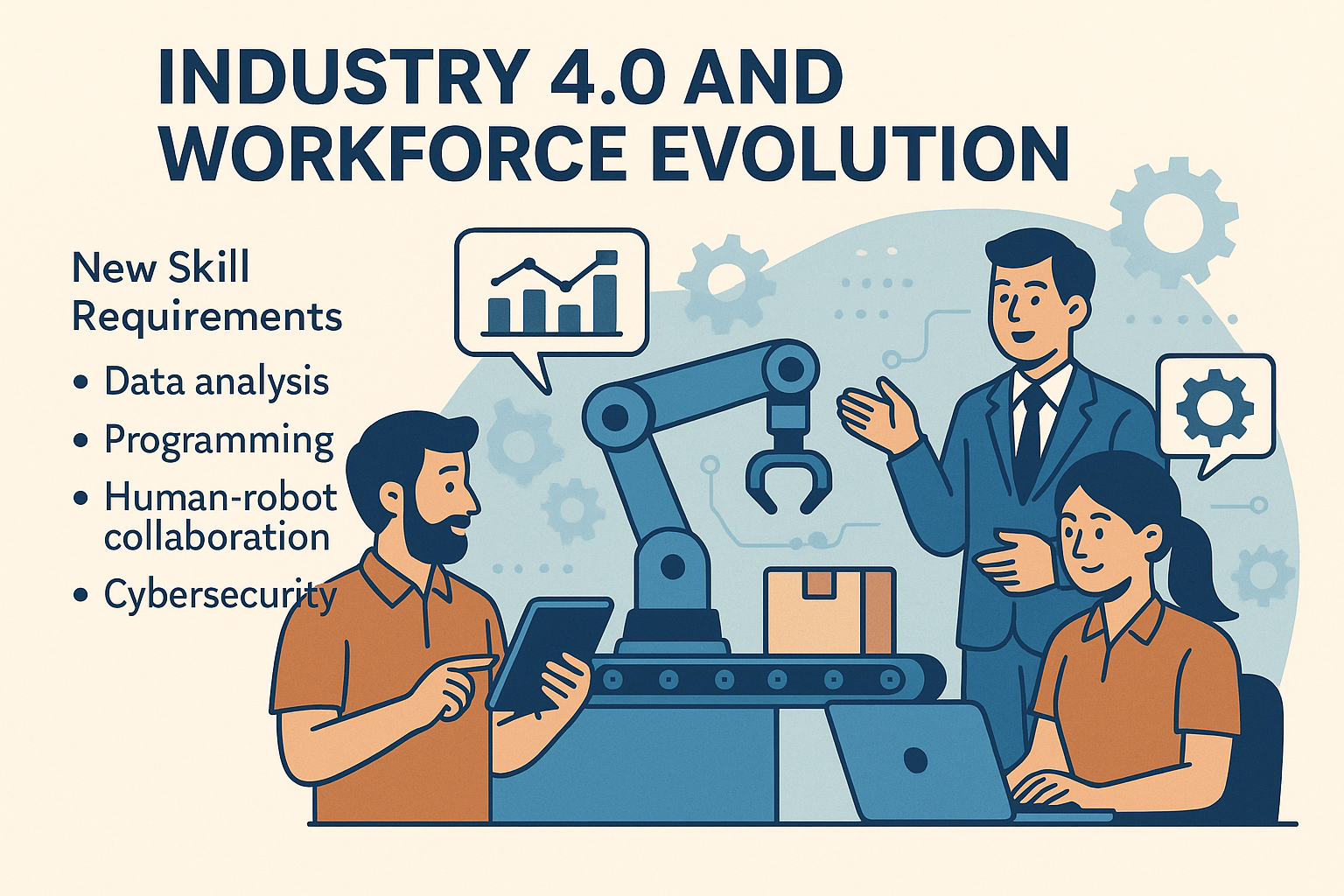
Contrary to early fears about automation eliminating jobs, Industry 4.0 has transformed workforce requirements:
New Skill Requirements:
- Data analysis and interpretation capabilities
- Programming and system configuration skills
- Human-robot collaboration understanding
- Cybersecurity awareness and practices
- Continuous improvement and problem-solving mindsets
Evolving Roles:
- Traditional maintenance technicians become “mechatronics specialists” managing integrated systems
- Quality inspectors evolve into “quality data analysts” identifying systemic improvement opportunities
- Production supervisors become “manufacturing systems coordinators” optimizing resources based on real-time data
Training and Development: Manufacturers invest in workforce development through:
- Technical training on new equipment and systems
- Data literacy programs enabling interpretation of analytics
- Cross-functional collaboration skills
- Change management and continuous improvement methodologies
Successful implementations treat workforce development as a critical success factor, involve employees early, and provide clear pathways for skill growth.
EVS Metal’s Industry 4.0 Capabilities
EVS Metal has progressively implemented Industry 4.0 technologies across contract manufacturing and sheet metal fabrication operations:
Advanced Manufacturing Equipment: Fiber laser cutting systems with automated material handling, CNC press brakes with offline programming and automatic tool changing, robotic welding cells with adaptive process control, and automated powder coating lines with process monitoring.
Data Collection Infrastructure: Equipment monitoring systems track utilization, cycle times, quality metrics, and maintenance requirements—supporting data-driven decisions and continuous improvement.
Quality Management Systems: ISO 9001:2015 certified quality systems with digital traceability, statistical process control, and comprehensive documentation supporting customer requirements and regulated environments.
Multi-Facility Coordination: Four manufacturing locations (New Jersey, Texas, Pennsylvania, New Hampshire) with enterprise-wide visibility supporting load balancing, capacity optimization, and geographic redundancy.
Engineering Integration: CAD/CAM systems support automated programming, design for manufacturability analysis, and digital file management for efficient transition from engineering to production.
Strategic Considerations for Industry 4.0 Adoption
Manufacturers evaluating Industry 4.0 investments should consider:
Start with Business Problems, Not Technology: Identify specific operational challenges (downtime, scrap, delivery performance) and prioritize technologies that address them.
Build on Existing Systems: Retrofitting sensors and connectivity to existing equipment often delivers faster ROI than wholesale equipment replacement.
Prioritize Data Quality: Invest in data governance and consistency before deploying advanced analytics.
Plan for Scalability: Avoid point solutions that work in one cell but cannot scale across the enterprise.
Secure Executive Commitment: Industry 4.0 requires sustained investment and change management support.
Partner with Experienced Providers: Vendors, integrators, and peers can accelerate implementation and reduce avoidable mistakes.
The Competitive Imperative
Industry 4.0 has transitioned from competitive advantage to competitive necessity. Manufacturers operating without data-driven decision making, predictive maintenance, and process optimization increasingly struggle to compete on cost, quality, and delivery performance.
The question isn’t whether to implement Industry 4.0, but how quickly manufacturers can develop these capabilities while maintaining current operations. Phased approaches balancing risk management with steady progress enable sustainable transformation and measurable business results.
Ready to explore Industry 4.0 capabilities for your manufacturing operations? Request a quote to discuss your production requirements and technology integration opportunities, or call EVS Metal at (973) 839-4432.
Frequently Asked Questions
What’s the typical ROI timeline for Industry 4.0 investments?
Initial investments in data collection infrastructure often show payback within 12–18 months through reduced downtime and quality improvements. More advanced capabilities like predictive analytics and process optimization may require 24–36 months for full ROI realization. Phased implementation enables earlier returns versus attempting complete transformation at once.
Do we need to replace all our equipment to implement Industry 4.0?
No. Many Industry 4.0 benefits come from retrofitting existing equipment with sensors and connectivity rather than wholesale replacement. Most facilities operate mixed-age equipment, and retrofitting critical assets often delivers better ROI than prematurely replacing functional machinery.
How do we address cybersecurity risks with connected manufacturing systems?
Implement network segmentation separating OT from IT networks, deploy industrial firewalls controlling traffic between zones, maintain regular patching and updates, enforce access controls and authentication, and conduct security assessments to identify vulnerabilities. Many manufacturers engage specialized OT security consultants due to the unique requirements compared to traditional IT security.
What if our workforce lacks technical skills for Industry 4.0 systems?
Successful manufacturers invest in workforce development through technical training, data literacy initiatives, and continuous improvement programs. Involve employees early, provide clear skill pathways, and recognize that adoption takes time. Many manufacturers partner with community colleges and technical schools to create customized training.
Can small and mid-size manufacturers benefit from Industry 4.0, or is it only for large enterprises?
Industry 4.0 benefits scale to manufacturer size. Small manufacturers often implement faster than large enterprises due to fewer legacy constraints. Cloud solutions and subscription pricing reduce capital requirements, making advanced monitoring, analytics, and AI more accessible to smaller operations.
How do we justify Industry 4.0 investments when ROI is uncertain?
Start with pilots tied to specific problems with measurable costs (such as downtime on a critical machine or chronic scrap on a key part). Demonstrate value through targeted implementation and tracking, then use pilot results to build the case for broader rollout. Many manufacturers also factor in the competitive risk of delaying adoption while peers gain cost, quality, and delivery advantages.