

 The conversation around American manufacturing has evolved dramatically since the early optimism of the 2010s. What began as straightforward “bring jobs back home” rhetoric has matured into a complex strategic calculus involving reshoring, nearshoring, friend-shoring, and sophisticated total cost of ownership analysis. For manufacturers and procurement teams navigating sourcing decisions in 2025, understanding this nuanced landscape isn’t optional—it’s essential for competitive positioning.
At EVS Metal, we’ve observed these shifts firsthand as companies across industries reevaluate their supply chain strategies. The reality we’re seeing differs substantially from both the early reshoring cheerleading and the skepticism that followed. The truth, as data from 2024 and early 2025 demonstrates, is more interesting than either narrative suggested.
The Current State of Reshoring: What the Data Actually Shows
Recent research paints a picture far more complex than simple trend lines suggest. The Reshoring Initiative reports that 244,000 U.S. manufacturing jobs were announced in 2024 through reshoring and foreign direct investment. Since 2010, over 2 million jobs have been announced as companies and foreign investors bring manufacturing closer to U.S. customers. These numbers reflect sustained momentum driven by geopolitical risk, supply chain vulnerabilities, and growing bipartisan support for domestic industrial capacity.
However, Kearney’s 2025 Reshoring Index—which tracks the ratio of manufactured goods imported from Asian low-cost countries versus U.S. domestic gross manufacturing output—declined by 311 points in 2024, returning to negative territory after two consecutive years of growth. This reversal occurred despite increased CEO commitment to reshoring strategies.
What explains this apparent contradiction? The answer reveals the difference between intention and execution, between announcing capacity and actually delivering production at scale.
Supply, Demand, and Capacity Constraints
U.S. manufacturing gross output has remained essentially flat since early 2023 after absorbing most latent domestic capacity. Companies announced major investments—semiconductor fabs, battery plants, reshored production facilities—but converting capital into operational capacity takes time. Meanwhile, domestic demand continued growing faster than new domestic supply could accommodate.
Mexico, previously the primary beneficiary of nearshoring shifts away from Asian production, also struggled to scale quickly enough in 2024. As U.S. demand outpaced what domestic and nearshore production could supply, imports from Asian low-cost countries increased by approximately 10%, or $90 billion, led by computers, electronics, and electrical equipment categories.
This doesn’t indicate reshoring failure. It demonstrates that market fundamentals—supply availability, delivery timelines, and total costs—ultimately drive sourcing decisions more than policy announcements or CEO intentions. Political will and investment commitments matter, but physics and economics constrain how quickly manufacturing ecosystems can transform.
High-Tech Manufacturing Leads the Shift
Not all sectors are moving at the same pace. In 2024, 88% of announced reshoring jobs concentrated in high or medium-high tech sectors—a proportion that rose to 90% in early 2025. Industries leading this shift include:
Computer & Electronics Manufacturing: Driven substantially by CHIPS Act incentives for semiconductor production, with major fab construction underway across Arizona, Texas, Ohio, and New York.
Electrical Equipment & Batteries: Electric vehicle battery production and solar equipment manufacturing benefit from Inflation Reduction Act provisions, creating substantial domestic capacity in Southern states.
Transportation Equipment: Automotive manufacturing, particularly EV production, accounted for significant job announcements as automakers build domestic supply chains for electric powertrains.
Meanwhile, low-tech and consumer goods manufacturing remains heavily import-dependent. Mass-market consumer products, where price sensitivity dominates purchasing decisions and automation provides limited competitive advantage, continue sourcing primarily from Asian production.
This bifurcation matters for understanding which reshoring strategies succeed and which face structural headwinds.
Beyond Reshoring: The Rise of Nearshoring and Friend-Shoring
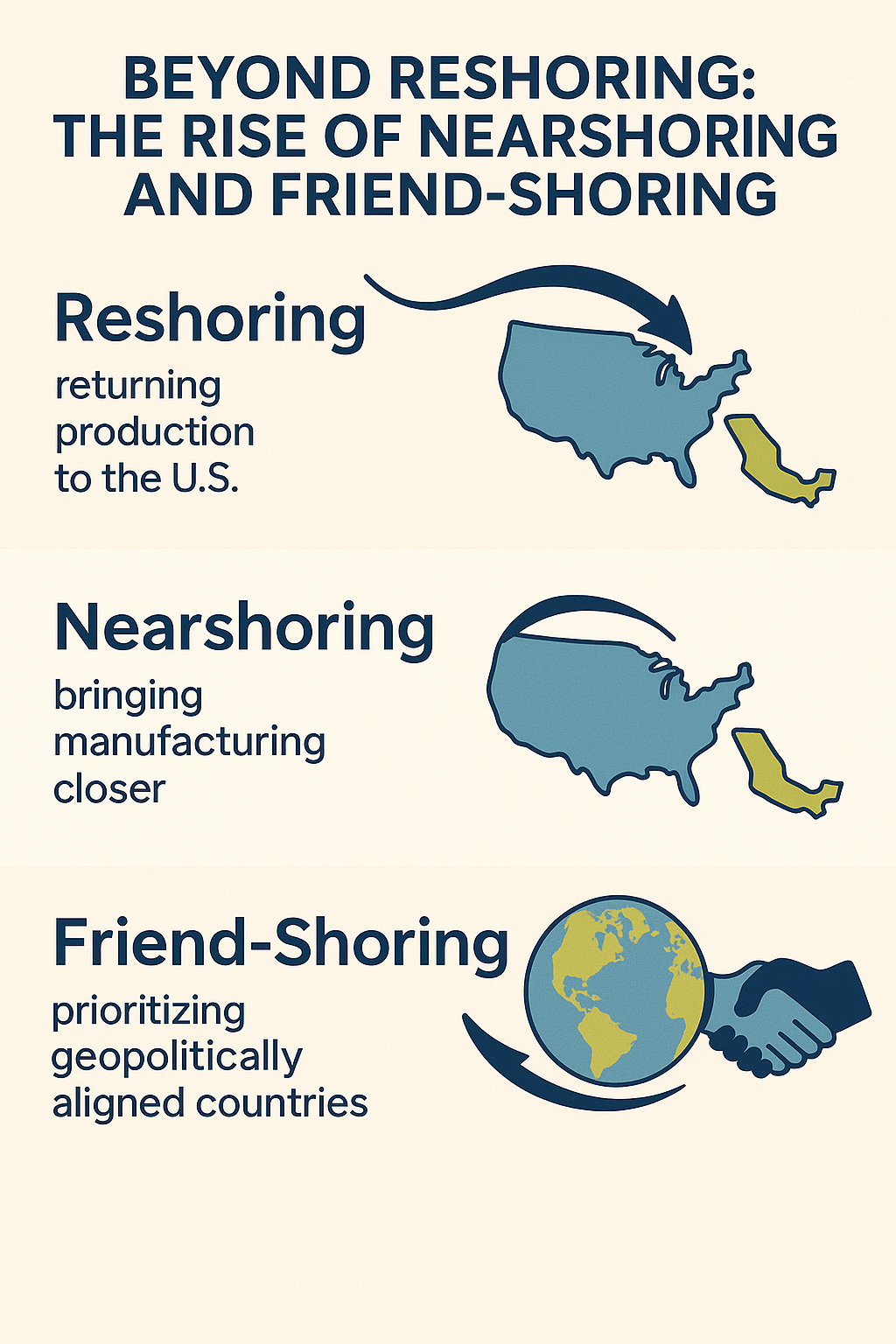 The terminology itself has evolved to reflect strategic nuance. Reshoring specifically means returning production to the United States. Nearshoring brings manufacturing geographically closer—typically to Mexico, Canada, or Caribbean nations—without returning it to U.S. soil. Friend-shoring prioritizes production in geopolitically aligned countries regardless of distance.
Each approach serves different strategic objectives and faces distinct challenges:
Mexico as Manufacturing Partner
Mexico remains the foremost nearshoring destination for North American companies, particularly strong in automotive manufacturing, industrial equipment, and increasingly electronics production. Geographic proximity enables shorter lead times than Asian sourcing while maintaining cost advantages versus domestic U.S. production.
However, Mexico faces infrastructure constraints that limit how quickly manufacturing can scale. Energy grid capacity, particularly in northern industrial zones, creates bottlenecks. Bureaucratic complexity slows facility development. Skilled labor availability varies substantially by region and industry.
These constraints explain why Mexico couldn’t fully absorb demand growth in 2024 despite substantial nearshoring momentum. Companies planning significant nearshore capacity need realistic timelines accounting for infrastructure limitations and workforce development requirements.
Canada and Caribbean Manufacturing
Canada offers political stability, aligned regulatory frameworks, and skilled manufacturing workforces, though higher labor costs versus Mexico make it selective for applications where technical sophistication or regulatory complexity justify premium pricing.
Caribbean nations increasingly attract consideration for specific manufacturing categories, particularly where duty advantages, English language capabilities, and U.S. cultural alignment create value. However, infrastructure limitations and smaller labor pools constrain scalability for high-volume production.
Friend-Shoring to Allied Nations
Geopolitical considerations increasingly influence sourcing strategy beyond pure economics. Companies diversifying away from China-centric supply chains often consider production in Vietnam, India, Thailand, and other Asian nations perceived as more politically stable and economically aligned with U.S. interests.
This strategy maintains cost advantages associated with Asian manufacturing while reducing concentration risk. However, friend-shoring to distant locations sacrifices the supply chain responsiveness and reduced logistics costs that nearshoring provides.
The Economics of Domestic Manufacturing: Total Cost of Ownership Analysis
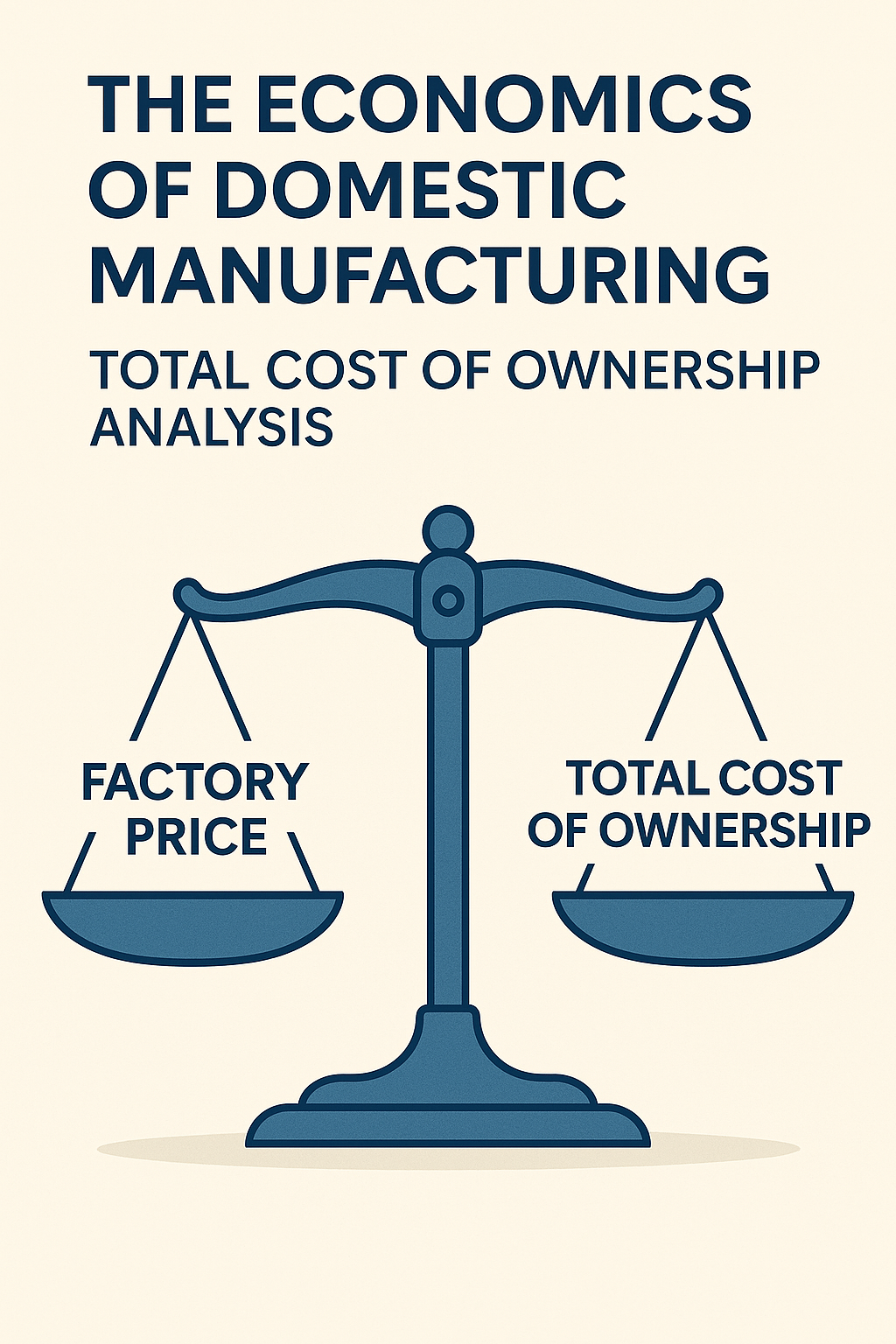 Understanding why reshoring succeeds or fails requires moving beyond simple factory price comparisons to comprehensive total cost of ownership (TCO) analysis.
The Reshoring Initiative’s research demonstrates that when companies evaluate TCO rather than just purchase price, U.S.-based manufacturing locations win against offshoring to China in 32% of cases—versus only 8% when considering factory price alone. This dramatic difference explains why sophisticated procurement teams increasingly employ TCO frameworks for sourcing decisions.
Components of Total Cost of Ownership
Direct Costs Beyond Factory Price:
- International shipping and freight (increasingly volatile)
- Customs duties and tariffs (particularly relevant with current trade policies)
- Inventory carrying costs (longer supply chains require larger buffer stock)
- Quality inspection and compliance verification
- Travel costs for supplier management and quality oversight
Indirect Costs Often Overlooked:
- Engineering collaboration inefficiencies across time zones and languages
- Intellectual property risk and protection costs
- Supply chain disruption risk (quantifying potential revenue impact)
- Slower time-to-market affecting competitive positioning
- Reduced flexibility responding to demand changes or design iterations
- Material sourcing complications when components cross multiple borders
Strategic Considerations:
- Domestic manufacturing’s proximity enables collaborative engineering relationships that improve product design and reduce manufacturing complexity
- Shorter lead times support leaner inventory strategies and faster market response
- U.S.-based facilities provide greater supply chain transparency and reduced geopolitical exposure
- Domestic sourcing for critical applications eliminates foreign supplier dependency
When Reshoring Makes Economic Sense
TCO analysis consistently favors domestic manufacturing when:
Technical Complexity is High: Precision fabrication requirements, tight tolerances, and complex assemblies benefit from proximity between engineering and production teams. Collaborative problem-solving across 12-hour time differences creates inefficiencies that compound throughout product development.
Product Iterations Are Frequent: Industries with rapid design evolution—technology hardware, medical devices, industrial equipment—benefit substantially from domestic manufacturing enabling quick prototype-to-production cycles and design optimization iterations.
Supply Chain Responsiveness Matters: Products facing demand volatility or shortened lifecycle curves need manufacturing flexibility that distant supply chains struggle to provide. Domestic fabricators can adjust production schedules within days rather than weeks or months.
Intellectual Property Protection is Critical: Proprietary designs, specialized processes, or competitive differentiation based on manufacturing techniques receive better protection through domestic production versus offshore manufacturing where IP controls prove more difficult to enforce.
Regulatory Compliance is Stringent: Industries facing extensive regulatory oversight—aerospace, defense, medical devices, food processing equipment—often find domestic manufacturing simplifies compliance documentation and reduces regulatory risk.
Labor Cost is Small Proportion of Total Cost: When material costs, capital equipment, or engineering content dominate product economics, geographic labor cost differences matter less. Automation and advanced manufacturing technologies increasingly enable domestic production competitiveness even in traditionally labor-intensive categories.
The Labor Challenge: Finding and Developing Manufacturing Workforce
For all the progress in reshoring job announcements, workforce availability represents the most frequently cited barrier to execution. In recent surveys, nearly 25% of CEOs identified labor cost as their primary reshoring challenge, while labor shortages and skills gaps compound the cost issue.
The Current Workforce Reality
Manufacturing employment in the United States totals approximately 12.8 million workers—just 8.1% of total nonfarm employment. Manufacturing employment peaked in absolute terms in 1979 at 19.4 million workers and declined by 6.6 million jobs even as overall U.S. employment grew by 68 million from 1979 to 2025.
This isn’t just about raw numbers. Manufacturing has struggled with workforce perception challenges. Younger workers often view manufacturing as dirty, dangerous, and technologically backward—perceptions increasingly disconnected from modern manufacturing reality but nonetheless affecting recruitment.
Manufacturing apprenticeships have increased 83% over the past decade, demonstrating growing investment in workforce development. However, retirements continue outpacing new workforce entrants in many manufacturing sectors, particularly in skilled trades like welding, precision machining, and quality inspection.
Addressing the Skills Gap
Successful reshoring increasingly requires coordinated workforce development strategies:
Industry-Education Partnerships: Manufacturers working directly with community colleges and technical schools to develop curriculum matching actual skill requirements create talent pipelines aligned with industry needs.
Apprenticeship and Training Programs: Structured programs combining classroom instruction with paid workplace training enable workers to earn while developing manufacturing competencies. These programs work particularly well for precision manufacturing roles requiring both technical knowledge and hands-on skill development.
Manufacturing Perception Transformation: The sector needs rebranding emphasizing modern manufacturing’s technological sophistication, safety improvements, competitive wages, and career advancement opportunities. Today’s manufacturing increasingly involves operating advanced CNC equipment, programming robotic systems, and managing digital manufacturing processes—roles appealing to technically-minded workers.
Automation as Workforce Complement: Rather than viewing automation as workforce replacement, leading manufacturers deploy automation to handle repetitive or physically demanding tasks while upskilling workers for higher-value technical, programming, and oversight roles. This approach addresses both productivity requirements and workforce attraction challenges.
Strategic Sourcing in 2025: A Framework for Decision-Making
Rather than treating reshoring as binary choice—domestic versus offshore—sophisticated manufacturers employ portfolio approaches balancing multiple considerations:
Risk-Adjusted Sourcing Strategy
Critical Components and Assemblies: Items where supply disruption creates substantial business impact increasingly source domestically or from highly reliable nearshore partners. This might mean paying premium prices for security of supply.
High-Volume Commodity Items: Products where specifications are stable, quality requirements are standard, and demand is predictable often continue sourcing from lowest-cost global suppliers. The economics simply favor offshore production when supply chain risk is manageable.
Technically Complex or Rapidly Evolving Products: These benefit from domestic or nearshore manufacturing enabling engineering collaboration and rapid iteration cycles.
Geographically Diverse Supply Base: Rather than single-sourcing from either domestic or offshore suppliers, leading companies maintain qualified suppliers across multiple regions, creating flexibility to shift production as conditions change.
Evaluating Domestic Fabrication Partners
When reshoring makes strategic sense, selecting the right manufacturing partner determines execution success. Key evaluation criteria include:
Technical Capabilities Matching Product Requirements: Does the fabricator possess equipment, processes, and technical expertise for your specific applications? Precision sheet metal fabrication differs substantially from general metal fabrication, and requirements vary dramatically across industries and applications.
Quality Systems Supporting Your Industry: Regulated industries require fabricators with appropriate quality certifications and documentation capabilities. ISO 9001 certification provides baseline assurance, but specific industries may require additional certifications or compliance frameworks.
Engineering Support Beyond Manufacturing: The most valuable fabricator relationships extend beyond build-to-print manufacturing to include design collaboration, value engineering, and manufacturing optimization. This requires fabricators maintaining engineering capabilities and fostering cultures of technical partnership.
Geographic Proximity and Multi-Location Capability: Domestic sourcing provides advantages, but does the fabricator’s geographic footprint align with your operations? Multiple facility locations can provide redundancy and regional coverage supporting diverse customer bases or regional project requirements.
Capacity and Scalability: Can the fabricator handle current volumes while accommodating future growth? Understanding capacity constraints and expansion capabilities prevents partnerships from becoming bottlenecks as demand scales.
Supply Chain Transparency and Communication: Domestic manufacturing should provide greater visibility than offshore sourcing. Fabricators with robust communication systems, proactive project management, and transparent scheduling enable better supply chain coordination.
Looking Forward: The Evolution Continues
 The reshoring conversation will continue evolving as economic conditions, technology capabilities, policy frameworks, and geopolitical realities shift. Several trends appear likely to influence the trajectory:
Policy Uncertainty Creates Investment Hesitation: Early 2025 data shows potentially declining job announcements as companies await clarity on tariff policies, tax incentives, and industrial strategy. Once policy frameworks stabilize, we may see another wave of capacity announcements converting to operational facilities.
Automation Narrows Labor Cost Gaps: Continued advances in manufacturing automation, robotics, and AI-enabled production systems increasingly offset labor cost differences between domestic and offshore manufacturing. This trend particularly benefits high-tech manufacturing and complex assemblies where automation provides substantial productivity advantages.
China Plus One Strategies Become Standard: Few companies will entirely eliminate China from their supply chains given its manufacturing scale and ecosystem depth. However, maintaining alternative suppliers outside China for critical components and having capability to shift production if geopolitical conditions deteriorate becomes standard practice.
Mexico Infrastructure Investment Accelerates: Recognizing constraints limiting nearshoring growth, both Mexican government and private investment in energy infrastructure, transportation systems, and industrial development will likely accelerate, expanding nearshore manufacturing capacity serving North American markets.
Skilled Workforce Development Becomes Competitive Advantage: Manufacturers investing in workforce training, apprenticeship programs, and technical education partnerships will increasingly differentiate themselves through available talent pools. Geographic regions developing strong manufacturing workforce ecosystems will attract disproportionate investment.
Total Cost of Ownership Frameworks Become Standard Practice: As more companies recognize the limitations of purchase-price-only sourcing decisions, TCO analysis will become standard procurement practice. This shift systematically favors domestic and nearshore manufacturing where appropriate.
The EVS Perspective on Domestic Manufacturing
At EVS Metal, we’ve operated as domestic precision fabricators for over 30 years, serving customers across industries through various economic cycles and supply chain disruptions. Our experience suggests several realities about successful domestic manufacturing partnerships:
Proximity Enables Collaboration: When engineering teams and production facilities operate in the same time zones and can visit each other’s facilities within hours rather than days, product development accelerates and manufacturing optimization becomes continuous rather than episodic.
Quality Consistency Requires System Discipline: Domestic manufacturing doesn’t automatically guarantee superior quality—quality results from systematic process control, inspection protocols, and continuous improvement cultures. Our four ISO 9001:2015-certified facilities across New Jersey, Pennsylvania, New Hampshire, and Texas maintain quality systems enabling consistent output regardless of which facility produces specific components.
Flexibility Serves as Competitive Advantage: Domestic fabricators able to accommodate design changes, adjust production schedules, and support compressed timelines provide strategic value beyond piece price. This responsiveness becomes increasingly valuable in volatile market conditions.
Technical Expertise Differentiates: Not all domestic manufacturers offer equivalent capabilities. Precision fabrication, advanced welding processes, complex assemblies, and regulated industry experience create substantial differentiation among domestic suppliers.
The reshoring conversation has matured beyond simplistic narratives. Success requires understanding total economics, matching applications to appropriate sourcing strategies, selecting qualified manufacturing partners, and maintaining realistic timelines for capacity development.
For companies evaluating domestic sourcing as part of supply chain resilience strategies, the opportunity exists—but execution requires more sophistication than simply redirecting purchase orders from offshore to domestic suppliers. It requires partnership with manufacturers possessing appropriate capabilities, collaborative engineering approaches, and commitment to continuous improvement.
The “Made in USA” designation matters—but only when backed by manufacturing excellence delivering competitive total cost of ownership, supply chain reliability, and technical collaboration creating genuine competitive advantage.
Exploring domestic precision sheet metal fabrication for your supply chain strategy? EVS Metal’s team brings decades of experience serving diverse industries with complex requirements. Request a personalized quote online or call (973) 839-4432 to discuss how our capabilities might align with your sourcing objectives.
Frequently Asked Questions About Reshoring and Sourcing Strategy
What is the difference between reshoring, nearshoring, and friend-shoring?
Reshoring refers to bringing manufacturing back to the United States. Nearshoring shifts production closer to U.S. markets, typically to countries such as Mexico or Canada. Friend-shoring prioritizes sourcing from geopolitically aligned or strategically friendly nations, even if they are geographically distant.
What does recent data say about the current state of reshoring?
Recent data shows strong momentum in reshoring and foreign direct investment, with significant numbers of manufacturing jobs announced in the United States. At the same time, indicators like the Kearney Reshoring Index suggest that imports from low-cost Asian countries remain substantial, highlighting a gap between reshoring intentions and fully realized domestic production capacity.
Why is there a gap between reshoring announcements and actual domestic production?
There is often a delay between announcing new facilities and achieving full operational capacity. Building plants, installing equipment, qualifying processes, and hiring and training workers all take time. While U.S. and nearshore capacity ramps up, demand can still exceed available domestic supply, so many companies continue relying on imports in the near term.
What is total cost of ownership (TCO) in manufacturing sourcing decisions?
Total cost of ownership in manufacturing looks beyond unit purchase price and accounts for all costs over the product lifecycle. This includes freight, duties, inventory carrying costs, quality issues, engineering coordination, supply chain risk, time-to-market impacts, and regulatory compliance. TCO analysis often shows domestic or nearshore options to be more competitive than offshore sources that appear cheaper on price alone.
When does domestic manufacturing make economic sense versus offshoring?
Domestic manufacturing tends to make the most sense when products are technically complex, subject to frequent design changes, face demand volatility, carry high regulatory or quality risk, or involve sensitive intellectual property. In these situations, shorter lead times, closer engineering collaboration, and reduced supply chain risk often outweigh offshore labor cost savings.
How do labor shortages and skills gaps affect reshoring efforts?
Labor availability is one of the main constraints on reshoring. Many manufacturers struggle to hire enough skilled tradespeople in areas like welding, precision machining, and quality inspection. Although apprenticeships and training programs are expanding, retirements and perception challenges around manufacturing careers make workforce development a critical factor in executing reshoring strategies.
How should companies think about sourcing strategy in 2025?
Instead of treating sourcing as a simple domestic-versus-offshore decision, leading companies use a portfolio approach. Critical or highly engineered components may be sourced domestically or nearshore for security and responsiveness, while stable, high-volume commodity items may stay with low-cost global suppliers. Many organizations intentionally diversify their supply bases geographically to reduce concentration risk.
What should companies look for in a domestic fabrication partner?
Key criteria include technical capabilities aligned with product requirements, robust quality systems and certifications, engineering support for design and manufacturability, a geographic footprint that matches customer locations, capacity and scalability for future growth, and transparent communication and scheduling practices.
How does EVS Metal support domestic manufacturing and reshoring strategies?
EVS Metal supports domestic manufacturing through four ISO 9001:2015-certified U.S. facilities in New Jersey, Pennsylvania, New Hampshire, and Texas. The company provides precision sheet metal fabrication, machining, welding, finishing, and engineering collaboration, helping customers reduce supply chain risk, improve responsiveness, and optimize total cost of ownership for reshored or domestically sourced products.