

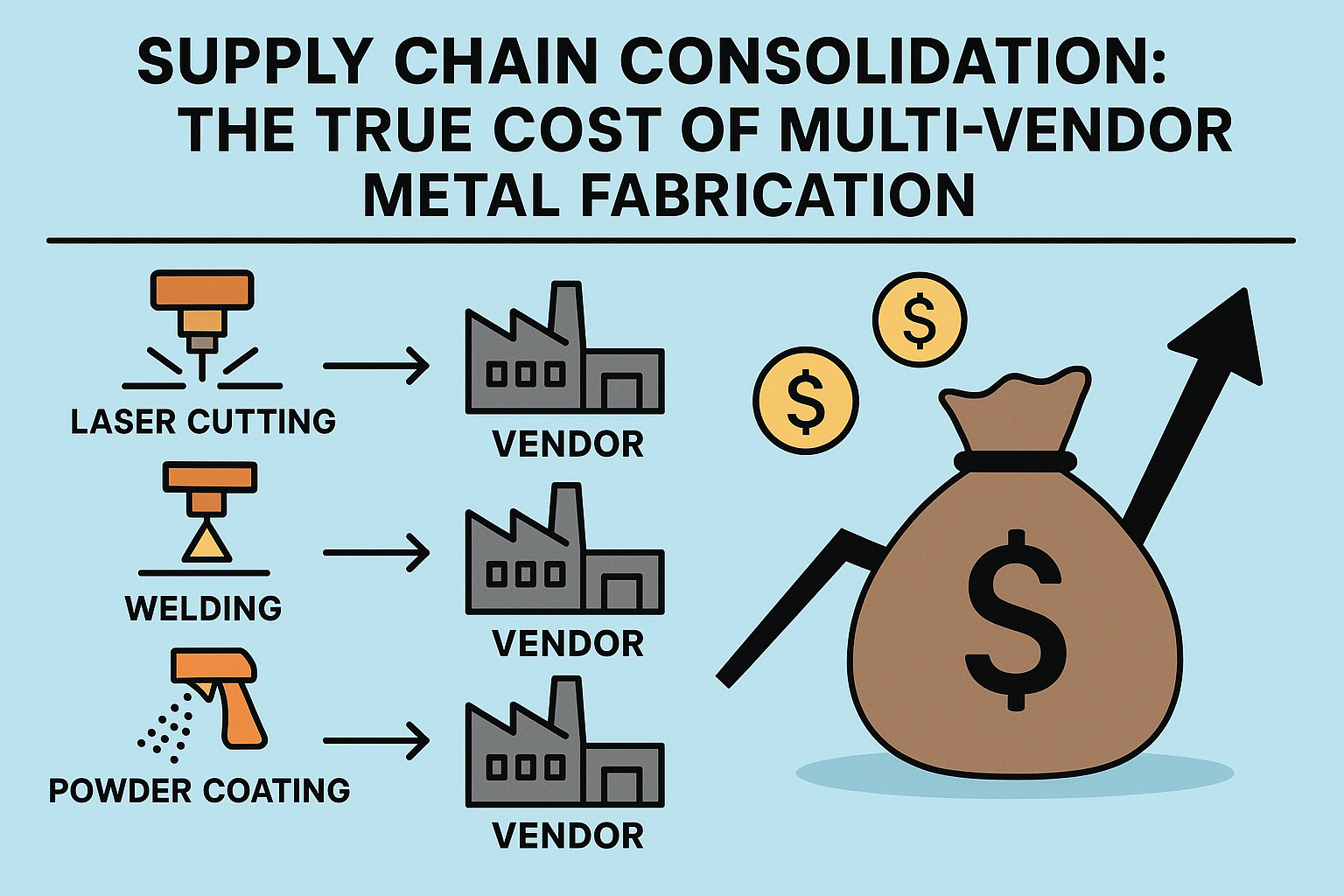
In manufacturing, the promise of competitive pricing from specialized vendors can be compelling. Why wouldn’t an OEM seek out the best price for laser cutting from one supplier, the lowest rate for welding from another, and the most competitive powder coating from a third? On paper, this multi-vendor strategy appears to maximize cost efficiency by leveraging each supplier’s competitive advantages.
In practice, however, this approach often produces the opposite result. When all factors are considered—including the less visible costs of coordination, quality management, logistics complexity, and risk—many OEMs discover they’re spending significantly more than if they’d consolidated with a comprehensive contract fabrication and manufacturing partner. In an era of supply chain disruption and increasing manufacturing complexity, understanding these hidden costs has never been more critical.
The Compounding Costs of Vendor Management
Every additional fabrication partner in your supply chain creates a multiplicative effect on management complexity. This isn’t simply about having more phone numbers to call—it’s about the infrastructure required to coordinate multiple vendors effectively.
Personnel and Oversight Requirements: Each vendor relationship requires dedicated management time for communication, scheduling coordination, quality oversight, and problem resolution. For organizations working with 5-10 different fabrication suppliers, this often necessitates full-time supply chain management staff whose sole responsibility is vendor coordination. Beyond base salaries and benefits, these positions create additional costs in training, tools, and administrative support.
Quality Assurance Travel and Verification: Responsible OEMs conduct regular on-site audits of their fabrication partners to verify quality standards, inspect facilities, and maintain relationships. With multiple vendors across different geographic locations, travel expenses compound quickly. More significantly, the time investment for these visits—including travel, facility tours, meetings, and follow-up documentation—represents a substantial opportunity cost. That’s time not spent on product development, customer relationships, or strategic planning.
Communication Overhead: Beyond scheduled oversight, the daily reality of managing multiple vendors creates constant communication demands. Questions about specifications, clarifications on drawings, discussions about material substitutions, coordination on delivery schedules—each vendor relationship generates its own stream of emails, calls, and meetings. This communication overhead doesn’t just cost time; it creates opportunities for miscommunication and error.
The Hidden Cost: Research from APQC (American Productivity & Quality Center) reveals the dramatic impact of supply chain management efficiency. Their benchmarking data shows that top-performing organizations spend $26.31 per $1,000 in revenue on supply chain management, while bottom performers spend $107.09 per $1,000 in revenue. For an organization with $5 billion in annual revenue, this difference represents over $400 million in supply chain costs. More broadly, companies with optimized supply chains demonstrate 15% lower supply chain costs overall compared to those without optimization focus.
Logistics Complexity and Transportation Expenses
 In today’s manufacturing environment, supply chain logistics represents one of the most significant and volatile cost factors. Multi-vendor strategies amplify these challenges exponentially. With U.S. logistics costs totaling $2.3 trillion annually according to industry data, even small inefficiencies translate to substantial expenses.
Freight Cost Multiplication: Shipping from multiple locations instead of a single source eliminates opportunities for consolidated freight and volume discounts. Each vendor ships separately, often in less-than-truckload quantities that carry premium rates. What might have been a single consolidated shipment becomes five separate deliveries, each with its own freight charges, fuel surcharges, and handling fees. According to the Bureau of Transportation Statistics, freight transportation costs increased 1.8-1.9% year-over-year through 2025, adding further pressure to already elevated transportation expenses.
Increased Inventory and Warehousing: When components arrive from multiple suppliers on different schedules, OEMs face two costly choices: maintain higher inventory levels to buffer against timing mismatches, or risk production delays waiting for all components to arrive. Either option creates cost—either in inventory carrying expenses and warehouse space, or in production inefficiency and scheduling complications.
Schedule Coordination Challenges: Coordinating delivery timing across multiple vendors creates constant logistical puzzles. One vendor’s production delay can cascade through the entire assembly process, forcing expedited shipping from other vendors to maintain schedule alignment. These expedited freight charges can easily eliminate months of carefully negotiated cost savings.
In-Transit Risk and Damage: More shipments mean more opportunities for damage, loss, or delay. Each incident requires investigation, insurance claims, and potentially emergency replacement orders—all of which create both direct costs and operational disruption. In industries where components must arrive in pristine condition for precision assembly, even a single damaged shipment can delay production by weeks.
Supply Chain Visibility Gaps: With components moving from multiple sources, maintaining real-time visibility into what’s where becomes significantly more complex. OEMs often invest in supply chain management software to track shipments across vendors, adding another layer of cost to the multi-vendor equation.
Quality Inconsistency and Rework Expenses
Quality consistency becomes exponentially more challenging when managing multiple fabrication partners, each with their own processes, equipment, and standards interpretation.
Process Variation Across Vendors: Even when all vendors are working from identical specifications, differences in equipment, techniques, and quality control procedures create part-to-part variation. One vendor’s laser cutting tolerance might be tighter than another’s. Welding techniques vary. Finishing quality differs. These inconsistencies can create fit and assembly challenges when components from different vendors must work together in final products.
The Cost of Rework: When quality issues arise—and with multiple vendors, the probability increases—the financial impact extends far beyond the immediate part cost. Manufacturing quality experts have long recognized what’s known as the “Rule of 10”: defects cost approximately 10 times more to fix at each subsequent stage of production. A defect caught during fabrication might cost $10 to correct; the same defect discovered during assembly costs $100; after delivery to the customer, it can cost $1,000 or more.
Industry research on the cost of poor quality consistently shows that rework expenses, when fully calculated, typically range from multiple times the original production cost. This includes investigation time to identify the source and cause, communication with the responsible vendor, decision-making about whether to rework or replace, potential production delays, quality re-verification, and documentation for quality management systems. Manufacturing rework rarely costs less than double the original part price when all factors are included, and problems discovered after assembly can cost ten times the original component value or more.
Inspection Burden: To protect against quality inconsistency across vendors, many OEMs implement more rigorous incoming inspection procedures. This creates additional labor costs, equipment investments, and time delays before parts can enter production. Ironically, the inspection infrastructure required to manage multi-vendor quality risks can cost more than the fabrication savings the strategy was designed to achieve.
Accountability Complexity: When quality problems occur in a multi-vendor environment, determining responsibility becomes complicated. If a finished product fails, was it due to Vendor A’s cutting precision, Vendor B’s welding quality, or Vendor C’s finishing process? This accountability ambiguity can delay problem resolution and make it difficult to implement effective corrective actions.
Risk Exposure and Business Continuity Challenges
 Every additional vendor in your supply chain represents another potential point of failure. In an era of increasing supply chain disruption, this distributed risk exposure carries significant costs—both realized and potential. Industry data shows that nearly 80% of organizations experienced at least one supply chain disruption in recent years, with disruptions lasting longer than one month occurring on average every 3.7 years.
Multiplied Disruption Probability: Natural disasters, equipment failures, labor disputes, financial instability, cyberattacks—any of these events can shut down a supplier’s operations. With a single manufacturing partner, you face one set of these risks. With five vendors, you face five independent sets of risks, each with its own probability of disruption. Statistically, the likelihood that your supply chain will experience some form of vendor disruption in any given year increases substantially with each additional supplier relationship.
Recovery Complexity: When a single-source partner experiences disruption, you have one problem to solve and one recovery plan to coordinate. When one of multiple vendors goes down, you must not only address that specific disruption but also manage the cascading effects on your other vendor relationships and production schedule. The coordination complexity of multi-vendor recovery scenarios can extend downtime significantly.
Intellectual Property Fragmentation: Distributing your product manufacturing across multiple vendors means distributing your intellectual property as well. Each additional vendor relationship creates additional exposure for proprietary designs, processes, or specifications. While NDAs and contracts provide legal protection, they don’t eliminate the risk of inadvertent disclosure or the challenges of enforcement if violations occur.
Limited Leverage in Crisis: When supply chain disruptions occur—whether pandemic-related, due to natural disasters, or caused by other factors—single-source partners typically prioritize their most strategic, highest-volume customers. In a multi-vendor strategy where your business is divided among many suppliers, you may represent a smaller percentage of each vendor’s revenue, potentially reducing your priority status when capacity becomes constrained.
The Opportunity Cost of Management Bandwidth
Perhaps the most significant but least quantified cost of multi-vendor manufacturing is the opportunity cost of the management attention it requires.
Strategic Focus Dilution: Every hour spent coordinating vendors, resolving quality issues, expediting delayed shipments, or managing logistics is an hour not spent on product innovation, market development, customer relationships, or strategic planning. For growing companies and resource-constrained operations, this diversion of management bandwidth away from value-creating activities can be the difference between capturing market opportunities and missing them.
Decision-Making Burden: Multi-vendor strategies create constant decision-making demands: Which vendor should produce this new component? How do we balance the workload? Should we split this order or consolidate it? What’s our backup plan if Vendor X can’t meet the schedule? These decisions consume time and mental energy that could be directed toward more strategic challenges.
Relationship Management Tax: Maintaining effective relationships with multiple vendors requires ongoing investment in communication, visits, performance reviews, and problem-solving. While relationship management is important with any partner, the overhead multiplies with each additional vendor in your network.
The Single-Source Alternative: Total Cost Advantages
Understanding these hidden costs of multi-vendor manufacturing illuminates why an increasing number of OEMs are consolidating their fabrication with comprehensive partners capable of handling the full range of metalworking processes.
Simplified Coordination: With a single manufacturing partner, coordination complexity collapses. One point of contact. One quality system to understand and verify. One delivery schedule to manage. One relationship to maintain. The reduction in administrative overhead and communication burden frees up management bandwidth for strategic activities.
Consolidated Logistics: Single-source manufacturing enables consolidated shipping—one shipment, one freight charge, one delivery schedule. This eliminates the logistics coordination puzzle, reduces transportation costs, and simplifies receiving and inventory management. Parts arrive together, ready for assembly, without the coordination challenges of multi-vendor timing.
Consistent Quality Standards: When all fabrication processes occur within a single quality management system, consistency improves dramatically. The same precision standards, the same quality control procedures, the same equipment calibration protocols—all applied across every operation. This consistency reduces inspection burden, minimizes rework, and increases first-pass quality rates.
Concentrated Risk: Rather than distributing risk across multiple vendors (and multiplying failure probability), single-source partnerships concentrate risk but with a key advantage: you can thoroughly evaluate and monitor that one set of risks. Site visits are more frequent and thorough when you’re visiting one facility instead of five. Business continuity planning is more robust when focused on one partner’s capabilities. And your business represents a larger percentage of your partner’s revenue, increasing their commitment to your success.
Process Integration and Efficiency: Comprehensive manufacturing partners can optimize process flow in ways impossible in multi-vendor arrangements. When cutting, forming, welding, and finishing all happen in the same facility, the transition between operations is seamless. There’s no shipping delay between processes, no re-handling costs, no coordination confusion. The efficiency gains from this integration often exceed the per-process cost differences that initially made the multi-vendor approach appear attractive.
Enhanced Agility: In today’s market environment, agility matters. Being able to adjust designs, modify specifications, increase volumes, or accelerate schedules is often critical to competitive success. These changes are dramatically simpler to implement with a single partner than when coordinating modifications across multiple vendors, each with their own change order processes and communication systems.
EVS Metal: Comprehensive Metal Fabrication Under One Roof
The strategic advantages of supply chain consolidation require a manufacturing partner with genuine comprehensive capabilities—not just multiple processes, but vertically integrated operations that deliver efficiency, consistency, and reliability.
EVS Metal operates four ISO 9001:2015-certified facilities comprising over 250,000 square feet of vertically integrated precision sheet metal fabrication and manufacturing space. From initial design and engineering support through laser cutting, forming, welding, powder coating, and final assembly, EVS handles the complete spectrum of precision metal fabrication processes under one roof.
This comprehensive approach eliminates the hidden costs of multi-vendor manufacturing while delivering the quality consistency, supply chain simplicity, and responsive partnership that OEMs need to compete effectively. Whether your project requires quick-turn prototypes or high-volume production runs, EVS provides the capabilities, capacity, and commitment to support your success.
EVS Metal serves OEMs across North America from our facilities New Jersey, Texas, Pennsylvania and New Hampshire. Request a personalized quote online or call (973) 839-4432 to discuss how consolidated fabrication can reduce your total manufacturing costs while improving quality and reliability.
Frequently Asked Questions About Multi-Vendor vs. Consolidated Fabrication
Why does managing multiple fabrication vendors increase total manufacturing cost?
Managing multiple fabrication vendors increases total cost because every additional supplier adds coordination overhead, quality oversight, scheduling complexity, and communication burden. Each relationship requires its own management time, documentation, and logistics alignment, which often outweighs any small per-part savings gained from vendor specialization.
What hidden supply chain costs are associated with multi-vendor fabrication strategies?
Hidden costs include extra labor for vendor management, expanded incoming inspection requirements, higher travel expenses for audits, production delays from misaligned schedules, and additional administrative overhead for documentation and communication. Benchmarking from groups like APQC shows that inefficient supply chain management can increase total costs several times over compared to optimized, consolidated operations.
How does logistics complexity impact the cost of multi-vendor manufacturing?
Multi-vendor manufacturing complicates logistics by replacing consolidated shipments with multiple less-than-truckload deliveries. That drives up freight costs, increases inventory requirements and warehouse handling, and makes expedited shipments more common when one supplier’s delay throws off the schedule. More shipments also raise the risk of transit damage, loss, and carrier-related delays.
Why does quality inconsistency increase with multiple fabrication suppliers?
Quality inconsistency increases because each supplier uses different equipment, process controls, tolerances, and inspection standards. When parts from different sources must fit together, even small variations can create assembly problems, misalignments, and functional issues. Fixing those problems often involves rework that costs more than the original part—especially when issues aren’t discovered until late in the build.
What risks increase when OEMs use several different fabrication partners?
Using several fabrication partners multiplies risk exposure. Each supplier brings its own potential failure points: workforce shortages, machine breakdowns, financial instability, regional weather events, or other disruptions. The more vendors involved, the higher the probability that at least one will have issues—and coordinating mitigation across multiple suppliers adds time, complexity, and downtime.
How does single-source manufacturing reduce supply chain costs?
Single-source manufacturing reduces supply chain costs by consolidating communication, logistics, quality oversight, and scheduling into one integrated system. This cuts duplicate freight charges, lowers administrative labor, improves quality consistency, and simplifies problem resolution. Coordinated workflows between processes also reduce handling, rework, and idle time between operations.
What operational advantages do consolidated fabrication partners provide?
Consolidated fabrication partners provide end-to-end capabilities—cutting, forming, welding, coating, assembly, and logistics—under a single quality system. That integration improves efficiency, reduces inspection points, minimizes rework, stabilizes schedules, and speeds up engineering changes. It also deepens the strategic relationship and increases agility when volumes shift or designs evolve.
How can EVS Metal support supply chain consolidation for OEMs?
EVS Metal supports consolidation by offering vertically integrated metal fabrication across four ISO 9001:2015-certified U.S. facilities. Services include design support, laser cutting, forming, welding, powder coating, assembly, and supply chain coordination under one roof. This allows OEMs to reduce vendor count, improve quality consistency, and lower their total manufacturing cost while strengthening supply-chain resilience.