

Enterprise Resource Planning (ERP) systems have become essential infrastructure for competitive precision sheet metal fabrication operations. While smaller shops may operate with disconnected software tools—separate quoting systems, manual scheduling boards, spreadsheet-based inventory tracking, and standalone accounting software—this fragmented approach creates inefficiencies, errors, and missed opportunities that compound as businesses grow.
Modern ERP systems integrate all business functions into a unified platform, providing real-time visibility across operations, eliminating redundant data entry, and enabling data-driven decision-making impossible with disconnected systems. For metal fabricators specifically, ERP software tailored to manufacturing workflows transforms how companies quote projects, schedule production, manage inventory, track costs, and analyze profitability.
This comprehensive guide examines what ERP systems do for metal fabricators, how to evaluate ERP solutions for manufacturing environments, implementation considerations, and the business value that justifies ERP investment. Whether you’re considering your first ERP implementation or evaluating whether your current system meets evolving needs, understanding the capabilities and requirements of modern manufacturing ERP is essential.
What is an ERP and What Does It Do for Metal Fabricators?
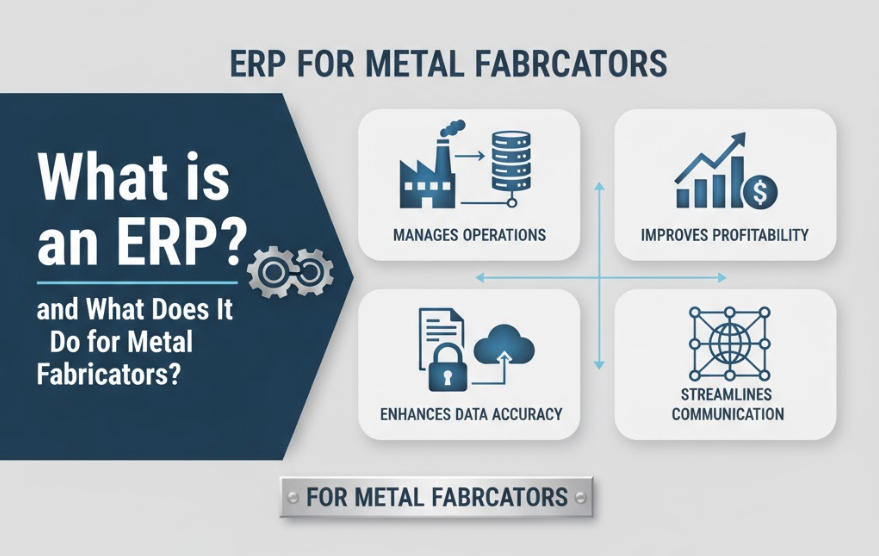
ERP stands for Enterprise Resource Planning—software that integrates business processes across an organization into a unified system sharing a common database. Rather than maintaining separate systems for quoting, production scheduling, inventory management, and accounting (with manual data transfer between systems), an ERP provides a single source of truth where information flows automatically between functional areas.
For metal fabrication operations, ERP systems typically manage:
Quoting and Estimating: Creating accurate quotes for custom fabrication projects requires calculating material costs, estimating labor hours across multiple operations (cutting, forming, welding, finishing), factoring in machine setup times, and applying appropriate markup. Manufacturing-focused ERP systems include estimating tools understanding fabrication processes, enabling faster, more accurate quotes than manual spreadsheet calculations.
Work Order Management: Converting accepted quotes into production work orders, routing jobs through appropriate operations, tracking progress at each manufacturing stage, and managing revisions or engineering changes. Work orders serve as the central organizing document coordinating all departments toward project completion.
Purchasing and Vendor Management: Generating purchase orders for materials, tracking vendor performance (on-time delivery, quality issues, pricing), managing blanket purchase orders for common materials, and automating reorder points for consumables. Integration with inventory systems ensures purchasing aligns with actual needs rather than guesswork.
MRP (Material Requirements Planning): Calculating material requirements based on work orders and inventory levels, determining what needs to be purchased and when, and optimizing order quantities balancing carrying costs against order frequency. MRP prevents both material shortages delaying production and excess inventory tying up working capital.
Inventory Management: Real-time tracking of raw materials, work-in-process, finished goods, and consumables across multiple locations. Inventory modules provide visibility into stock levels, locations, lot traceability, and valuation—critical for accurate financial reporting and efficient operations.
Production Scheduling: Sequencing jobs across machines and work centers, balancing workload to maximize throughput, identifying bottlenecks before they cause delays, and adjusting schedules dynamically as priorities change or unexpected issues arise. Advanced scheduling prevents underutilization of expensive equipment while avoiding overloading critical operations.
Shop Floor Data Capture: Recording actual time spent on operations, scrap and rework, machine downtime reasons, and production quantities. This real-time production data feeds back into estimating (improving future quote accuracy), scheduling (identifying realistic throughput rates), and costing (revealing actual job profitability).
Financial Accounting: General ledger, accounts payable, accounts receivable, job costing, financial statement generation, and period closing. Integration with operational modules means financial data reflects actual business activity without manual journal entries translating production information into accounting records.
Reporting and Business Intelligence: Transforming raw operational data into actionable insights through reports, dashboards, and analytics. Rather than wondering about profitability, on-time delivery performance, or capacity utilization, ERP systems provide answers based on actual operational data.
EVS Metal has used MIE Solutions’ MIE Trak Pro software for 30 years, and it has provided our precision sheet metal fabrication business with an excellent all-in-one ERP solution. In fact, MIE Trak Pro has grown with us through our expansion to four locations across the U.S.
Essential Features of ERP Systems for Metal Fabrication
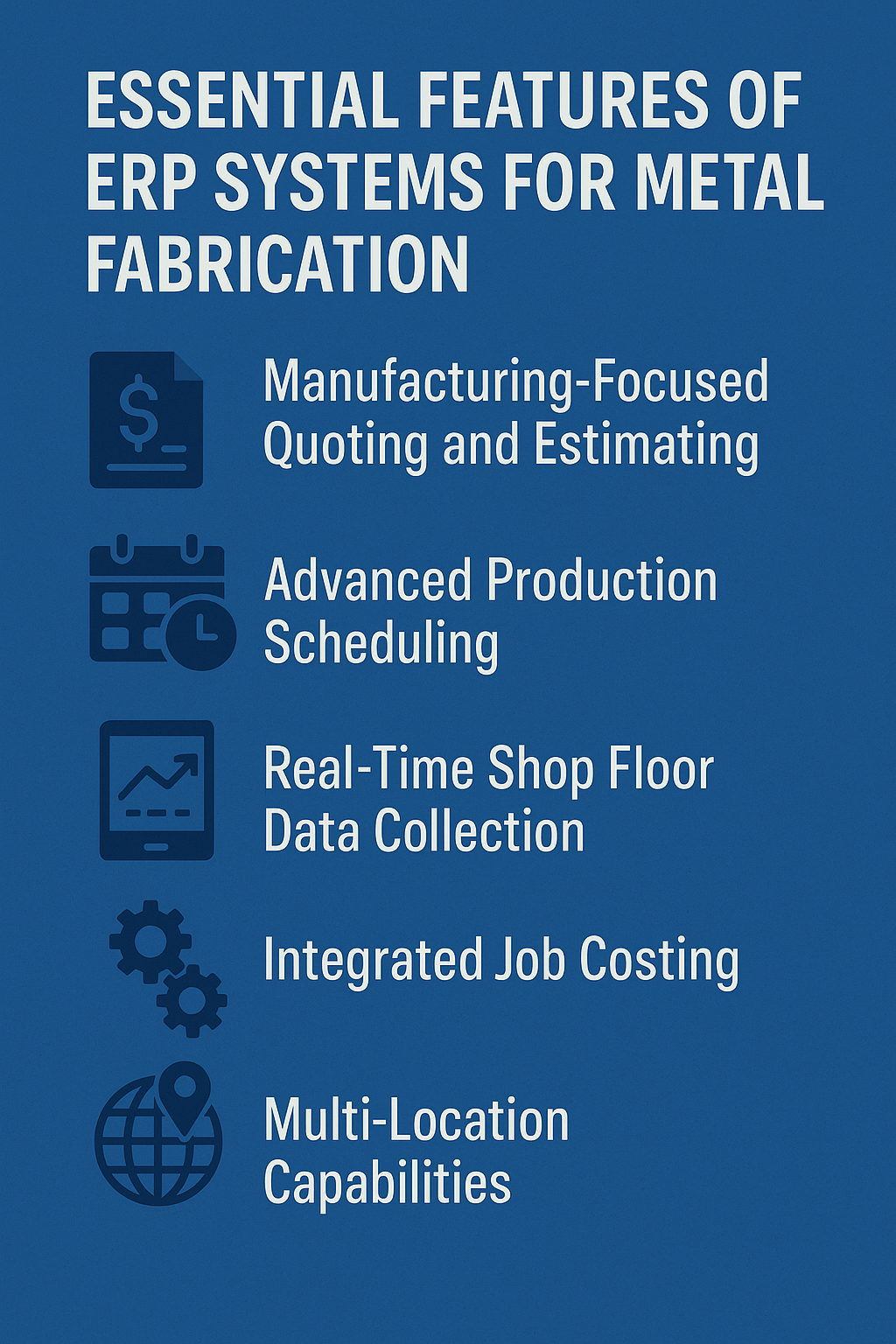
Not all ERP systems are created equal, and generic business software often lacks capabilities critical for metal fabrication operations. When evaluating ERP solutions, metal fabricators should prioritize these manufacturing-specific features:
Manufacturing-Focused Quoting and Estimating
Generic ERP estimating modules designed for distribution or service businesses don’t understand fabrication processes. Manufacturing ERPs should include:
Operation-based estimating where quotes break down into discrete manufacturing steps (laser cutting, punching, forming, welding, powder coating) with time standards, setup requirements, and labor rates specific to each operation. This granularity enables accurate quotes for complex custom work.
Material yield calculations accounting for nesting efficiency, scrap factors, and material utilization specific to sheet metal fabrication. Simple “multiply quantity by unit cost” calculations don’t capture the reality that ordering a 4×8 sheet provides usable material for multiple parts.
Tooling and setup cost allocation differentiating between fixed setup costs (machine programming, fixture setup, first article inspection) and variable run costs. Small-quantity custom orders have different cost structures than high-volume production runs—ERP estimating should reflect this reality.
Historical costing data enabling estimators to reference actual costs from previous similar jobs rather than relying solely on theoretical time standards. The best estimates combine engineering calculations with real-world performance data.
For precision sheet metal fabricators, accurate quoting directly impacts competitiveness and profitability—quote too high and you lose work, quote too low and you lose money even when winning jobs.
Advanced Production Scheduling
Enterprise-level precision fabrication shops juggle dozens or even hundreds of active jobs simultaneously, each requiring multiple operations across different machines and work centers. Effective scheduling requires:
Finite capacity scheduling that recognizes machines and work centers have limited capacity. Infinite capacity scheduling (common in generic ERP systems) generates unrealistic schedules assuming resources are always available.
Constraint-based scheduling identifying bottleneck operations and optimizing schedules to maximize throughput through constraints. A schedule optimized for laser cutting efficiency that creates bottlenecks in forming isn’t truly optimized.
Dynamic rescheduling responding to reality—rush orders, machine breakdowns, material delays, and engineering changes constantly disrupt plans. Scheduling tools must enable quick rescheduling without manual recalculation of every downstream operation.
What-if scenario analysis allowing planners to evaluate the impact of accepting rush orders or prioritizing specific customers before committing to schedule changes.
Real-Time Shop Floor Data Collection
Theoretical schedules and estimates mean little if actual shop floor performance differs significantly. Modern ERP systems capture production data through:
Barcode scanning or RFID enabling workers to clock in/out of operations quickly without manually entering job numbers and operation codes. This reduces data entry errors and encourages accurate time tracking.
Machine integration where CNC equipment, laser cutters, and press brakes automatically report cycle times, part counts, and downtime to the ERP system. Machine data is more accurate than manual reporting and doesn’t depend on operator diligence.
Tablet or mobile interfaces providing shop floor access to work instructions, drawings, and quality requirements without workers returning to office terminals. Mobile data capture increases real-time visibility while keeping workers on the floor.
The value of shop floor data extends beyond basic time tracking—it feeds continuous improvement by revealing where estimates diverge from reality, which operations create bottlenecks, and where quality issues concentrate.
Integrated Job Costing
Understanding actual job profitability requires comparing estimated costs to actual costs across all cost categories:
Material cost tracking comparing estimated material quantities and prices to actual material issued to jobs, revealing estimating accuracy and identifying material waste or scrap issues.
Labor cost analysis showing actual hours spent versus estimated hours for each operation, highlighting where estimates are consistently wrong and where training or process improvements could increase productivity.
Overhead allocation distributing indirect costs (facility overhead, utilities, depreciation) to jobs using appropriate allocation bases, providing complete cost visibility beyond just direct materials and labor.
Work-in-process valuation calculating the value of partially completed jobs for accurate financial statements and cash flow analysis.
Many metal fabricators discover their most profitable work differs from what they expected once actual job costing data becomes available. This insight drives better quoting strategies and customer mix decisions.
Multi-Location Capabilities
Metal fabricators operating multiple facilities require ERP systems managing operations across locations while providing consolidated visibility.
Centralized database where all locations share common customer records, part numbers, and accounting data while maintaining location-specific inventory, work orders, and scheduling.
Inter-facility transfers tracking material and work-in-process movement between locations, maintaining accurate inventory valuation and traceability across the enterprise.
Consolidated reporting aggregating performance across all facilities for enterprise-level visibility while allowing drill-down into individual location detail.
Distributed authority enabling location managers to control local operations while corporate management maintains overall visibility and policy control.
EVS Metal operates four facilities across New Jersey, New Hampshire, Pennsylvania, and Texas. MIE Trak Pro’s multi-location capabilities allow us to manage these facilities as an integrated operation rather than separate businesses, providing flexibility in how we quote and produce customer work.
Key Questions ERP Systems Help Metal Fabricators Answer
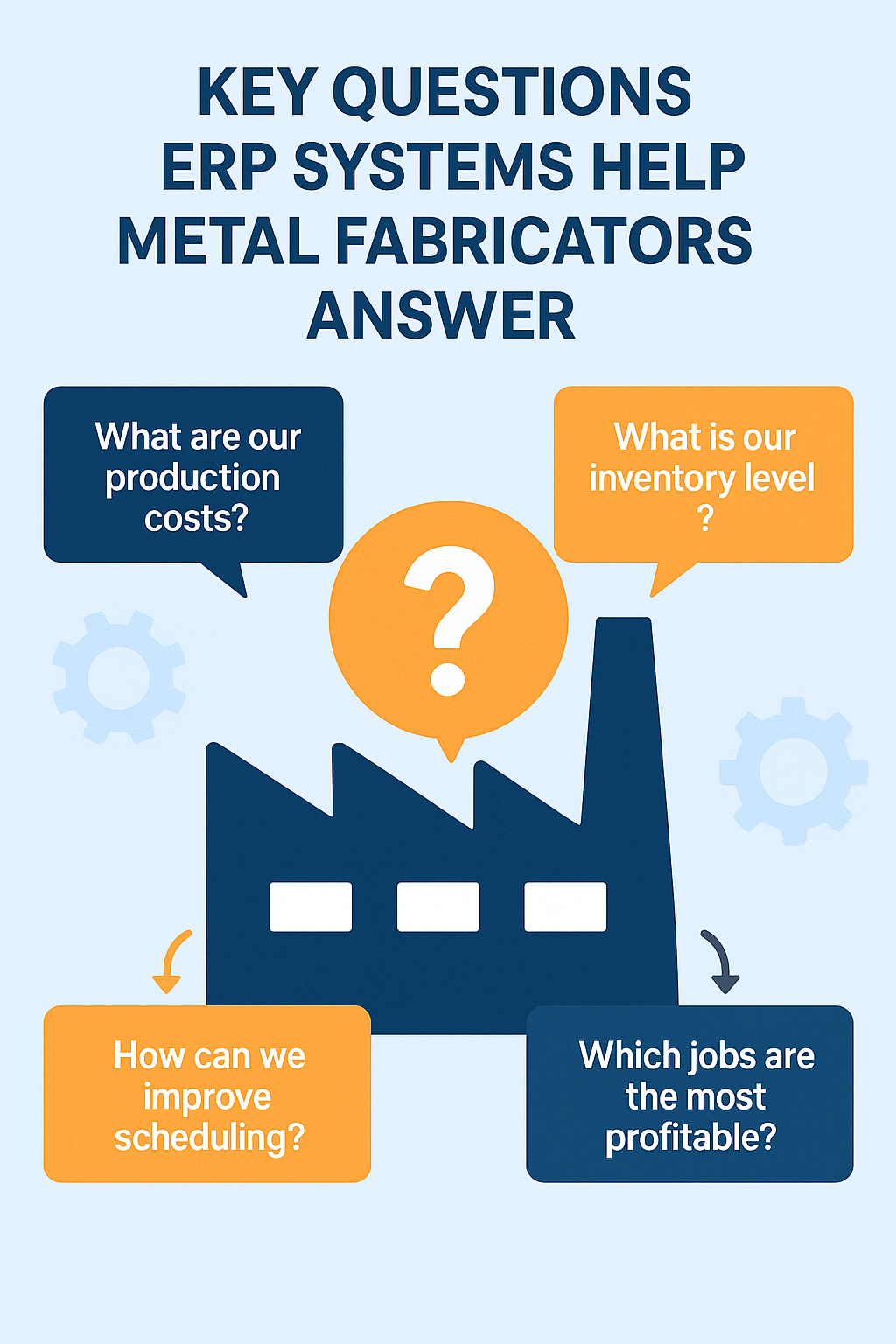
A good ERP software solution helps manufacturers and fabricators like EVS Metal answer critical business questions empirically by making sense of operational data constantly generated. MIE Trak Pro illustrates this value by enabling answers to questions that directly impact business performance:
“Am I quoting too low?” Job costing comparing estimated costs to actual costs reveals whether estimates accurately reflect true costs. Systematically underestimating specific operations or material requirements leads to winning unprofitable work.
“Should I run overtime?” Scheduling and capacity analysis shows whether current workload justifies overtime expense or whether better scheduling could accommodate work within regular hours. ERP data supports decisions about capacity expansion, hiring, or strategic choices about which work to accept.
“What’s my cash-flow like?” Integrated financial modules provide real-time visibility into accounts receivable aging, accounts payable obligations, work-in-process value, and projected cash requirements. This visibility enables proactive cash management rather than reactive crisis responses.
“Am I on schedule?” Production tracking comparing actual progress to scheduled completion dates identifies jobs at risk of missing commitments before customers start calling. Early warning enables corrective action—adding resources, expediting materials, or proactively communicating revised timelines.
“Do I need to purchase now or later?” MRP analysis of material requirements against current inventory and incoming purchase orders identifies what needs purchasing and when, preventing both expensive rush orders and carrying costs from excess inventory.
“Are we making a profit?” Job-level profitability analysis reveals which customers, product types, and work characteristics generate profits versus those consuming resources without adequate return. This insight drives strategic decisions about business development focus and customer relationships.
“Where is my inventory?” Real-time inventory visibility across multiple locations and storage areas eliminates time wasted searching for material and prevents ordering duplicates of material already in stock.
Just looking at raw ERP data output can be overwhelming. ERP software like MIE Trak Pro transforms data into actionable intelligence that can mean the difference between profit and loss, or growth and stagnancy.
Ease of Use and User Adoption
One of the reasons EVS Metal employees appreciate MIE Solutions’ ERP software is its ease of use. Much of it is drag and drop, and the user interface is robust but uncluttered, utilizing well-designed, intuitive dashboards giving our employees insight into multiple business areas at once—from scheduling to deliveries to machine capacity. There is no wild learning curve to throw a wrench into the works.
User adoption represents a critical success factor in ERP implementations. Even the most capable ERP system fails to deliver value if employees don’t use it correctly or consistently. Key factors supporting user adoption include:
Intuitive interface design that matches how people naturally work rather than requiring convoluted workflows to accomplish common tasks. Software designed for manufacturing operations should reflect manufacturing logic.
Role-based dashboards presenting information relevant to each user’s responsibilities without cluttering screens with irrelevant data. Shop floor workers need different views than estimators, purchasing agents, or financial managers.
Minimal data entry leveraging barcode scanning, dropdown selections, and auto-population from existing records rather than requiring manual typing. Every keystroke represents an opportunity for errors and resistance from users.
Responsive support providing help when users encounter problems or confusion. ERP vendors offering strong support, training resources, and user communities significantly ease implementation and ongoing operation.
Why ERP Systems Are Valuable in Metal Fabrication
When used intelligently, ERP software can streamline the entire manufacturing business process from RFQ through product delivery. The business value extends across multiple dimensions:
Operational Efficiency
ERP eliminates duplicate data entry, reduces errors from manual information transfer between systems, automates routine tasks like purchase order generation, and provides workflow tools ensuring proper approval processes. The cumulative time savings across an organization operating ERP versus disconnected systems typically measures in hours per day—time that can be redirected to revenue-generating activities rather than administrative overhead.
Improved Quote Accuracy
Access to historical job costing data, material usage patterns, and actual labor hours improves estimating accuracy. Better estimates mean winning profitable work rather than either losing bids (quotes too high) or winning unprofitable work (quotes too low).
Inventory Optimization
Real-time inventory visibility and MRP analysis reduce both stockouts (eliminating rush orders and production delays) and excess inventory (reducing carrying costs and cash tied up in materials). Many metal fabricators find ERP implementation enables 20-30% inventory reduction while improving material availability.
Better Cash Flow Management
Integrated financial modules provide visibility into the complete cash conversion cycle—from quoting through invoicing and collection. Understanding work-in-process value, identifying overdue receivables, and managing payables strategically improves cash flow and working capital efficiency.
Data-Driven Decision Making
Rather than relying on intuition or incomplete information, ERP provides empirical data supporting strategic decisions about capacity investment, customer relationships, product mix, and operational improvements. Businesses operating with good data consistently outperform those making decisions based on gut feel.
Scalability for Growth
Disconnected systems that work adequately for smaller operations often break down as businesses grow. ERP platforms designed for manufacturing scale from small shops to multi-facility enterprises without requiring replacement as companies expand. For our growth from a single facility to four locations in New Jersey, Texas, New Hampshire and Pennsylvania, MIE Trak Pro’s scalability meant we could expand operations without changing core business systems or losing operational continuity.
How EVS Metal Utilizes ERP Software
Understanding ERP value becomes clearer through specific examples of how metal fabricators use these systems across different functional areas.
Handling Accounting Tasks
EVS uses MIE Solutions’ MIE Trak Pro, which is equipped with a range of functionality right out of the box. Our accounting team takes advantage of many of these features, from human resources modules to financial statement generation. Quality ERPs like MIE Trak Pro allow easy integrations to streamline other accounting areas such as payroll activity. Our ERP not only gives us greater bottom-line visibility but also speeds up the closing of financial periods because so much of the system is automated.
The integration between operational modules and financial accounting eliminates manual journal entries that consume time and introduce errors. When shop floor workers complete operations, labor costs automatically flow to job costing and financial accounting. When material is issued to work orders, inventory valuation updates automatically. When finished goods ship, cost of goods sold posts without manual intervention.
Ensuring Quality Outcomes and Continuous Improvement
ERPs should offer features that help QA/QC departments stay ahead of problems by minimizing failures in the first place. EVS Metal’s quality department can identify and address concerns at each step in the metal fabrication and finishing process. Our ERP software generates helpful reports that identify areas needing improvement. It can tell us not only which products failed, but why and when. This visibility enables root cause analysis and corrective action rather than simply firefighting quality escapes as they occur.
Quality data collection integrated with production tracking reveals patterns—whether quality issues concentrate in specific operations, correlate with particular machines or operators, or appear more frequently during specific shifts or production volumes.
Expediting the Quote/RFQ Process
Anyone in manufacturing knows that quotes and RFQs represent both the best and worst part of the business cycle. While we actively seek out custom metal fabrication customers and projects, generating the paperwork to create an accurate proposal can take hours of time that could be better spent elsewhere. ERPs make the quoting process much more efficient than issuing manual quotes. MIE Trak Pro allows us to quickly and easily create everything from sales and work orders to invoices with a single step. It also provides detailed pricing breakdowns for both individual parts and larger projects.
The ability to clone similar previous quotes and adjust for current project specifics accelerates estimating dramatically. Rather than building each estimate from scratch, estimators start with proven templates and historical data, focusing effort on project-specific variations rather than reinventing standard calculations.
Tracking Inventory
As a large metal fabrication and manufacturing company with four locations across the U.S., knowing we can track our inventory all in one place is essential to the smooth operation of our business, but most importantly, to the health of our bottom line. Our ERP allows us to collect valuable data from the accuracy of our inventory quantities to our suppliers’ delivery performance from any facility in the nation. Real-time inventory visibility prevents situations where material exists in one location while another location places a rush order for the same material—wasteful duplication that occurs frequently without centralized visibility. Material traceability through lot tracking enables compliance with customer requirements for material certifications and quality documentation, particularly important for aerospace and defense work requiring documented material pedigree.
ERP Implementation Considerations
Implementing ERP systems represents a significant undertaking requiring careful planning, resource allocation, and change management. Understanding common implementation challenges helps organizations prepare appropriately.
Data Migration and Cleanup
ERP implementations require migrating existing data—customer records, part numbers, bills of material, supplier information, and often years of transactional history. This migration process frequently reveals data quality problems: duplicate customer records, obsolete part numbers, incomplete information, and inconsistencies between systems.
Successful implementations treat data migration as an opportunity for cleanup rather than simply transferring problematic data into the new system. This cleanup effort takes time but pays dividends through better data quality supporting accurate reporting and efficient operations.
Process Documentation and Standardization
ERP implementation forces organizations to document and often standardize business processes. Companies operating with informal workflows must formalize procedures for quoting, work order management, purchasing, and other functions the ERP will support. While challenging, this process standardization improves operational consistency and reduces dependence on individual employees’ institutional knowledge. Documented processes enable training, support continuous improvement, and maintain business continuity when employees change roles or leave the organization.
Training and Change Management
Employees comfortable with existing systems often resist ERP implementation fearing productivity loss during the learning curve or job displacement from automation. Effective change management addresses these concerns through:
Clear communication about why the organization is implementing ERP, what benefits it will provide, and how it will affect different roles. Transparent communication reduces uncertainty and resistance.
Comprehensive training providing hands-on practice in realistic scenarios before going live. Training should focus on how the ERP helps employees do their jobs better rather than just mechanical “click here, then click there” instruction.
Phased rollout implementing modules progressively rather than attempting a “big bang” conversion of all functions simultaneously. Phased approaches allow organizations to learn from early implementations before expanding scope.
Super users designating employees with deep ERP knowledge who can assist colleagues encountering questions or problems. Super users bridge the gap between IT support and end users, speaking both technical and operational languages.
Integration with Existing Systems
Few organizations implement ERP in a complete vacuum—existing systems for CAD/CAM, quality management, or other specialized functions may need to exchange data with the ERP system. Understanding integration requirements early in the evaluation process prevents discovering incompatibilities after implementation begins. Modern ERP systems typically offer APIs or standard integration tools supporting data exchange with external systems. The sophistication of these integration capabilities varies significantly between vendors and should factor into selection decisions.
Vendor Selection and Partnership
The ERP vendor relationship extends far beyond the initial software purchase—ongoing support, updates, and enhancements continue throughout the system’s operational life. Selecting vendors with strong support organizations, active product development, and financial stability ensures the ERP investment remains valuable long-term.
EVS Metal’s 30-year relationship with MIE Solutions exemplifies the value of strong vendor partnerships. As MIE Solutions has enhanced MIE Trak Pro’s capabilities over decades, EVS has benefited from continuous improvement without changing core business systems. This long-term relationship has provided stability supporting our growth while enabling access to new capabilities as manufacturing technology evolved.
According to our VP and Co-Founder, Joe Amico, “MIE Trak Pro is extremely powerful and versatile, capable of handling the entire production process from start to finish. It enables us to manage the large amounts of data generated from our products into usable, understandable, and actionable reports.”
Evaluating ERP Solutions: Key Selection Criteria
Choosing the right ERP system requires balancing multiple factors. No single ERP perfectly fits every organization, but systematic evaluation helps identify the best match for your specific requirements.
Manufacturing-Specific Functionality
Generic business software lacking manufacturing-specific capabilities forces workarounds, customizations, or continued use of separate systems for critical functions. Prioritize ERP solutions designed for manufacturing with proven implementations in metal fabrication operations.
Scalability and Growth Capacity
Consider not just current needs but projected growth over the next 5-10 years. Can the ERP handle additional users, locations, and transaction volumes as your business expands? Outgrowing an ERP shortly after implementation forces expensive migrations or constrains growth.
Total Cost of Ownership
Initial software licensing represents only part of total ERP cost. Factor in implementation services, training, hardware infrastructure, ongoing support costs, and internal IT resources required. A seemingly inexpensive ERP with high implementation costs or expensive ongoing support may prove more costly than alternatives with higher upfront licensing but lower total ownership costs.
Vendor Stability and Support
ERP relationships extend years or decades. Vendor financial health, product roadmap, support organization quality, and user community strength all impact long-term value. Research vendor reputation through existing customer references rather than relying solely on vendor marketing materials.
User Experience and Adoption Factors
The most capable ERP delivers little value if employees don’t use it properly. Evaluate user interfaces, workflow logic, and ease of use through hands-on demonstrations with actual employees who will use the system daily rather than just reviewing presentations with management. Implementing lean manufacturing principles helps standardize processes and optimize ERP adoption across the organization.
The ROI of ERP Investment
Justifying ERP investment requires understanding both quantifiable cost savings and strategic benefits difficult to measure precisely.
Quantifiable Cost Savings
Reduced labor for administrative tasks: Elimination of duplicate data entry, automated generation of purchase orders and work orders, and streamlined reporting reduce administrative staffing requirements or enable redeployment to revenue-generating activities.
Improved inventory turns: Better inventory management typically enables 20-30% inventory reduction while improving material availability. The working capital freed from excess inventory delivers immediate cash flow benefits.
Reduced quote preparation time: Accelerated estimating processes enable sales teams to respond to more RFQs without adding estimating staff, improving quote volume and win rates.
Decreased overtime costs: Better scheduling optimization and capacity visibility reduce reliance on expensive overtime to meet customer commitments.
Lower error rates: Automated data flow between systems eliminates transcription errors that cause rework, scrap, and customer dissatisfaction.
Strategic Benefits
Beyond direct cost savings, ERP provides strategic capabilities supporting growth and competitive positioning:
Faster response to customer inquiries: Immediate access to order status, inventory availability, and production schedules enables responsive customer service differentiating you from competitors.
Improved on-time delivery performance: Better scheduling and production tracking improve delivery reliability, strengthening customer relationships and enabling premium pricing for reliability.
Data-driven continuous improvement: Operational visibility enables systematic process improvement identifying and addressing inefficiencies, quality issues, and capacity constraints.
Scalability for growth: ERP infrastructure supports business growth without proportional increases in administrative overhead or operational complexity.
Competitive advantages from better information: Companies with superior operational data make better decisions about pricing, capacity investment, customer mix, and strategic direction than competitors operating with limited visibility.
Common ERP Implementation Mistakes to Avoid
Learning from others’ implementation challenges helps organizations avoid predictable problems.
Insufficient Executive Sponsorship
ERP implementations affecting the entire organization require visible executive leadership championing the project, removing organizational barriers, and reinforcing the importance of user adoption. Implementations delegated to IT departments without strong executive sponsorship frequently stall or fail to achieve potential value.
Unrealistic Timeline Expectations
ERP implementations take longer than most organizations expect. Rushing implementation to meet arbitrary deadlines leads to inadequate testing, insufficient training, and data quality problems. Allow realistic timeframes for each implementation phase rather than optimistic best-case scenarios.
Excessive Customization
Every organization believes their operations are unique requiring custom ERP modifications. While some customization may be necessary, excessive customization increases implementation time and cost, complicates future upgrades, and often reflects resistance to beneficial process changes rather than genuine unique requirements. Best practice involves configuring the ERP using built-in options rather than custom code modifications wherever possible, accepting some process changes to align with ERP best practices rather than forcing the software to match every existing procedure.
Inadequate Training Investment
Insufficient training represents a common cause of poor user adoption and suboptimal ERP utilization. Organizations budget carefully for software and implementation services but underinvest in comprehensive training, assuming employees will figure things out through trial and error. This false economy leads to frustrated users, low adoption, and failure to realize ERP benefits.
Neglecting Data Quality
Poor data quality in source systems creates poor data quality in the ERP—the implementation doesn’t magically fix data problems. Organizations must invest in data cleanup, establish data governance processes, and assign clear responsibility for maintaining data accuracy. Effective inventory management practices require clean, accurate data from the start.
Frequently Asked Questions About ERP Systems for Metal Fabricators
What’s the difference between ERP and MRP systems?
MRP (Material Requirements Planning) focuses specifically on calculating material needs based on production schedules and inventory levels. ERP (Enterprise Resource Planning) is broader, integrating MRP with financial accounting, customer management, purchasing, quality management, and other business functions. Modern manufacturing ERPs include MRP functionality as one module within a comprehensive business management platform.
How long does ERP implementation typically take for metal fabricators?
Implementation timeframes vary based on organization size, complexity, and scope. Small to mid-size fabricators implementing comprehensive ERP typically require 6-12 months from selection through go-live. Larger organizations or those with complex multi-location operations may need 12-18 months. Phased implementations starting with core modules then expanding functionality can shorten time to initial value while spreading implementation effort over longer periods.
Should we implement all ERP modules at once or phase implementation?
Phased implementations generally reduce risk and allow organizations to learn from early modules before expanding scope. Common approaches start with core financial and operational modules (quoting, work orders, inventory, purchasing) then add advanced features like sophisticated scheduling or business intelligence. However, some modules work best implemented together—implementing inventory without purchasing, for example, provides limited value.
What happens to our data if we switch ERP vendors?
Quality ERP systems allow data export in standard formats enabling migration to alternative systems. However, migrating between ERPs is expensive and disruptive—comparable in effort to the original implementation. This reality emphasizes the importance of careful vendor selection and considering the long-term vendor relationship rather than just immediate features and pricing.
Can ERPs integrate with our CAD/CAM systems?
Modern manufacturing ERPs typically offer integration capabilities with CAD/CAM systems, allowing transfer of part geometry, nesting information, and machining data. Integration sophistication varies between vendors—some offer tight integration with specific CAD/CAM platforms while others provide generic file exchange capabilities. If CAD/CAM integration is critical for your operations, evaluate specific integration capabilities during vendor selection rather than assuming integration will be straightforward.
How do we measure ERP success after implementation?
Define success metrics before implementation begins, establishing baseline measurements for comparison. Common metrics include: quote turnaround time, inventory turns, on-time delivery percentage, quote-to-actual cost variance, schedule adherence, and administrative labor hours. Track these metrics quarterly after go-live to quantify ERP impact and identify areas needing additional attention or training.
What kind of training do employees need to run an ERP system?
Training requirements vary by role. Executive-level users need overview training on reporting and dashboards. Power users (estimators, schedulers, purchasing) require comprehensive training on their functional areas. Shop floor workers need focused training on data collection and accessing work instructions. Plan for initial training before go-live, follow-up training addressing questions after go-live, and ongoing training for new employees. Budget 2-5 days of training per user depending on their role and ERP complexity.
Can small metal fabricators benefit from ERPs or is it only for large companies?
Small fabricators benefit from ERP when disconnected systems create inefficiencies, when growth is straining manual processes, or when customer requirements demand better tracking and documentation. Modern cloud-based ERP options with subscription pricing make ERP accessible to smaller organizations previously unable to afford enterprise systems. The key question isn’t company size but whether operational complexity and growth trajectory justify ERP investment.
Should we choose cloud-based or on-premise ERP?
Cloud-based ERP (SaaS model) offers lower upfront costs, predictable subscription pricing, vendor-managed updates and backups, and accessibility from any internet connection. On-premise ERP provides greater control over data, potential integration advantages with other on-premise systems, and may have lower long-term costs for organizations comfortable managing their own IT infrastructure. Many fabricators find cloud-based ERP attractive for easier implementation and reduced IT burden, though some industries with strict data security requirements prefer on-premise deployment.
ERPs as Strategic Infrastructure for Metal Fabricators
ERP systems have evolved from back-office accounting tools to strategic infrastructure enabling competitive metal fabrication operations. The integrated visibility, process automation, and data-driven decision support provided by modern manufacturing ERP delivers measurable value through improved efficiency, better resource utilization, and enhanced customer service.
For EVS Metal, MIE Solutions’ MIE Trak Pro has served as foundational infrastructure supporting our growth from a single facility to a multi-location precision fabrication operation. The system’s manufacturing-focused functionality, scalability, ease of use, and MIE Solutions’ strong support have made this 30-year partnership instrumental to our success.
Organizations considering ERP implementation should approach the decision systematically—clearly defining requirements, evaluating alternatives thoroughly, planning implementation carefully, and committing to the change management necessary for successful adoption. While ERP implementation represents significant investment, the operational improvements and strategic capabilities justify that investment for metal fabricators committed to growth and operational excellence.
As our VP and Co-Founder Joe Amico says: “MIE Trak Pro is extremely powerful and versatile, capable of handling the entire production process from start to finish. It enables us to manage the large amounts of data generated from our products into usable, understandable, and actionable reports.”
Regardless of the solution chosen, enterprise-level manufacturers will benefit from the integration of a quality ERP system designed specifically for manufacturing operations. The competitive landscape increasingly favors organizations leveraging data and technology to optimize operations—ERP provides the foundation for that competitive advantage.
Ready to learn more about how EVS Metal manages complex manufacturing operations? Contact our team today!