

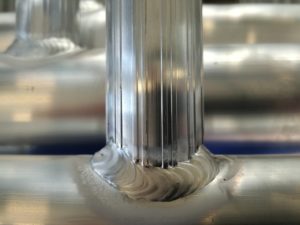
 Welding certifications directly affect fabrication quality, regulatory compliance, and manufacturing risk. For engineers and procurement teams evaluating fabrication partners, understanding welding certifications helps identify manufacturers capable of meeting code requirements, maintaining quality consistency, and documenting procedures for regulated industries.
The American Welding Society (AWS) establishes welding standards that govern welder qualifications, procedure specifications, and quality requirements across industries. These standards exist because welding quality depends on multiple variables—operator skill, process parameters, material compatibility, joint design, and environmental conditions—that must be controlled and documented to ensure reliable results.
Fabricators employing AWS-certified welders and qualified welding procedures demonstrate stronger process control, documented quality systems, and commitment to operator training that reduce manufacturing risk and support regulatory compliance requirements.
Why Welding Certifications Matter in Manufacturing
Welding certifications serve multiple purposes beyond demonstrating technical capability.
Quality Assurance
Certified welders and qualified welding procedures provide predictable, repeatable results. Certifications verify that operators understand proper techniques, material handling, and quality standards specific to their welding processes and materials.
Regulatory Compliance
Many industries require specific welding certifications for regulatory compliance. Pressure vessels must meet ASME Boiler and Pressure Vessel Code requirements. Structural steel fabrication must comply with building codes referencing AWS D1.1 or D1.2 standards. Aerospace, defense, and medical device manufacturing often mandate documented welding procedures and qualified operators.
Liability Protection
Proper certifications protect both fabricators and customers. When welding failures occur, documented certifications and qualified procedures demonstrate due diligence and proper process control. Projects lacking appropriate certifications create liability exposure for all parties.
Traceability and Documentation
Certified welding operations maintain documentation linking specific welders, procedures, and inspection records to individual projects. This traceability matters for regulated industries requiring complete manufacturing records and for troubleshooting quality issues when they arise.
Understanding the AWS Certification System
The American Welding Society administers multiple certification programs governing different aspects of welding operations.
Welder Certification
AWS Certified Welder programs verify individual operator competency through testing and performance qualification. These certifications specify:
- Welding processes (MIG, TIG, SMAW, etc.)
- Material types (steel, stainless steel, aluminum)
- Positions (flat, horizontal, vertical, overhead)
- Joint configurations (groove welds, fillet welds)
- Material thicknesses
Certifications are process- and material-specific. A welder certified for TIG welding aluminum may not be qualified for MIG welding steel without additional certification.
Welding Procedure Specifications (WPS)
Welding Procedure Specifications document the specific parameters required to produce acceptable welds for particular applications. These specifications define:
- Base materials and filler metals
- Welding processes and techniques
- Electrical parameters (voltage, amperage, polarity)
- Travel speeds and heat input
- Preheat and interpass temperatures
- Post-weld heat treatment requirements
- Shielding gases and flow rates
Procedure Qualification Records (PQR)
Procedure Qualification Records document testing performed to validate that a Welding Procedure Specification produces acceptable results. PQRs include mechanical testing, visual examination, and other inspection methods verifying weld quality meets code requirements.
The distinction matters: certified welders demonstrate personal competency, while qualified procedures prove specific welding parameters produce acceptable results for particular applications.
Key AWS Certifications for Metal Fabrication
Several AWS standards apply specifically to sheet metal fabrication and structural welding.
AWS D9.1: Sheet Metal Welding Code
AWS D9.1 provides welding requirements specifically for sheet metal fabrication. This code addresses the unique challenges of welding thin materials, including:
- Distortion control and heat management
- Joint design for thin-gauge materials
- Appropriate welding processes for sheet metal
- Quality requirements and inspection criteria
Fabricators producing precision sheet metal components typically qualify welding procedures to D9.1 standards, ensuring processes appropriate for thin materials that require careful heat control to prevent warpage or burn-through.
AWS D1.2: Structural Welding Code – Aluminum
AWS D1.2 governs structural welding of aluminum, covering:
- Material specifications and design requirements
- Fabrication procedures and techniques
- Qualification requirements for welders and procedures
- Inspection and quality control standards
This certification matters for aluminum welding applications requiring structural integrity, including transportation equipment, architectural components, and industrial structures where aluminum’s strength-to-weight ratio provides design advantages.
AWS B2.1: Specification for Welding Procedure and Performance Qualification
AWS B2.1 establishes qualification requirements for welding procedures and welder performance across multiple materials and processes. It serves as the framework supporting procedure development, testing, and documentation across many fabrication environments.
ASME Section IX: Welding and Brazing Qualifications
While not an AWS standard, ASME Section IX governs welding qualifications for pressure vessels, boilers, and piping systems. Fabricators producing pressure equipment must maintain ASME-qualified welding procedures and certified welders meeting these more stringent requirements.
Common Welding Processes in Metal Fabrication
Different welding processes suit different applications, materials, and production requirements.
MIG Welding (GMAW)
Gas Metal Arc Welding uses a continuous wire electrode and shielding gas (typically argon with CO2) to produce welds. MIG welding offers:
- High deposition rates for production efficiency
- Relatively easy operator training
- Good performance on thicker materials
- Compatibility with robotic welding automation
MIG welding suits medium- to high-volume production and materials ranging from thin sheet to heavy plate.
TIG Welding (GTAW)
Gas Tungsten Arc Welding uses a non-consumable tungsten electrode with separate filler wire and inert gas shielding (argon or helium). TIG welding provides:
- Superior weld quality and appearance
- Excellent control for thin materials
- Clean welds without spatter
- Capability for critical applications
TIG welding suits precision applications, thin materials, and projects where weld appearance and quality are paramount. The process requires higher operator skill and produces slower welding speeds than MIG.
Spot Welding (RSW)
Resistance Spot Welding joins sheet metal through localized heating from electrical resistance. Spot welding offers:
- Fast cycle times for high-volume production
- No filler materials required
- Minimal heat-affected zones
- Easy automation for repetitive operations
Spot welding suits sheet metal assemblies requiring multiple discrete weld points rather than continuous seam welds.
Robotic Welding
Robotic welding systems automate MIG, TIG, or spot welding processes through programmable robots. Benefits include:
- Consistent quality through repeatable positioning and parameters
- High production rates for medium- to high-volume runs
- Reduced labor costs once programming is complete
- Improved safety by removing operators from welding hazards
Robotic welding suits production environments where setup costs can be amortized across sufficient volume to justify programming and fixturing investment.
How to Evaluate a Fabricator’s Welding Capabilities
When selecting a fabrication partner, several factors indicate welding capability beyond basic certification claims.
Current Certifications and Documentation
Request copies of relevant AWS certifications, welder qualification records, and welding procedure specifications. Verify certifications cover the specific materials, processes, and positions your project requires.
Quality Management Systems
ISO 9001:2015 certification or other quality management systems demonstrate systematic approaches to process control, documentation, and continuous improvement that support consistent welding quality.
Inspector Qualifications
Certified Welding Inspectors (CWI) provide independent verification of welding quality. Fabricators employing AWS-certified inspectors demonstrate commitment to quality verification beyond operator self-inspection.
Process Capabilities
Understand what welding processes the fabricator operates, what materials they regularly weld, and what thickness ranges they accommodate. Fabricators specializing in your material and thickness range typically produce better results than those operating at the edges of their capability.
Testing and Inspection Equipment
Ask about available inspection methods: visual inspection, dye penetrant testing, radiographic testing, ultrasonic testing. Different applications require different inspection levels, and fabricators should have appropriate equipment or subcontractor relationships for required testing.
Project-Specific Procedure Development
For specialized applications, fabricators should be willing to develop project-specific welding procedures, conduct procedure qualification testing, and document results meeting your requirements.
Frequently Asked Questions: Welding Certifications
What welding certifications should I look for in a metal fabricator?
Look for AWS certifications relevant to your materials and application. Sheet metal fabrication typically requires AWS D9.1 qualifications. Structural aluminum requires AWS D1.2. Pressure vessels require ASME Section IX qualifications. Request documentation proving current certifications.
What is the difference between a certified welder and a qualified welding procedure?
A certified welder demonstrates individual operator competency through testing. A qualified welding procedure proves specific welding parameters produce acceptable results through documented testing. Both are necessary—skilled operators must follow proven procedures to ensure consistent quality.
How long do welding certifications last?
Welder certifications typically require periodic renewal, often every six months to two years depending on the specific certification and code requirements. Fabricators must maintain documentation proving welders remain current and active in their certified processes.
Do all welding projects require certified welders?
Not all projects legally require certified welders, but certifications provide quality assurance regardless of legal requirements. For regulated industries (pressure vessels, structural steel, aerospace), certifications are mandatory. For commercial products, certifications reduce risk and improve consistency.
Can a fabricator develop custom welding procedures for my project?
Yes. Experienced fabricators can develop Welding Procedure Specifications for unique materials, joint configurations, or performance requirements. This involves procedure development, qualification testing, and documentation. Custom procedures increase setup costs but enable applications standard procedures cannot support.
What is the difference between AWS and ASME welding qualifications?
AWS standards cover general welding practices across industries. ASME Section IX specifically governs pressure equipment (boilers, pressure vessels, piping). ASME requirements are generally more stringent and require additional documentation. Fabricators may hold both AWS and ASME qualifications.
How do welding certifications affect project cost and lead time?
Certified welders and qualified procedures may increase labor rates compared to uncertified welding but reduce rework and improve first-pass quality. For regulated applications, certifications are mandatory regardless of cost. Custom procedure development can affect lead times for specialized applications.
EVS Metal’s Welding Certifications and Capabilities
EVS Metal maintains AWS-qualified welding personnel and documented welding procedures across our facilities in Pennsylvania, Texas, New Jersey, and New Hampshire. Our welding capabilities include MIG, TIG, spot, and robotic welding for aluminum, stainless steel, and carbon steel fabrication.
Our welding operations support AWS D9.1 sheet metal welding requirements and AWS D1.2 structural aluminum applications. We maintain documented Welding Procedure Specifications and Procedure Qualification Records for common materials and can develop custom procedures for specialized applications. Combined with our fabrication, machining, finishing, and assembly capabilities, certified welding operations enable complete component manufacturing under controlled quality systems.
For projects requiring documented welding procedures, certified operators, or regulatory compliance support, EVS Metal provides the certifications, process documentation, and quality systems that reduce manufacturing risk across electronics, medical devices, industrial equipment, and other precision manufacturing applications.
Ready to Discuss Welding Requirements for Your Project?
EVS Metal provides certified welding services for precision metal fabrication across industries requiring documented quality systems and regulatory compliance. Our engineering teams can help evaluate welding requirements during the design phase to ensure appropriate processes, materials, and certifications for your application.
Request a quote or call (973) 839-4432 to discuss welding certifications, procedure qualifications, and fabrication requirements for your next project.