

Integrated digital graphics that reduce vendor stacking and accelerate production timelines.
In-House UV Digital Printing for Panels, Enclosures, and Industrial Assemblies
Direct-to-substrate printing (DTSP) is an advanced UV digital printing technology that applies full-color, high-resolution graphics directly onto fabricated components. Unlike traditional screen printing or applied decals, DTSP integrates permanent graphics into the manufacturing workflow—reducing lead times, eliminating secondary vendors, and improving quality control.
At EVS Metal’s New Jersey facility, this capability is fully integrated into our precision fabrication operations using industrial flatbed UV technology capable of producing durable graphics on metal panels, enclosures, and engineered components used in demanding industrial environments.
For OEM manufacturers, that integration translates to fewer handoffs, faster production cycles, and consistent results from prototype through full production.
How Direct-to-Substrate Printing Works
The process is similar to advanced inkjet printing but engineered for industrial substrates and durability.
1. Material Placement
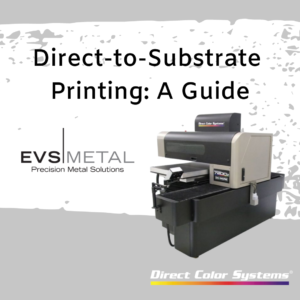
Precision fabricated sheet metal parts—such as control panels or enclosure components—are placed directly onto a flatbed UV printer. The system accommodates parts up to 23.8″ x 48.0″.
2. Precision Ink Application
UV-curable inks are digitally applied using high-precision print heads. These inks are formulated to bond to metal, powder-coated finishes, plastics, and other engineered materials.
3. Immediate UV Curing
As ink is deposited, ultraviolet light instantly cures it through a photochemical reaction. The result is a hardened, permanent graphic layer with no drying time required.
Because curing is immediate, parts can move directly to the next stage of production without delay.
Why In-House Digital Printing Matters
Many manufacturers outsource graphics to a separate screen printing or labeling vendor. That introduces:
- Additional shipping
- Production delays
- Increased handling risk
- Revision complexity
- Quality variability
By integrating direct-to-substrate printing into its New Jersey fabrication operations, EVS Metal eliminates these inefficiencies.
Benefits include:
- Shorter total production timelines
- Tighter quality control within one manufacturing environment
- Faster implementation of engineering change orders (ECOs)
- Reduced cosmetic damage risk
- Seamless coordination between fabrication, finishing, and graphics
For OEMs managing complex programs, that integration reduces operational friction and schedule risk.
Materials Compatible with Direct-to-Substrate Printing
Direct-to-substrate printing supports a wide range of materials used in precision manufacturing:
- Stainless steel
- Aluminum
- Powder-coated components
- Acrylic
- Polycarbonate
- PVC and engineered plastics
Printing can be applied directly to finished, powder-coated surfaces without compromising finish integrity or requiring secondary adhesion methods.
Key Capabilities
High-Resolution Output
Printing resolutions up to 5760 dpi enable fine text, detailed layouts, and complex graphics suitable for industrial control panels and branded assemblies.
Pantone Color Matching
Precise alignment with the Pantone Matching System (PMS) ensures brand consistency across production runs.
White and Clear Ink Options
White ink enables printing on dark or transparent materials. Clear overcoat layers can enhance abrasion resistance and durability.
Immediate Production Readiness
UV curing eliminates drying time, reducing work-in-process and accelerating throughput.
Industrial Durability
UV-cured inks chemically bond to the substrate, offering resistance to scratching, handling wear, and environmental exposure. Compared to solvent-based methods, UV printing significantly reduces VOC emissions. As part of EVS Metal’s ISO 9001:2015-certified quality system, graphics and marking processes are controlled within the same production environment as fabrication and finishing.
Direct-to-Substrate Printing vs. Traditional Methods
Direct-to-Substrate Printing Is Ideal For:
- Short production runs
- Prototypes
- Multi-color graphics
- Fine text and detailed layouts
- Programs requiring frequent revisions
- Compressed production schedules
Screen Printing May Be Suitable For:
- Extremely high-volume production
- Limited color designs
- Established legacy programs
Engraving May Be Preferred When:
- Permanent depth marking is required
- Parts are exposed to extreme abrasion
- Regulatory requirements specify engraved identification
Offering multiple marking and finishing methods—including direct-to-substrate printing at the Riverdale, NJ HQ—allows EVS Metal to recommend the most appropriate solution for each application.
Applications in Industrial Manufacturing
Direct-to-substrate printing is commonly used for:
- Industrial control panels
- Electronic enclosures
- Medical device housings
- Custom metal signage
- Equipment labels and instructional graphics
- Branded fabricated assemblies
Because printing is integrated into fabrication, graphics align precisely with cutouts, bends, and assembly features.
When Direct-to-Substrate Printing Makes the Most Sense
DTSP is particularly valuable when:
- Graphics are functional, not just decorative
- Brand consistency is critical
- Lead time compression matters
- Design revisions are expected
- Production quantities vary
For example, OEM customers producing control panels with frequent labeling updates benefit from digital printing’s ability to revise graphics without screen retooling delays.
For OEM programs moving from prototype to production, digital printing scales without the tooling requirements associated with screen processes.
Frequently Asked Questions
What is the difference between direct-to-substrate printing and screen printing?
Direct-to-substrate printing is a digital UV printing process that applies graphics directly onto a material without screens or stencils. Screen printing uses mesh screens to transfer ink and is typically more economical for extremely high-volume runs with limited color variation.
Can direct-to-substrate printing be applied to powder-coated metal?
Yes. UV digital printing can be applied directly to powder-coated surfaces, allowing finished metal components to receive permanent graphics without adhesive labels or additional fasteners.
How durable is UV direct-to-substrate printing?
UV-cured inks chemically bond to the substrate and harden instantly under ultraviolet light. The resulting print layer resists scratching, handling wear, and environmental exposure. A clear overcoat can further enhance abrasion resistance.
Is direct-to-substrate printing suitable for outdoor use?
UV-cured inks provide good resistance to fading and weather exposure. Suitability for long-term outdoor use depends on environmental conditions, substrate selection, and finish requirements.
When should engraving be used instead of direct-to-substrate printing?
Engraving may be preferable when permanent depth marking is required, extreme abrasion conditions are present, or regulatory requirements specify engraved identification.
Does direct-to-substrate printing affect part tolerances?
No. The cured ink layer is thin and does not significantly impact part dimensions or mechanical fit, making it suitable for precision components.
Is direct-to-substrate printing cost-effective for short runs?
Yes. Because DTSP does not require screens or tooling, setup costs are minimal compared to traditional screen printing, making it ideal for prototypes and low-volume production.
Is direct-to-substrate printing available at all EVS Metal facilities?
Direct-to-substrate printing is currently available at EVS Metal’s New Jersey facility. Other marking and finishing methods are available across all four locations.
Request a Consultation
Have a fabricated panel, enclosure, or assembly that requires permanent graphics? Our engineering team can help determine whether direct-to-substrate printing, screen printing, engraving, or labeling is the right solution for your application.
Request a personalized metal fabrication quote online or call 1-888-9EVSMET to speak with a specialist.