

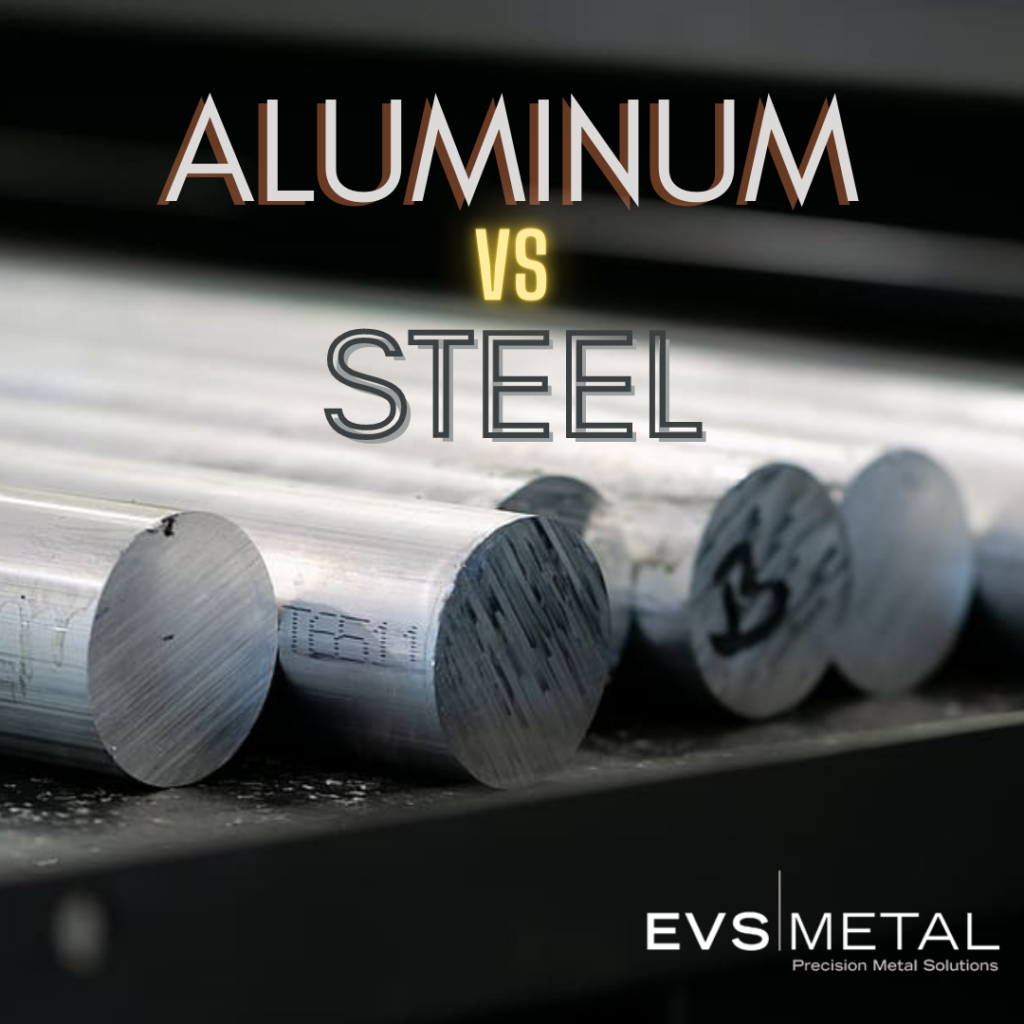
Material selection affects more than finished component performance. It directly influences fabrication complexity, finishing requirements, cost, lead time, and long-term manufacturability. For engineers and procurement teams evaluating sheet metal components, understanding how aluminum and steel differ in fabrication environments helps optimize designs for manufacturability, cost, and delivery predictability.
Both materials serve critical roles in precision manufacturing, but they behave differently during cutting, forming, welding, and finishing operations. Those differences create tradeoffs that matter when balancing strength requirements, weight constraints, corrosion resistance, thermal properties, and budget limitations.
At EVS Metal, both aluminum and steel fabrication run through the same production environments using material-specific tooling, programming, and process controls. Understanding these differences helps explain why material selection deserves careful consideration early in the design process.
Aluminum vs. Steel: Quick Comparison
| Property | Aluminum | Steel |
|---|---|---|
| Weight | Low | High |
| Strength | Moderate–High (alloy dependent) | High |
| Corrosion Resistance | Naturally strong | Requires finish/coating |
| Cost | Higher per lb | Lower per lb |
| Weldability | More sensitive | More forgiving |
| Thermal Conductivity | Excellent | Lower |
| Machinability | Faster, less tool wear | Slower, more tool wear |
Key Material Properties: Aluminum vs. Steel
Material properties drive fabrication decisions and end-use performance. Several characteristics distinguish aluminum from steel in ways that affect both manufacturing and application suitability.
Alloy selection within each material family significantly affects formability, weldability, corrosion resistance, and final cost.
Strength and Weight
Steel provides higher tensile strength than aluminum in comparable thickness. However, certain aluminum alloys can approach or exceed the strength of some steel grades in specific applications while maintaining lower weight—typically about one-third the density of steel.
That weight advantage matters in aerospace, transportation, automation, and any application where reduced mass improves energy efficiency, payload capacity, or handling characteristics.
Corrosion Resistance
Aluminum naturally forms a protective oxide layer that provides inherent corrosion resistance in many environments. Steel requires protective coatings, plating, or stainless alloy formulations to achieve comparable corrosion protection.
This difference affects both material cost and finishing requirements. Aluminum components may not require additional corrosion protection depending on the operating environment, while steel fabrications often need powder coating, plating, or other protective finishes.
Thermal and Electrical Conductivity
Aluminum conducts heat approximately four times more effectively than steel and provides superior electrical conductivity. These properties make aluminum preferable for heat sinks, electrical enclosures, thermal management components, and applications where heat dissipation matters.
Steel’s lower thermal conductivity can be advantageous in applications requiring thermal insulation or where heat retention is desirable.
Weldability
Both materials can be welded, but they require different approaches. Steel welding is generally more forgiving and can be accomplished with multiple welding processes including MIG, TIG, and spot welding.
Aluminum welding demands tighter process control due to the material’s oxide layer, higher thermal conductivity, and lower melting point. Aluminum welding typically requires TIG or specialized MIG processes with precise heat management to prevent warping, porosity, or joint weakness.
Cost Considerations
Raw material costs fluctuate, but aluminum typically costs more per pound than carbon steel. However, aluminum’s lower density means comparable strength can be achieved with less material weight, potentially offsetting the per-pound cost difference.
Stainless steel costs significantly more than both carbon steel and aluminum, but provides corrosion resistance without additional finishing.
Fabrication Process Differences
Material properties translate into practical differences during fabrication operations.
Laser Cutting
Both aluminum and steel can be laser cut, but aluminum’s high reflectivity and thermal conductivity create challenges. Aluminum requires more laser power and specialized cutting parameters compared to steel of equivalent thickness.
Steel’s lower reflectivity makes it easier to process across a wider range of thicknesses with standard laser cutting equipment.
Forming and Bending
Aluminum’s softer properties make it easier to form and bend, requiring less tonnage than steel for equivalent thickness. However, aluminum’s lower ductility compared to steel means it can crack when bent to tight radii, particularly in certain alloy tempers.
Steel’s higher ductility generally allows tighter bend radii without cracking, but requires greater forming forces and more robust tooling.
Machining
Aluminum machines faster than steel and generates less tool wear due to its softer properties. This can reduce machining cycle times and tooling costs for components requiring secondary operations like drilling, tapping, or milling.
Steel’s hardness increases tool wear and requires slower cutting speeds, but provides better dimensional stability during machining operations involving high cutting forces.
Surface Finishing
Aluminum can be anodized to improve corrosion resistance and provide decorative finishes, or it can be powder coated for color and additional protection. Some applications use aluminum without additional finishing when corrosion environments are benign.
Steel fabrications typically require powder coating, plating, painting, or other protective finishes unless stainless alloys are specified. Finishing adds process steps, cost, and lead time compared to bare aluminum in applications where finishing is optional.
When to Choose Aluminum
Aluminum serves applications where specific property combinations create value that justifies potential cost premiums over steel.
Weight-Critical Applications
Aerospace components, transportation equipment, robotic systems, and portable devices benefit from aluminum’s low density when weight reduction improves performance, efficiency, or usability.
Corrosion-Prone Environments
Marine equipment, outdoor enclosures, and food processing systems often specify aluminum to reduce maintenance and extend service life. It is also frequently selected for electronics enclosures where corrosion resistance, reduced weight, and thermal dissipation all matter.
Thermal Management Requirements
Heat sinks, electronics enclosures, LED housings, and other components requiring heat dissipation leverage aluminum’s superior thermal conductivity.
Electrical Conductivity Needs
Electrical enclosures, power distribution components, and RF shielding applications benefit from aluminum’s electrical conductivity properties.
Aesthetic Considerations
Aluminum’s natural finish, anodizing potential, and clean appearance make it desirable for visible components and consumer-facing applications where appearance matters.
When to Choose Steel
Steel provides advantages in applications where strength, durability, magnetic properties, or cost optimization drive material selection.
High-Strength Requirements
Structural components, mounting brackets, frames, and load-bearing parts often require steel’s higher tensile strength, particularly when weight is not a limiting factor.
Magnetic Property Requirements
Applications requiring magnetic properties—electrical transformers, motor housings, magnetic shielding—must use steel, as aluminum is non-magnetic. Steel remains common in industrial enclosures requiring structural rigidity, shielding performance, or lower material cost.
High-Temperature Environments
Steel’s higher melting point and better performance at elevated temperatures make it preferable for applications involving heat exposure beyond aluminum’s capabilities.
Cost-Sensitive Applications
When corrosion resistance is not critical and weight is not a constraint, carbon steel often provides the most economical solution for fabricated components.
Wear Resistance Needs
Steel’s hardness provides better wear resistance than aluminum in applications involving sliding contact, abrasion, or impact.
Cost and Lead Time Considerations
Material selection affects both project cost and delivery timing beyond raw material price differences.
Material Availability
Common aluminum alloys (5052, 6061) and steel grades (cold-rolled, hot-rolled, stainless 304/316) are widely available. Specialty alloys or unusual thicknesses may require longer procurement lead times that affect project schedules.
Processing Complexity
Aluminum’s welding requirements and steel’s greater forming forces affect setup time, tooling requirements, and production efficiency. Complex geometries may favor one material over another based on fabrication challenges.
Finishing Requirements
Steel fabrications requiring powder coating, plating, or other protective finishes add process steps and lead time compared to aluminum components used without additional finishing.
Volume Considerations
High-volume production may favor materials that machine or form more efficiently, potentially offsetting raw material cost differences through reduced labor and cycle time.
Common Material Selection Mistakes
Several recurring mistakes complicate fabrication or increase costs unnecessarily.
Specifying Aluminum When Weight Doesn’t Matter
Using aluminum in applications where weight provides no functional advantage adds material cost without performance benefit. If weight reduction doesn’t improve the product, steel may be more economical.
Choosing Steel Without Considering Finishing Costs
Specifying steel without accounting for required finishing operations can make aluminum more cost-effective when total project cost is considered, particularly for corrosion-prone environments.
Overlooking Fabrication Complexity
Material selection should consider manufacturing implications. Complex geometries, tight bend radii, or extensive welding may favor one material over another regardless of raw material cost.
Ignoring Thermal Expansion Differences
Aluminum expands approximately twice as much as steel with temperature changes. Mixed-material assemblies or applications with wide temperature ranges require accommodation for differential expansion.
Assuming Stainless Steel Solves All Corrosion Problems
While stainless steel provides excellent corrosion resistance, it costs significantly more than aluminum in many applications. Aluminum with appropriate surface treatment often provides adequate corrosion protection at lower cost.
How EVS Metal Supports Both Aluminum and Steel Fabrication
EVS Metal operates ISO 9001:2015-certified facilities equipped to fabricate both aluminum and steel across prototype through production volumes. Our Pennsylvania and Texas locations maintain material inventory, tooling, and process expertise for both material families.
This dual-material capability allows engineering teams to optimize material selection based on application requirements rather than fabricator limitations. Our engineering and design for manufacturability teams can provide material selection guidance during the design phase, helping identify opportunities to reduce cost, improve manufacturability, or enhance performance through informed material choices.
Whether a project requires aluminum for weight reduction and corrosion resistance or steel for strength and cost optimization, EVS Metal provides fabrication, machining, welding, finishing, and assembly services across both material platforms.
For manufacturers seeking to consolidate vendors, dual-material capability simplifies sourcing and provides consistency in quality standards, documentation, and delivery performance across different material requirements.
Frequently Asked Questions: Aluminum vs. Steel Fabrication
What is stronger, aluminum or steel?
Steel is inherently stronger than aluminum in comparable thicknesses. However, certain aluminum alloys can approach or exceed the strength of some steel grades while maintaining lower weight. The strength-to-weight ratio often favors aluminum in applications where weight matters.
Is aluminum more expensive than steel for fabrication?
Aluminum typically costs more per pound than carbon steel but less than stainless steel. However, aluminum’s lower density means less material weight is needed for comparable strength. Total project cost depends on material, fabrication complexity, finishing requirements, and volume.
Can aluminum and steel be welded together?
Aluminum and steel cannot be welded together using conventional fusion welding due to metallurgical incompatibility. Joining dissimilar metals requires mechanical fastening, adhesive bonding, or specialized processes like friction stir welding or explosion welding.
Which material is better for outdoor applications?
Aluminum provides better natural corrosion resistance for outdoor applications. Steel requires protective coatings or stainless alloy grades to achieve comparable outdoor durability. The choice depends on environment severity, maintenance expectations, and budget.
Does material choice affect fabrication lead time?
Material selection can affect lead time through material procurement, processing complexity, and finishing requirements. Common alloys and grades are readily available. Specialty materials or extensive finishing operations may extend delivery schedules.
How do I know which material is right for my application?
Material selection should balance strength requirements, weight constraints, corrosion environment, thermal properties, cost targets, and fabrication complexity. Working with experienced fabrication partners during the design phase helps optimize material selection for both performance and manufacturability.
Can the same fabrication equipment handle both aluminum and steel?
Most modern fabrication equipment can process both materials, but they require different tooling, process parameters, and handling approaches. Experienced fabricators adjust cutting speeds, forming pressures, welding procedures, and finishing processes based on material properties.
Ready to Discuss Material Selection for Your Project?
EVS Metal provides precision fabrication for both aluminum and steel components across industries including electronics, medical devices, telecommunications, automation, and industrial equipment. Our engineering teams can help evaluate material options during the design phase to optimize performance, manufacturability, and cost.
Request a quote or call (973) 839-4432 to discuss material selection and fabrication requirements for your next project.