


The difference between an expensive metal fabrication project and a cost-effective one often comes down to decisions made before manufacturing begins. After 16 years on the Fabricator Fab 40 list, EVS Metal has learned that the most significant cost savings come from collaborative design optimization, not just competitive bidding. Smart design choices can substantially reduce fabrication costs while improving quality and delivery performance. Here’s how Design for Manufacturing (DFM) and Design for Assembly (DFA) principles turn engineering constraints into competitive advantages.
The Real Cost of Design Decisions
When Design Drives Up Costs
Design decisions create cascading effects throughout manufacturing. Consider the impact of seemingly small choices:
Complex Bend Requirements: Custom tooling setup, additional handling, longer cycle times
Non-Standard Material Sizes: Increased waste, special ordering, inventory complexity
Difficult Assembly Access: Extended labor time, quality risks, fixture requirements
Tight Tolerances Everywhere: Unnecessary inspection, potential rework, process constraints
Each design choice either works with standard manufacturing capabilities or requires additional time, tooling, and coordination that increases costs.
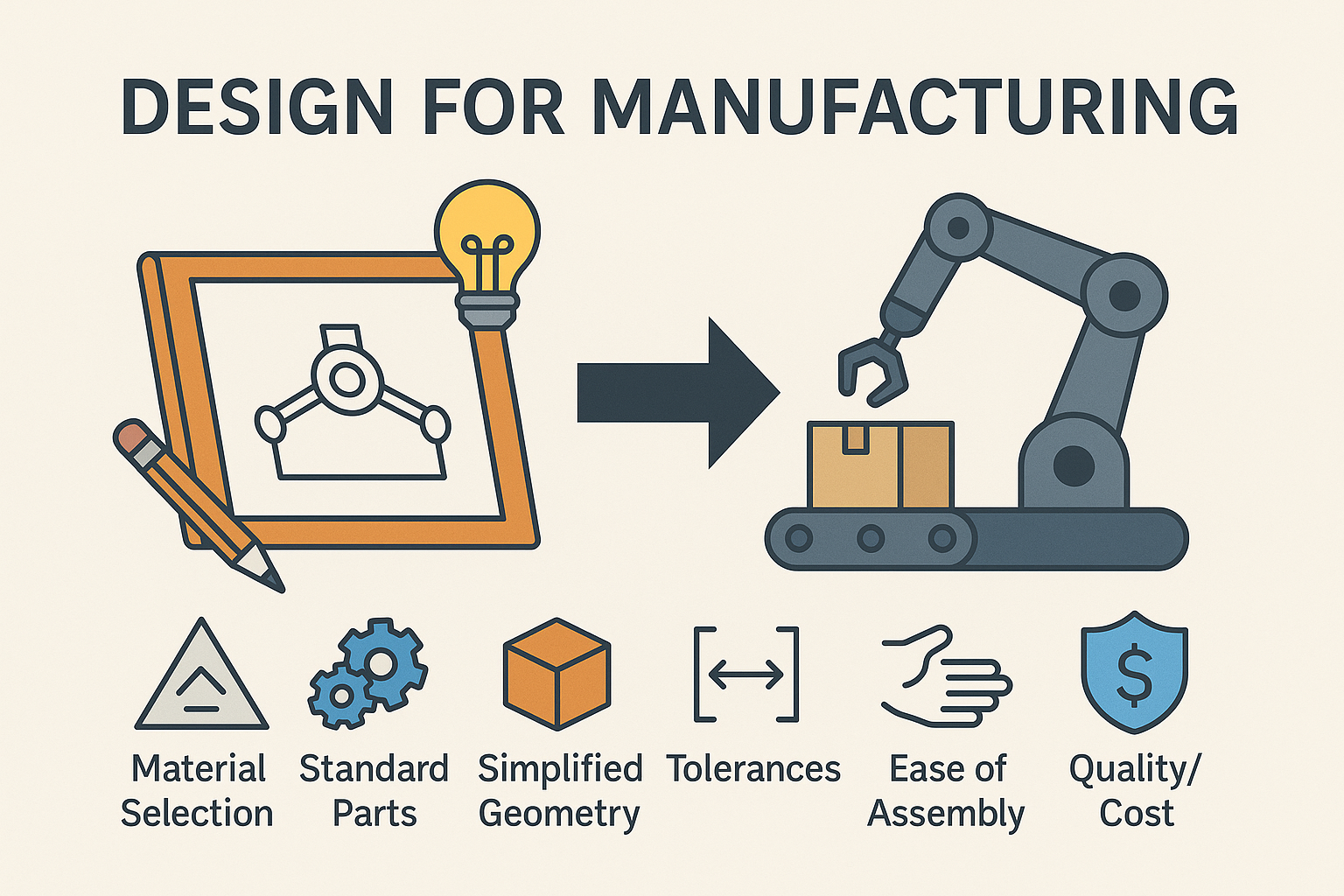 Design for Manufacturing: Engineering Cost Out Early
Material Optimization Strategies
Standard Material Utilization: The most overlooked cost driver is material waste. Precision sheet metal fabrication efficiency depends on how well designs accommodate standard sheet sizes and grain direction. Designs optimized for material utilization typically achieve better cost performance than those focused solely on function.
Bend Optimization: Every custom tool setup adds time and expense. EVS Metal’s standard forming capabilities include bend radii from 0.031″ to 0.250″ depending on material thickness. Designs using these standard radii eliminate custom tooling requirements and associated delays.
Hole Pattern Efficiency: Coordinating hole patterns with standard punch tooling reduces processing time significantly. Our Amada turret punch systems maintain extensive tooling libraries that can create complex hole patterns without custom dies.
Manufacturing Process Integration
Laser Cutting Optimization: Modern fiber laser systems like EVS’s Amada ENSIS 3015 can cut complex geometries efficiently, but design choices still impact processing efficiency:
- Connecting cut paths where possible minimizes piercing points
- Consistent material thicknesses reduce setup changes
- Strategic micro-joint placement facilitates part separation
Forming Sequence Planning: Complex parts may require multiple forming operations. Designs that accommodate standard press brake tooling and minimize part handling typically achieve better cost and quality outcomes.
Design for Assembly: Reducing Labor and Error Costs
Self-Locating Features
Alignment Solutions: Parts designed with self-locating features reduce assembly time and improve consistency. Design elements like tabs, slots, and registration holes eliminate complex fixture requirements while ensuring proper alignment.
Fastener Strategy: The choice between welding, riveting, or mechanical fasteners impacts both initial cost and long-term serviceability:
- Welded assemblies: Lowest material cost, permanent connection
- Riveted assemblies: Moderate cost, strong strength-to-weight ratio
- Mechanical fasteners: Higher initial cost, field serviceable
Quality Integration Through Design
Access for Inspection: Designs that accommodate quality verification improve manufacturing efficiency. When critical dimensions are accessible for measurement and welds are positioned for easy inspection, quality control becomes more efficient and reliable.
Stress Distribution: Understanding how forming operations affect material properties helps prevent quality issues. Sharp corners and tight radii can create stress concentrations that may lead to cracking or dimensional instability.
EVS Metal’s Collaborative Design Process
Engineering Partnership Approach
Our design optimization process integrates multiple disciplines:
Design Review Phases:
- Concept Review: Evaluate design approach and material selection
- Manufacturability Analysis: Identify potential cost reduction opportunities
- Process Planning: Optimize manufacturing sequence and tooling requirements
- Quality Planning: Establish inspection points and acceptance criteria
Cross-Functional Team Integration:
- Design engineers assess functionality and performance requirements
- Manufacturing engineers evaluate process feasibility and optimization opportunities
- Quality engineers establish inspection and testing protocols
- Production planning coordinates material flow and capacity utilization
Technology-Enabled Design Optimization
3D Modeling Integration: Using SolidWorks and Pro-Engineer platforms, we can evaluate design alternatives and manufacturing feasibility before material is cut. This collaborative approach helps identify potential cost reduction opportunities when changes are least expensive to implement.
Manufacturing Simulation: Advanced CAM software allows us to simulate manufacturing processes, potentially identifying issues with material flow, tool access, or dimensional stability before production begins.
Industry-Specific Design Considerations
Electronics and Technology Manufacturing
Thermal Management: Electronic enclosures require designs that accommodate heat dissipation while protecting sensitive components. Strategic placement of ventilation features, heat sink mounting provisions, and component spacing considerations affect both thermal performance and manufacturing efficiency.
EMI/RFI Shielding: Electronic devices often require electromagnetic interference shielding. Design features like continuous ground planes, proper seam construction, and gasket interfaces must be considered early to ensure both electrical performance and cost-effective manufacturing.
Component Access and Serviceability: Technology products benefit from designs that accommodate component installation, cable routing, and field service requirements. Removable panels, cable management features, and strategic access points reduce assembly time while supporting long-term serviceability.
Precision Tolerances for Mounting Systems: Electronic components often require precise mounting locations and alignment features. Understanding which tolerances are critical versus those that can use standard fabrication capabilities helps optimize both function and cost.
Energy Sector Applications
Environmental Resistance: Oil and gas applications require designs that withstand harsh environmental conditions. Material selection, protective coatings, and sealed construction details must be integrated from initial design to ensure long-term performance while maintaining cost effectiveness.
Safety and Access Requirements: Energy sector equipment often requires specific safety features and maintenance access. Designs that incorporate lockout/tagout provisions, maintenance platforms, and safety barriers from initial conception typically achieve better cost performance than retrofitted solutions.
Modular Design for Field Installation: Large energy equipment benefits from modular construction that facilitates transportation and field assembly. Breaking complex assemblies into manageable components reduces shipping costs while enabling efficient on-site installation.
Corrosion Protection Integration: Energy applications frequently face corrosive environments requiring protective strategies. Designs that accommodate proper coating application, drainage features, and sacrificial protection systems help ensure long-term performance while controlling maintenance costs.
Industrial Equipment Manufacturing
Heavy-Duty Construction Requirements: Industrial applications often require robust construction to withstand operational stresses. Design features that distribute loads effectively, provide adequate structural support, and accommodate operational forces help ensure reliable performance while optimizing material usage.
Maintenance Access and Safety: Industrial equipment requires regular maintenance and inspection. Designs that provide safe access to critical components, clear sight lines for inspection, and adequate working space around maintenance points typically reduce long-term operational costs.
Integration with Existing Systems: Industrial equipment often integrates with existing facility infrastructure. Designs that accommodate standard mounting systems, utility connections, and interface requirements reduce installation complexity and associated costs.
Scalability and Standardization: Industrial applications frequently require equipment families or scalable solutions. Designs that leverage common components, standard interfaces, and modular construction approaches can achieve better cost performance across product lines.
Medical Device Manufacturing
Biocompatibility and Cleanability: Medical device enclosures require designs that accommodate sterilization requirements and minimize contamination risks. Smooth internal surfaces, minimal crevices, and appropriate material selection support both regulatory compliance and manufacturing efficiency.
FDA Documentation Requirements: Design history files (DHF) benefit from manufacturing input during development. Understanding how design changes affect manufacturing processes helps maintain regulatory compliance while optimizing production efficiency.
User Safety and Ergonomics: Medical devices require designs that prioritize user safety and operational efficiency. Features that eliminate sharp edges, provide secure mounting, and enable intuitive operation must be integrated early to avoid costly redesigns during regulatory review.
Manufacturing Cost Impact Areas
Direct Manufacturing Considerations
Material Utilization: Designs optimized for standard sheet sizes and efficient nesting can significantly reduce material waste and associated costs.
Tooling Requirements: Using standard bend radii, hole sizes, and forming operations eliminates custom tooling requirements and setup delays.
Process Efficiency: Streamlined manufacturing sequences reduce handling, setup time, and potential quality issues.
Quality-Related Factors
Design for Consistency: Features that support repeatable manufacturing processes tend to produce more consistent results with less inspection time.
Dimensional Stability: Understanding material behavior during forming helps create designs that maintain dimensional accuracy throughout processing.
Delivery Performance Factors
Standard Process Utilization: Designs that leverage existing capabilities and standard tooling typically achieve shorter lead times.
Manufacturing Flow: Optimized assembly sequences and material handling reduce bottlenecks and improve production efficiency.
Implementation Strategy for Design Optimization
Early Engagement Benefits
The most significant cost reductions typically occur when manufacturing expertise is integrated during initial design phases rather than after designs are finalized. EVS Metal’s engineering team works with clients to:
Evaluate Design Alternatives: Compare multiple approaches for functionality, cost, and manufacturability before committing to specific solutions.
Optimize Material Selection: Balance performance requirements with material costs, availability, and processing characteristics.
Plan Manufacturing Strategy: Coordinate design features with available equipment capabilities and standard processes.
Making Design Decisions That Improve Project Economics
Companies achieving better manufacturing cost performance understand that design optimization is an investment in project success. Collaborative engineering approaches that consider manufacturing constraints during design development typically deliver better outcomes than designs developed in isolation. Smart design choices create positive effects throughout manufacturing: better material utilization reduces waste, standard tooling eliminates setup delays, optimized assembly sequences reduce labor requirements, and quality-focused design reduces rework and inspection time.
Ready to explore how design optimization can improve your metal fabrication project economics? Contact EVS Metal to discuss how our collaborative engineering approach can enhance your project’s cost performance while maintaining quality and delivery requirements.
EVS Metal: Engineering Excellence Meets Manufacturing Efficiency
Multi-Location U.S. Manufacturing | 16-Year Fab 40 Excellence | Collaborative Design Solutions
Frequently Asked Questions About Design for Manufacturing (DFM)
How does DFM actually reduce metal fabrication costs?
DFM reduces costs by aligning design decisions with real-world manufacturing capabilities. This minimizes material waste, eliminates custom tooling, shortens setup time, and simplifies assembly. The result is fewer manufacturing steps, faster throughput, and less rework — all major cost drivers in metal fabrication.
When should manufacturers involve a fabricator in the design process?
As early as possible. The highest-impact cost savings come during concept development, before final drawings are locked. Early DFM engagement helps avoid costly redesigns, ensures material and tooling choices support efficient production, and prevents tolerance over-specification.
What design mistakes most commonly increase fabrication costs?
- Specifying unnecessarily tight tolerances on noncritical features
- Using nonstandard bend radii or hole sizes that require custom tooling
- Designing parts that waste material or don’t nest efficiently on standard sheet sizes
- Creating assemblies that require complex fixtures or lack alignment features
- Overlooking access for inspection, fastening, or welding
Most of these can be avoided with a quick manufacturability review.
How does DFM affect product quality?
DFM improves quality by designing parts that are easier to produce consistently. Standard tooling, stable forming processes, manufacturable tolerances, and self-locating assembly features all reduce variation — which directly enhances quality, repeatability, and long-term reliability.
What is the difference between DFM and DFA?
DFM focuses on simplifying how individual parts are fabricated.
DFA focuses on simplifying how those parts are assembled.
Together, they reduce labor, minimize rework, improve consistency, and shorten lead times.
Do DFM principles limit design creativity or functionality?
No — they refine it. DFM aims to preserve function while reducing unnecessary complexity that increases cost or risk. Most optimizations involve minor dimensional adjustments, smarter material choices, or replacing custom features with standard alternatives.
How can DFM help with high-mix, low-volume production?
By standardizing design elements wherever possible:
- Using common hardware
- Choosing standard radii and tooling
- Designing parts that require fewer setups
- Optimizing assemblies to reduce operator skill requirements
These principles stabilize production even when individual part numbers vary widely.
What tools does EVS use to support DFM analysis?
EVS integrates SolidWorks, Pro-Engineer, advanced CAM simulation, and MIETrak Pro ERP systems to evaluate manufacturability, predict process flow, optimize material usage, and plan forming sequences before fabrication begins.
Can DFM help shorten lead times?
Absolutely. Designs aligned with standard manufacturing processes reduce setups, eliminate special-order materials, improve flow across cutting-forming-welding-finishing, and prevent rework — all of which shorten delivery cycles.
Will EVS perform a DFM review before quoting?
Yes. EVS routinely performs manufacturability assessments during the quoting stage. If there are opportunities to reduce cost, improve fit, or simplify assembly, the engineering team will recommend proven alternatives that maintain the part’s intended function.