

One-piece flow (also called continuous flow or single-piece flow) is a lean manufacturing and fabrication approach where individual parts move directly from one operation to the next with minimal work-in-progress between stations. Each workstation produces only what the next operation requires, creating a continuous production stream that eliminates batching delays and excess inventory.
Originally developed as part of the Toyota Production System (TPS), one-piece flow aims to streamline production by making the right parts available in the right quantities exactly when needed—the foundation of just-in-time manufacturing.
How One-Piece Flow Works in Sheet Metal Fabrication
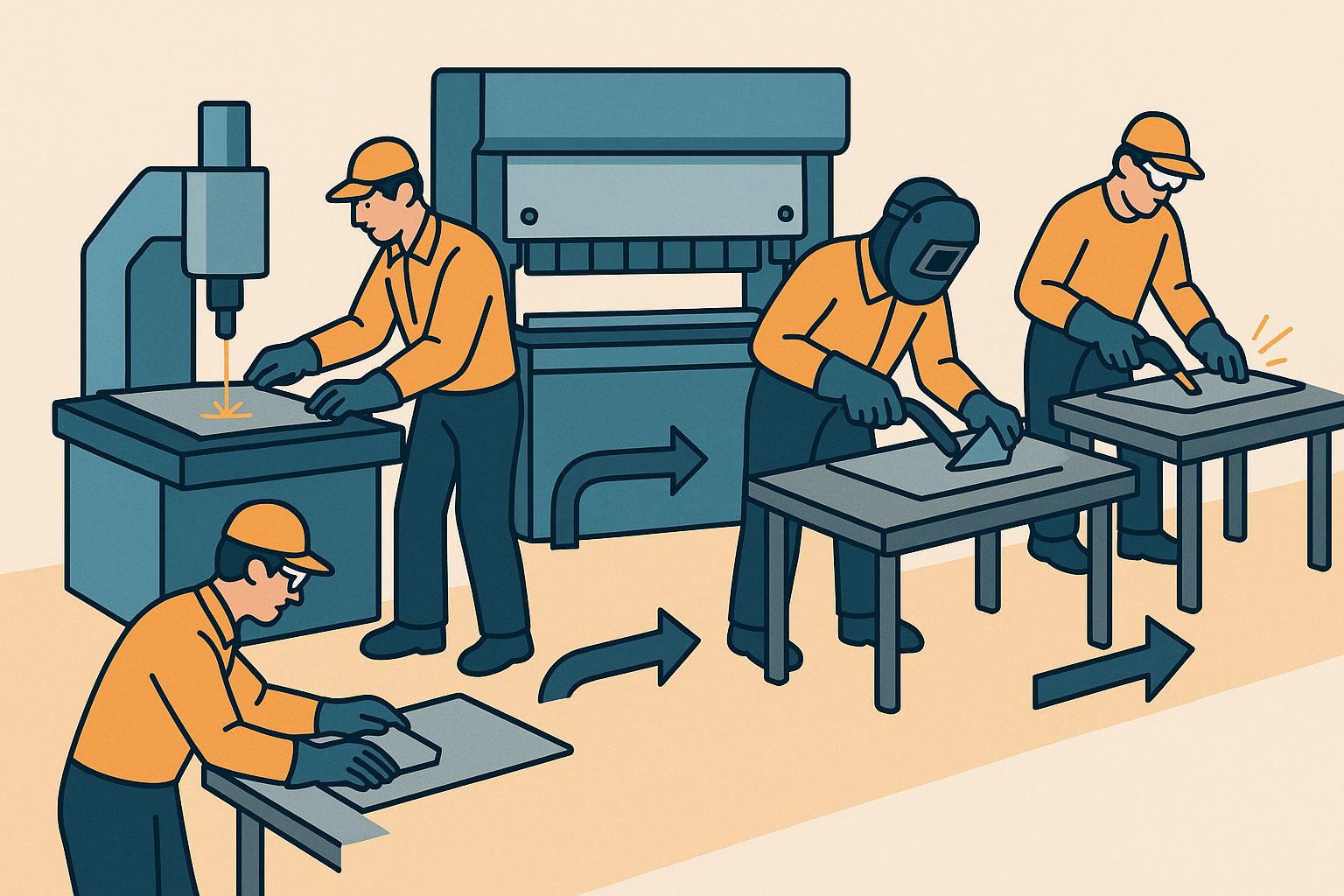 In a one-piece flow environment, a metal part moves immediately from cutting to forming to welding to finishing without sitting in queue between operations. Each station completes its work and hands off to the next process, creating a synchronized production rhythm across the entire facility.
This requires three fundamental conditions:
- Process consistency – Operations must have predictable, repeatable cycle times
- Equipment reliability – Near-100% uptime to prevent flow disruption
- Resource availability – Materials, tooling, and skilled operators ready when needed
When these conditions exist, continuous flow creates measurable operational advantages.
Benefits of Continuous Flow Manufacturing
Properly implemented one-piece flow delivers several interconnected benefits:
- Quality improvements – Defects are identified immediately at the next operation rather than discovered hours or days later in a batch. This enables faster correction and prevents defective parts from progressing through multiple operations.
- Reduced inventory – Parts don’t accumulate between stations, freeing floor space and reducing capital tied up in work-in-progress. Lower inventory also simplifies tracking and reduces handling damage.
- Faster throughput – Parts move through the facility continuously rather than waiting in batches. This shortens lead times without increasing process speeds.
- Improved ergonomics – Continuous flow often reveals and eliminates unnecessary movement, reaching, and material handling that contribute to worker fatigue and injury.
- Greater scalability – Production can be adjusted more responsively because there’s less inventory buffering demand signals from actual customer requirements.
These factors ultimately improve customer satisfaction through faster delivery, better quality, and more predictable lead times.
When One-Piece Flow Isn’t the Right Approach
Continuous flow requires specific operational conditions that don’t exist in every manufacturing environment. Several factors can make one-piece flow impractical or counterproductive:
- High process variability – If cycle times fluctuate significantly between operations, it may create bottlenecks. Parts either queue at slower stations (eliminating the flow benefit) or faster stations sit idle waiting for work.
- Quality inconsistency – When operations produce defects at unpredictable rates, continuous flow amplifies disruption. A quality issue at one station immediately starves downstream operations.
- Equipment reliability issues – Machines with frequent unplanned downtime break the flow and create cascading delays. Continuous flow requires near-perfect equipment uptime.
- High-mix, low-volume production – Job shops producing many different parts in small quantities may find the setup required for this approach outweighs the benefits, particularly when each part requires unique fixturing, tooling, or process sequences.
- Demand uncertainty – One-piece flow works best when customer demand is relatively stable and predictable. Highly variable demand makes it difficult to balance station capacities.
In these situations, batch processing with appropriate buffer inventory may deliver better results than forcing continuous flow implementation.
 One-Piece Flow in High-Mix Sheet Metal Fabrication
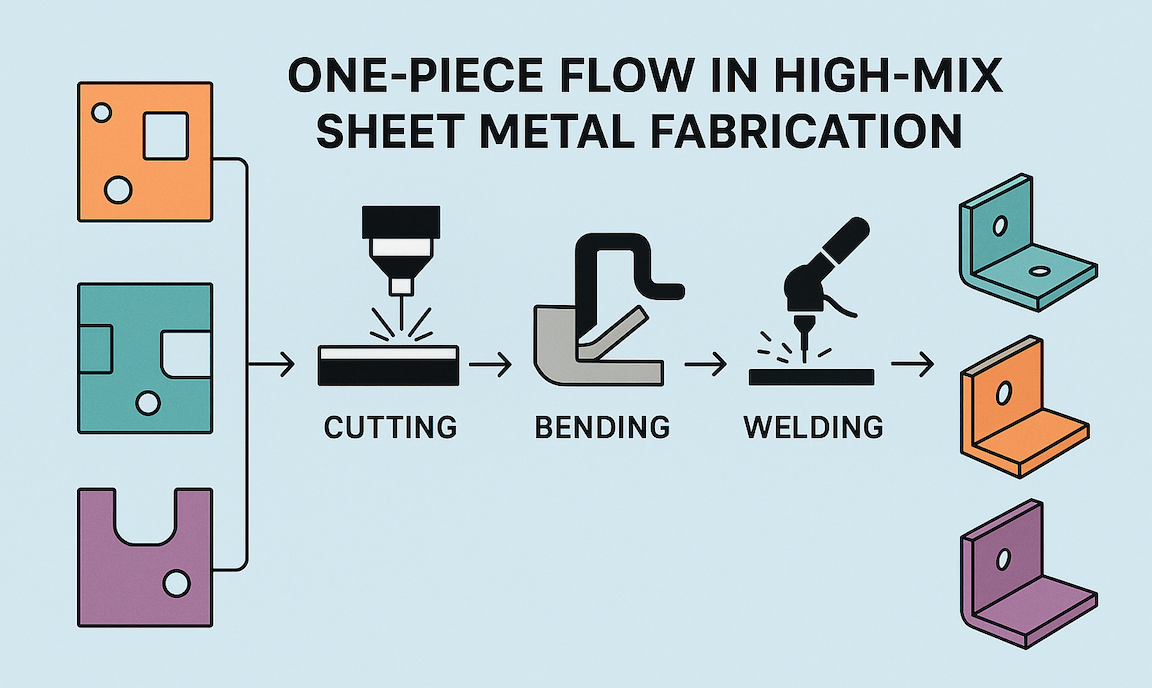 One-Piece Flow in High-Mix Sheet Metal Fabrication
EVS Metal operates in a challenging environment for traditional lean implementation, specializing in high-mix, often lower volume precision sheet metal fabrication projects that are repeatable, where part specifications, materials, and volumes vary significantly across projects. Despite this complexity, we’ve implemented one-piece flow principles where they create genuine operational advantage.
Our approach focuses on:
- Process standardization – Developing repeatable methods for common operations (laser cutting, bending, welding) even when part geometries differ. This creates the consistency continuous flow requires.
- Equipment investment – Maintaining laser systems, CNC press brakes, robotic welding cells, and powder coating lines with the reliability continuous flow demands. Preventive maintenance schedules ensure near-100% availability.
- Cross-trained workforce – Operators with multi-process capabilities can respond to flow disruptions and maintain production rhythm across stations.
- Selective implementation – Applying continuous flow to operations and part types where conditions support it, while using batch processing where it’s more appropriate.
This hybrid approach allows us to gain continuous flow benefits—faster throughput, improved quality, reduced inventory—while remaining flexible enough to handle the custom, engineering-intensive projects that define precision sheet metal fabrication.
Practical Implications for Your Projects
When evaluating metal fabricators for your project, understanding their operational approach reveals capacity for consistent delivery:
- Lead time predictability – Fabricators using continuous flow principles typically provide more reliable delivery schedules because parts move through operations systematically rather than competing for attention in batch queues.
- Quality systems – One-piece flow requires immediate quality feedback between operations, which typically correlates with more robust overall quality management.
- Scalability – Facilities organized for continuous flow can often adjust production volumes more responsively because they’re not constrained by batch-size economics.
- Communication – Shops that implement lean principles typically have better visibility into production status, enabling more accurate project updates.
EVS Metal’s implementation of lean manufacturing principles, including selective one-piece flow, supports faster turnaround, consistent quality, and flexible capacity across prototype and production runs. This operational approach enables competitive lead times without sacrificing the engineering precision custom sheet metal fabrication requires.
Ready to discuss your sheet metal fabrication project? Request a quote online or call (973) 839-4432.
Frequently Asked Questions
Can one-piece flow work with custom, low-volume parts?
Yes, with appropriate modifications. The key is standardizing processes rather than parts. Even when fabricating unique geometries, operations like laser cutting, forming, and welding can follow consistent methods that enable flow principles.
How does one-piece flow affect lead times?
One-piece flow typically reduces lead times by 30-50% compared to batch processing because parts don’t wait in queue between operations. However, this assumes the facility has balanced station capacities and reliable processes.
What’s the difference between one-piece flow and cellular manufacturing?
Cellular manufacturing organizes equipment and processes into cells dedicated to part families. One-piece flow is a production method that can be implemented within cells (or across an entire facility). They’re complementary approaches often used together.
Does one-piece flow increase costs?
Initially, implementing continuous flow requires investment in equipment reliability, process standardization, and training. Long-term, it typically reduces costs through lower inventory, less rework, and faster throughput. The economic benefit depends on production volume and part complexity.
How do you maintain one-piece flow with unpredictable customer demand?
True one-piece flow requires relatively stable demand. In high-variability environments, hybrid approaches work better: using continuous flow principles for predictable operations while maintaining strategic buffer inventory for demand fluctuations.