

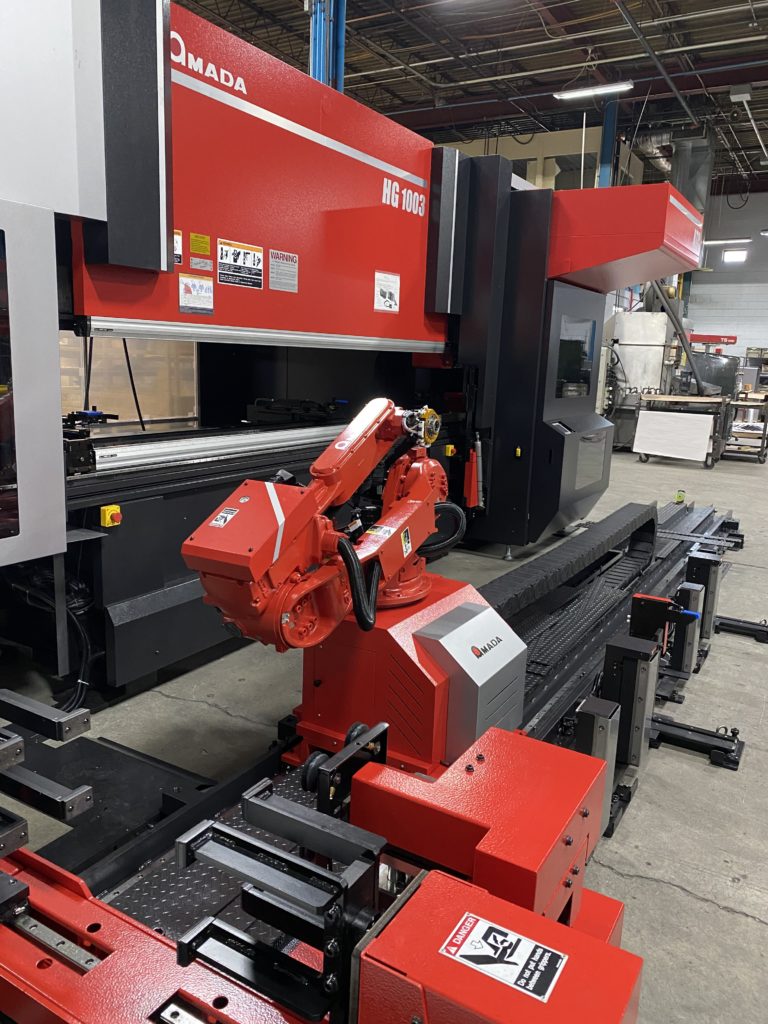
 Robotic press brake automation solves bending challenges that manual operations cannot always manage consistently. Automated systems eliminate operator variability, execute complex multi-bend sequences with repeatable precision, and maintain tight tolerances across long production runs.
For manufacturers evaluating fabrication partners, automation matters most when part complexity, volume, or tolerance requirements demand consistency beyond what manual bending can economically sustain. At EVS Metal, robotic press brake systems support production ranging from prototype development through high-volume manufacturing across four facilities.
What Robotic Press Brake Automation Provides
Robotic press brake automation integrates part handling, positioning, and manipulation with press brake operation through programmable multi-axis robots that load material, execute bend sequences, and unload finished parts without operator intervention for routine handling tasks. The technology addresses three fundamental challenges: maintaining consistent part positioning across production cycles, executing complex bend sequences requiring precise part manipulation between bends, and eliminating the operator variability that creates quality inconsistencies in manual bending.
Automation does not eliminate skilled operators. It shifts their role from repetitive part handling toward programming, quality verification, and process optimization. Skilled operators remain essential, but their focus changes from executing individual bends to ensuring the automated system maintains quality standards and optimizing programs for efficiency and precision.
Modern robotic press brake systems combine the robot itself with automatic tool changers, angle measurement systems, and offline programming software that allows program development concurrent with production. This integration means automation provides value through multiple mechanisms—not just faster cycle times but also reduced setup variation, improved dimensional consistency, and the ability to execute bend sequences that would be extremely difficult or impossible through manual manipulation alone.
Positioning Accuracy and Process Consistency
Robotic systems position parts with repeatability measured in hundredths of millimeters, which eliminates the positioning variation inherent in manual operations where operator technique affects consistency. When a part requires positioning against back gauges or reference surfaces before each bend, robot positioning ensures identical placement cycle after cycle, which directly translates to tighter dimensional tolerances in finished parts.
This positioning consistency matters particularly for parts with multiple bends where dimensional accumulation magnifies small positioning errors. A manually operated part might see ±0.5mm variation in gauge positioning across a production run simply from operator technique differences, and across four or five bends that variation compounds into dimensional spread that pushes parts toward or beyond specification limits. Robotic positioning eliminates that source of variation, which means the remaining contributors to dimensional variation—material thickness tolerance, springback variation, tooling wear—become more manageable because they are not compounded by positioning inconsistency.
Manual press brake operations depend heavily on operator consistency, so quality naturally varies with experience, fatigue, and attention to detail.
An experienced operator can produce excellent parts, but maintaining that consistency across long shifts, multiple operators, and thousands of cycles introduces variation that process controls alone cannot fully eliminate. Robotic automation removes operator technique as a variable by positioning parts identically, executing bend sequences in the same order, and applying force consistently cycle after cycle.
The precision improvement shows most clearly in applications requiring tight angular tolerances where small execution differences create measurable quality impacts. Parts with tolerances approaching ±0.5 degrees often struggle to maintain consistency in manual operations simply because operator positioning and technique variations introduce angular spread even when the press brake itself can achieve the required precision. Robotic execution eliminates that variability source, which means process capability improves without changing the fundamental bending method.
Speed and Throughput for Production Volumes
Robotic systems execute bend sequences faster than manual operations for most parts because the robot does not fatigue, maintains consistent cycle times, and can manipulate parts at speeds human operators cannot safely match. For simple parts with one or two bends, the speed advantage may be minimal—an experienced operator can load, bend, and unload efficiently. But as bend count increases and parts require complex manipulation between bends, robotic speed advantages compound.
A part requiring six bends with multiple reorientations might take a skilled operator 90-120 seconds to complete, with cycle time varying based on operator technique, fatigue, and the specific manipulation challenges each bend presents. The same part under robotic control might complete in 45-60 seconds with identical cycle time part after part, hour after hour. Over a production run of 1,000 parts, that difference translates to substantial throughput improvement and more predictable production scheduling.
The speed advantage extends beyond cycle time to setup time and changeover efficiency. Robotic systems with automatic tool changers swap dies and punches based on programmed requirements without operator intervention, which means complex tooling setups that might require 15-20 minutes of manual tool changes can execute in 3-5 minutes automatically. For production environments running varied part mixes with frequent changeovers, this setup efficiency often provides more value than raw cycle time improvements. Understanding how to streamline project timelines through automation helps manufacturers evaluate whether robotic systems align with production schedule requirements.
Complex Part Capabilities and Multi-Bend Sequences
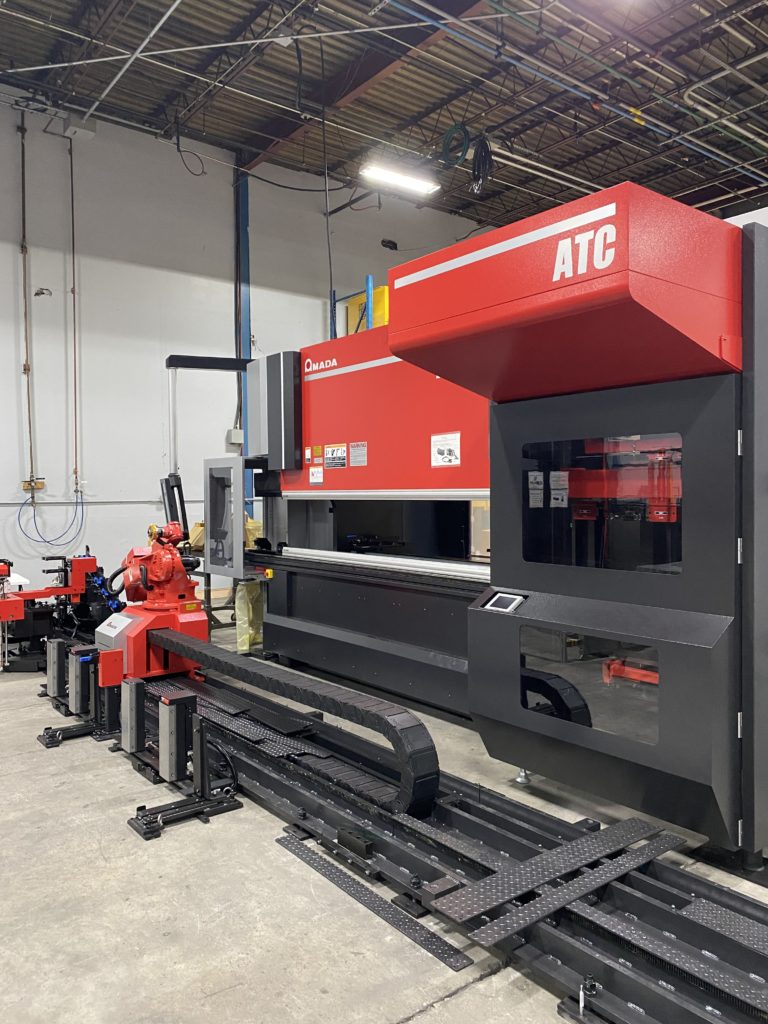
One of automation’s biggest advantages is making complex part geometries practical in production when manual bending would be slow, inconsistent, or prohibitively difficult. Parts with many bends in multiple directions, complex bend sequences requiring specific tooling and part orientation changes, or geometries where previously formed bends interfere with access for subsequent operations become practical under robotic control where they might be prohibitively expensive or quality-limited through manual execution.
Robotic systems can regrip parts between bends—releasing the part, repositioning grippers to different locations, and reacquiring the part in a new orientation—which enables bend sequences impossible with fixed gripping. A part might require the robot to hold the part from one edge for the first three bends, release and regrip from a different edge for bends four through six, then regrip again for final bends. Manual operators can accomplish similar reorientation through fixtures and careful manipulation, but the time required and consistency challenges often make such parts impractical for production volumes.
The programming flexibility also allows experimentation with bend sequences during development to find the most efficient approach. An offline programmer can simulate different bend orders, evaluate tooling interference, and optimize the sequence for speed and quality before running the first production part. This development capability means complex parts can reach production-ready status faster because programming iterations happen in simulation rather than through physical trial and error on the press brake. Engineers addressing design for manufacturability can collaborate with fabricators during development to optimize part geometry for robotic bending efficiency.
Offline Programming and Production Efficiency
Offline programming through systems like Amada’s Dr.ABE BendCAD software moves program development away from the press brake while the machine continues running other jobs. Programmers create bend sequences, simulate execution, verify tooling clearances, and generate production-ready programs without tying up press brake capacity for programming time.
Programs developed at one location transfer to equivalent press brakes at other facilities, which means setup knowledge gained during prototype development or initial production runs carries forward to future production regardless of which facility handles the work. The simulation capability also reduces scrap during program development by identifying potential issues before committing material to test parts.
When Automation Provides the Most Value
Not every bending application benefits equally from automation, and understanding where automation delivers measurable advantages helps focus investment where it provides returns. High-volume production of moderately complex parts represents the sweet spot for robotic automation—parts with enough bends and manipulation requirements that manual operations struggle with consistency and speed, produced in sufficient volumes that setup and programming investment amortizes across the production run.
Simple parts with one or two bends and straightforward positioning often see minimal automation benefit. An experienced operator can execute these efficiently, and the programming and setup time for robotic automation may exceed the cycle time savings unless production volumes reach thousands of parts. Conversely, extremely complex one-off parts may not justify automation programming investment when manual execution by a skilled operator produces acceptable results for single-piece quantities.
The automation value calculation changes significantly for parts requiring tight tolerances where consistency matters more than raw speed. Parts where ±1-degree angular tolerance is critical may justify automation even at lower volumes simply because the consistency improvement reduces scrap and rework that would otherwise occur in manual production. Assemblies with mating features, parts where bent flanges provide alignment, or components where multiple bends interact geometrically often fall into this category where automation provides value through quality consistency rather than pure throughput.
Material considerations also affect automation value. Expensive materials where scrap costs are high benefit from automation’s consistency advantages because reducing scrap directly impacts production economics. Similarly, materials with unpredictable springback or forming characteristics benefit from automation’s ability to execute consistent compensation strategies and maintain process control that manual operations struggle to replicate reliably. Understanding fabrication strategies that improve yield and lower cost helps manufacturers evaluate whether automation investments align with broader production efficiency goals.
Integration with Manual Operations
Automation does not replace manual press brake operations entirely but rather complements them by handling applications where automated execution provides clear advantages. Most fabrication environments run both automated and manual operations based on part characteristics, production volumes, and schedule demands.
Manual operations remain more flexible for prototype development, design iterations, and low-volume specialty work where programming investment does not justify returns. Skilled operators can quickly execute test bends, evaluate part quality, make adjustments, and iterate toward production-ready processes faster than automation programming cycles allow.
Automation excels once production parameters stabilize and volumes justify programming investment. The transition from prototype to production often coincides with the shift from manual to automated execution, with programs developed during initial production runs then optimized for efficiency and quality as volumes increase. The relationship between different forming processes and when each provides advantages helps frame automation decisions within broader manufacturing strategy.
Frequently Asked Questions: Robotic Press Brake Automation
What types of parts benefit most from robotic press brake automation?
Parts with multiple bends, tight tolerances, or complex manipulation requirements benefit most from robotic automation. High-volume production gains the greatest advantage because setup efficiency and repeatable cycle times improve overall production economics.
Does robotic automation reduce labor requirements?
Automation shifts labor from part handling toward programming, quality verification, and process optimization. Total labor hours may decrease for high-volume production, but skilled operators remain essential for setup, calibration, and program optimization.
How does automation affect setup time and changeovers?
Robotic systems with automatic tool changers reduce setup time significantly. Complex setups requiring 15-20 minutes manually might complete in 3-5 minutes automatically. This efficiency matters most in mixed-production environments with frequent changeovers.
Can robotic press brakes handle the same material thickness as manual operations?
Press brake tonnage capacity determines maximum material thickness, not whether the operation is manual or automated. Robotic systems can handle any material thickness the press brake is rated for, though very thick materials may require specialized grippers.
What is offline programming and why does it matter?
Offline programming allows program development away from the press brake while the machine continues running other jobs. This eliminates programming downtime and enables simulation, tooling verification, and optimization before committing material to test parts.
Does automation improve bend quality compared to skilled manual operators?
Automation eliminates operator variability, which improves consistency across production cycles. A skilled operator might produce excellent individual parts, but maintaining that quality across thousands of cycles over multiple shifts introduces variation that automation avoids.
EVS Metal’s Robotic Press Brake Capabilities
EVS Metal operates robotic press brake systems with automatic tool changing across facilities in Pennsylvania, Texas, New Jersey, and New Hampshire, supporting production from complex prototypes through high-volume manufacturing with multi-bend sequences, complex part manipulation, and integration with offline programming for reduced setup times and improved consistency.
Process selection between manual and automated bending happens during quoting and engineering review based on part complexity, tolerance requirements, and production volumes. Our engineering teams can evaluate whether automation provides value for specific applications and recommend the most appropriate production strategy.
Request a quote or call (973) 839-4432 to discuss robotic press brake automation capabilities for your production requirements.