

CNC machining becomes important when a part needs more precision than cutting, punching, or forming can reliably deliver on their own. A fabricated enclosure may look complete after laser cutting and bending, but in practice it often still requires threaded mounting points, precision bores, countersinks, machined sealing surfaces, or alignment features before it can move into assembly. That transition—from something that is geometrically complete to something that is functionally complete—is where machining stops being a secondary operation and becomes central to how the part actually performs.
At EVS Metal, this transition happens every day as fabricated components move from cutting, forming, and welding into precision machining at our Texas and Pennsylvania facilities. Instead of treating machining as a separate outsourced step, it operates within the same production environment, allowing parts to move forward without losing dimensional continuity or introducing unnecessary delays.
CNC, or computer numerical control machining, approaches that problem through programmed material removal. Rather than relying on operator-controlled movement, CNC systems follow digital toolpaths that define position, speed, and depth of cut with repeatable precision. Once a process is proven, the same geometry can be reproduced across prototypes, production runs, and multi-operation parts without introducing the variability that manual machining inevitably brings.
That level of consistency matters because modern manufacturing rarely allows for approximation. Dimensional requirements often extend beyond what manual processes can hold reliably, especially when parts must fit into assemblies that combine fabricated, machined, and purchased components. Across industries like electronics, industrial equipment, medical devices, and automation, machining is often what bridges the gap between a formed metal part and a finished product that actually works as intended—particularly when precision CNC machining is integrated directly into fabrication workflows.
What CNC Machining Actually Adds to Fabrication
Fabrication processes are efficient at shaping material, but they are not designed to produce every feature a finished component requires. Laser cutting defines profiles, forming introduces geometry, and welding creates assemblies, but those processes alone cannot reliably control every surface, location, or tolerance that downstream components depend on. Machining fills that gap by removing material in a controlled way, allowing specific features to be located, sized, and finished with a level of precision that fabrication alone cannot consistently achieve.
In practice, that shows up in very real ways. A formed housing may need tapped holes for internal hardware, while a welded bracket may require a bore that maintains alignment under load, and a fabricated chassis may depend on machined surfaces where flatness affects sealing or assembly fit. These requirements rarely drive the initial design, but they often determine whether a part performs correctly once everything comes together.
Within EVS Metal’s production workflow, these features are added without moving parts between suppliers, which allows machining adjustments to happen in context rather than after the fact. That continuity reduces variation, shortens lead times, and supports broader machine shop capability inside fabrication, where machining operates as part of a continuous sequence that often continues into finishing, assembly, and other value-added manufacturing services.
How CNC Machining Differs from Manual Machining
That integration also changes how machining itself is evaluated. Manual machining still has a place, particularly for simple repairs, one-off modifications, or early prototypes where speed matters more than repeatability. But once production requires multiple identical parts or tighter control across several dimensions, CNC machining becomes the more reliable approach—not simply because it is automated, but because it preserves consistency in a way manual processes cannot.
Instead of relying on operator judgment, CNC machining locks in toolpaths, spindle speeds, feed rates, and cutting sequences so that each part is produced under the same controlled conditions. That shift from operator-driven variability to process-driven repeatability is what allows dimensional performance to remain stable across an entire batch. For production buyers, that distinction is not theoretical. A part that holds tolerance once but drifts across a run can create assembly problems that cost far more than the machining operation itself.
Core CNC Machining Processes
Those consistency requirements also influence how different machining processes are applied. Milling is the most common CNC operation used alongside fabrication because it allows rotating cutting tools to remove material from stationary workpieces, creating pockets, surfaces, contours, and threaded features in a single setup. That flexibility makes it especially effective when fabricated parts require multiple precision features to be added after forming or welding.
Turning approaches the same goal from a different direction by rotating the workpiece while a stationary tool shapes diameters, threads, and cylindrical features. Components such as shafts, bushings, and threaded interfaces often begin here, particularly when concentricity is critical. From there, drilling, reaming, and boring refine hole geometry beyond what fabrication processes can achieve alone, while grinding is introduced when surface finish or tolerance requirements exceed what milling can hold efficiently.
In practice, these processes are selected based on how geometry, material, and production volume interact, which is why machining strategy tends to evolve alongside the part itself rather than being fixed at the start.
3-Axis, 4-Axis, and 5-Axis Machining in Real Production
That same progression applies to machine configuration. Three-axis machining handles a large percentage of production work because many parts can be reached effectively through linear motion alone. As soon as parts require machining across multiple faces, however, additional axes begin reducing setup changes and improving consistency between operations.
Four-axis systems allow the part to rotate into position without being removed and re-fixtured, which is especially valuable for fabricated components where each setup introduces another opportunity for variation. Five-axis machining extends that capability further by allowing simultaneous multi-directional cutting, making it possible to machine complex geometry in a single setup.
While five-axis systems are often seen as the most advanced option, they are not always the most practical. They introduce additional programming complexity and cost, which means their value depends on whether the part actually benefits from reduced setups and improved access to complex surfaces.
Material Choice Changes Machining Economics
Machine capability alone does not determine machining performance. Material selection plays an equally important role because cutting behavior directly affects tool life, cycle time, and achievable surface finish. Aluminum alloys support high-speed machining with relatively low tool wear, while stainless steel requires tighter process control due to its tendency to work-harden during cutting.
Carbon steels vary depending on hardness and composition, and engineered plastics introduce a different challenge altogether, requiring support to prevent deflection under cutting forces. These differences mean that material choice often has as much influence on production cost as part geometry, even when two parts appear identical in design.
What Tolerances Really Mean in CNC Machining
Those material and process considerations become more visible when tolerances are defined. It is easy to focus on the tightest number a machine can achieve, but the more practical question is whether that level of precision is necessary. Standard CNC machining commonly holds ±0.005 inches, while tighter tolerances such as ±0.001 inches require slower feeds, additional passes, and more intensive inspection.
Because that added effort increases cost quickly, tighter tolerances should be applied only where function demands them. This becomes especially important when machining follows fabrication, where formed or welded geometry already introduces variables that must be accounted for during finishing operations.
Why Setup Strategy Often Matters More Than Cutting Time
As tolerances tighten and part complexity increases, the role of setup becomes more significant. In low-volume production, fixture preparation, tool loading, program verification, and first-article inspection can take longer than the machining cycle itself. That balance shifts as production scales, but setup strategy continues to influence overall efficiency.
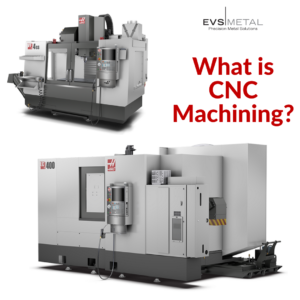
This is where machine configuration begins to matter more in practice. Horizontal systems such as the Haas EC-400 horizontal machining center reduce idle spindle time through palletization while maintaining more consistent setups between cycles. That kind of efficiency becomes increasingly valuable once production moves beyond prototypes and into repeat work.
CNC Machining Capabilities at EVS Metal
At EVS, CNC machining operates as part of an integrated manufacturing environment rather than a standalone service. Machining capacity is located within both the company’s Texas and Pennsylvania facilities, allowing fabricated components to move directly into secondary machining without leaving a controlled production workflow.
These operations support aluminum, stainless steel, carbon steel, and engineered plastics across industries including electronics, automation, energy, telecommunications, and medical equipment manufacturing. Equipment includes vertical machining centers for general-purpose precision work, horizontal machining systems for multi-face and higher-volume production, and CNC turning centers supporting cylindrical and threaded components.
Because machining is coordinated alongside fabrication, finishing, and assembly, EVS Metal is able to maintain tighter control over dimensional relationships throughout the entire production process. For customers, that integration reduces vendor coordination, shortens lead times, and helps ensure that parts move into assembly without unnecessary delays or variation.
When CNC Machining Is Not the Best Choice
Despite its flexibility, CNC machining is not always the most efficient solution. Many sheet metal features can be produced more economically through punching or forming, while high-volume components may justify stamping or casting once tooling costs are absorbed. In those cases, machining may still play a role, but not necessarily as the primary process.
The most effective manufacturing strategies come from understanding where machining adds real functional value rather than applying it automatically to every part.
Quality Control in CNC Production
That focus on function carries through to quality control. Machining accuracy depends not only on machine capability but also on inspection discipline. In-process checks confirm that parts remain within tolerance, while first-article inspection verifies that setups and programs are performing correctly before production continues.
For more complex geometry, coordinate measuring systems provide full dimensional validation across multiple axes. This is often where the difference becomes clear between simply owning equipment and operating a quality machine shop with consistent inspection standards that support repeatable production.
Frequently Asked Questions About CNC Machining
What tolerances can CNC machining typically achieve?
Standard machining commonly holds ±0.005 inches, while tighter tolerances such as ±0.001 inches are achievable when required by part function.
Can CNC machining be combined with fabrication?
Yes. Machining is often used after cutting, forming, or welding to add precision features such as threaded holes, bores, and machined surfaces.
What materials are commonly CNC machined?
Aluminum, stainless steel, carbon steel, brass, bronze, and engineered plastics are all commonly machined depending on part requirements.
Does tighter tolerance always mean better quality?
No. Tighter tolerances should only be specified where function requires them, because they increase machining time and production cost.
Why CNC Machining Remains Central to Modern Manufacturing
At EVS Metal, machining is not treated as a separate capability, but as part of a larger manufacturing process that connects fabrication, finishing, and assembly into one continuous workflow. As product requirements become more complex and tolerances more demanding, keeping those capabilities aligned under one roof often makes the difference between a part that simply looks complete and one that performs reliably in the field.